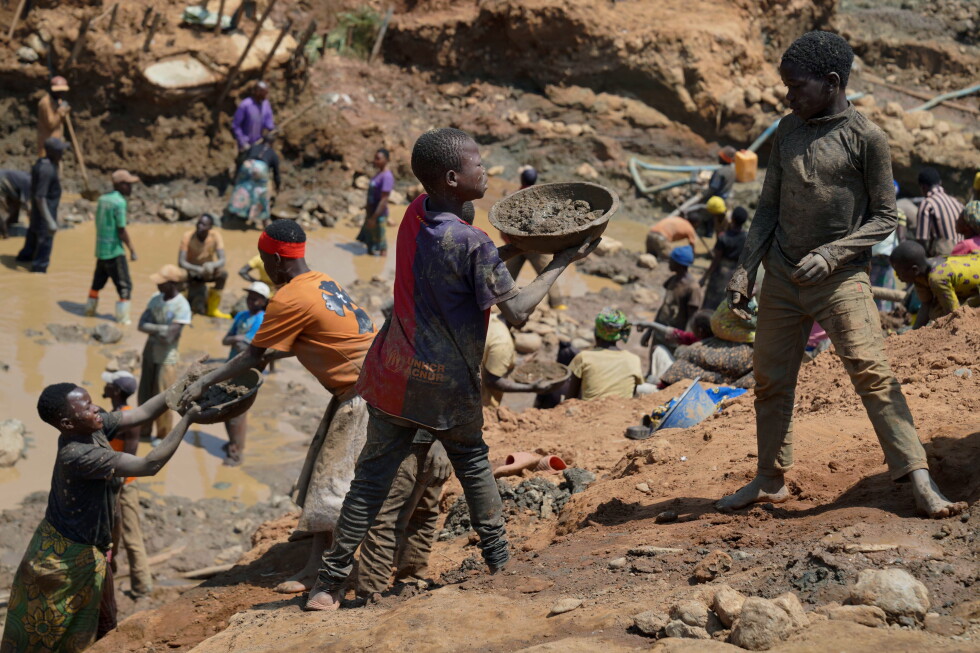
Nestled in the conflict-wracked Ituri Province of eastern Democratic Republic of the Congo, hundreds of artisanal gold miners — including children like 11-year-old Isaac Batisa — crowd into narrow, hand-dug pits and deep underground shafts every day, panning and digging for small traces of the precious metal to earn meager wages that feed their families. For Batisa, who lost his parents and two brothers in a rebel attack and now supports five younger siblings while living with his aunt, Ebola, the deadly viral outbreak that has already claimed more than 2,300 lives across the country, is not his immediate priority. “We don’t know about Ebola here,” he says, noting he often earns as little as $2 a day for his backbreaking labor.
This remote, hard-to-reach mining site in Iga-Barrière offers a rare, unfiltered look at one of the most intractable barriers to containing the fastest-growing Ebola outbreak in recorded history. While no confirmed Ebola cases have yet been documented at Congo’s artisanal mining sites, public health officials warn that the true spread of the virus in these isolated areas remains nearly impossible to track. The vast majority of new cases and deaths are currently recorded among unmonitored populations, a category that perfectly describes the transient workforce that moves between small mining claims, rural villages and urban population centers on a constant basis.
Unlike formal industrial mining operations, most small-scale artisanal mines in eastern Congo are unregulated and often illegal, with miners actively evading local authorities to access gold deposits. Workers dig with nothing more than basic hand tools like shovels and hand-held pans, crowding shoulder-to-shoulder in pits and tunnels with no structural reinforcement to prevent collapses. Crucial public health measures to slow Ebola transmission — including regular handwashing stations and physical distancing protocols — are entirely absent from these work sites. This creates a perfect storm for rapid spread of the virus, which spreads through direct contact with infected bodily fluids and contaminated surfaces.
Complicating response efforts even further, the strain behind the current outbreak — the Bundibugyo virus — is one of the less common variants of Ebola, meaning no proven targeted treatments or vaccines are currently available for widespread use. As of 2024, the outbreak has spread to six Congolese provinces, with nearly 5,000 confirmed cases and 2,325 recorded deaths, 90% of which are concentrated in Ituri. Public health experts now warn the outbreak could surpass the 2014–2016 West Africa Ebola crisis, which killed more than 11,000 people, to become the deadliest Ebola outbreak in history.
The transient nature of artisanal mining work is the single biggest obstacle to effective contact tracing, according to frontline Ebola response workers. Miners regularly cross village and provincial boundaries in search of new gold deposits, while small-scale mineral traders move between remote mining camps and densely populated urban centers to sell extracted gold. This constant movement makes it nearly impossible to track potential contacts once an infection is identified.
“Artisanal miners may come into contact with several communities as they move from one place to another, which can facilitate the transmission of the virus if a person is infected,” explained Mari Ndika, an Ebola response coordinator leading local monitoring efforts. Community health worker Anna Ndroy Kansime recently experienced this gap firsthand: two miners identified as close contacts of a confirmed Ebola case vanished after moving to an unregistered mining site, their current location still unknown. There is also no formal system to register mining workers or record their travel, leaving response teams blind to potential new transmission chains, Kansime added. “People can become infected in one place and travel elsewhere before monitoring teams know they have been exposed, potentially creating new chains of transmission that are difficult to trace.”
For the miners and their families, there is often no other option but to keep digging. Decades of conflict in eastern Congo, where more than 100 armed militant groups operate including the ADF and CODECO militias that terrorize Ituri, have displaced millions of people and pushed countless families into extreme poverty. A 2024 OECD report estimates that roughly 2 million Congolese work in artisanal and small-scale mining, which produces not just gold but also coltan, tin and tungsten that power global electronics supply chains. UNICEF estimates that 15% of Congolese children between the ages of 5 and 17 are engaged in child labor, with no reliable recent count of how many of those children work in mines. At the Iga-Barrière site, children work alongside adults, and even pregnant women work in open pits late into their third trimesters, Kansime confirmed.
“In Ituri province, where conflict has uprooted families and where jobs are scarce, the mines offer the only possibility of cash income, however dangerous the work,” said Singoma Aimé, a 36-year-old miner at the site. He added that miners have repeatedly called for basic public health infrastructure to protect themselves from Ebola: “We especially need hand-washing facilities because everyone comes from home to work at the site, and we lack any kind of adequate protection.”
International humanitarian organizations warn the outbreak’s continued spread is an urgent global crisis. Last week, Mercy Corps warned that confirmed cases have now been recorded along a major travel route just 22 miles from the South Sudanese border, raising fears of cross-border spread that could expand the crisis exponentially. Trish Newport, emergency coordinator for Doctors Without Borders (MSF), called the outbreak’s unrelenting speed “extremely concerning” in an interview with the Associated Press, noting it continues to outpace all containment and contact tracing efforts.
“We see family members that come in who have had 15 people in their family die,” Newport said. “We rapidly need to scale up to be able to prevent more deaths from happening, more families and communities from being impacted.”
Response teams say the path forward requires targeted outreach to mining communities, working with local authorities, mine managers and community leaders to educate miners on Ebola prevention and establish systems to track suspected cases. But deep structural barriers remain: impassable rural roads, the constant presence of armed groups that block access to remote areas, and the simple reality that mining is the only source of food and income for millions of Congolese. “For many families, gold is what pays for food,” Kansime said — a reality that leaves few with the option to stop working, even in the face of a deadly pandemic.