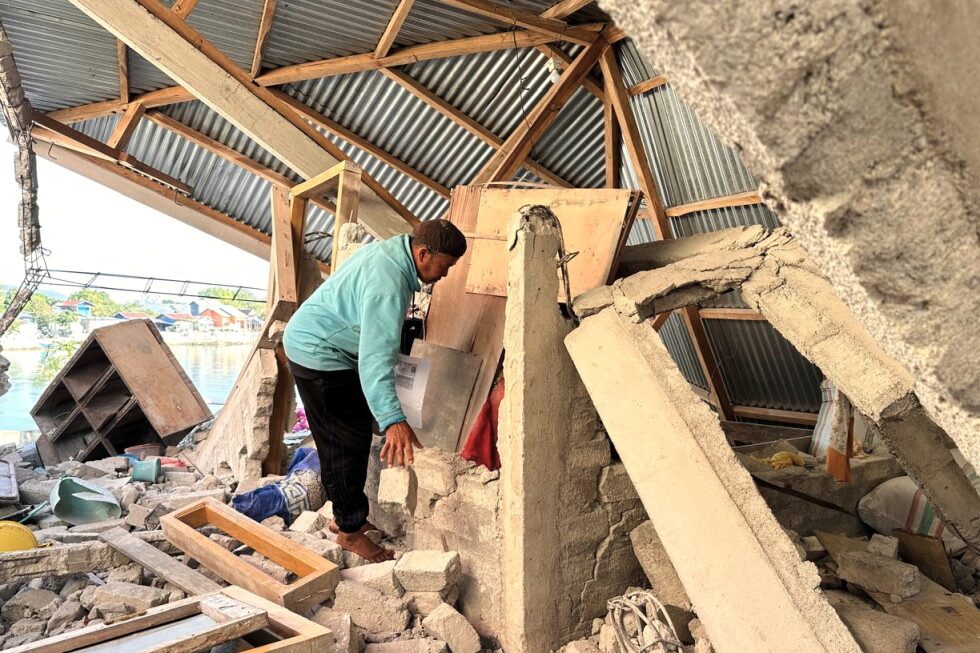
Four days after a powerful 6.2-magnitude-level earthquake left at least 70 people dead, nearly 1,200 injured, and thousands displaced on Indonesia’s Flores Island, basic commercial operations have begun a gradual return to service, even as rescue teams continue searching for missing victims and tens of thousands remain displaced from their destroyed homes.
The disaster struck just before 6 a.m. local time on Saturday, with the U.S. Geological Survey recording the quake at a shallow depth of 10 kilometers (6 miles) off the coast of the remote island, located in Indonesia’s East Nusa Tenggara province. Shallow seismic events in coastal regions often amplify surface damage, and this quake was no exception: official data from Indonesia’s National Disaster Management Agency confirms widespread destruction across the island, with at least 11,925 residential homes, 182 public health facilities, 653 educational institutions, 184 government administrative buildings, and 173 religious sites sustaining damage or complete collapse.
In the immediate aftermath of the quake, authorities issued a tsunami warning that sparked panic among local residents, who fled for higher ground, before the alert was ultimately lifted. Through Tuesday, geological agencies had recorded more than 2,100 aftershocks, only 70 of which were strong enough to be felt by local communities. The persistent risk of further tremors has left thousands of residents sleeping outdoors in open areas, unwilling to return to damaged or unstable structures.
As of Wednesday, grocery stores, gas stations, and public markets had resumed partial operations in hard-hit regions. In Maumere, the main port city of Sikka regency, reopened fuel stations and marketplaces drew large crowds of residents seeking to restock supplies. In Reo, a town in heavily impacted Manggarai regency, locals queued outside a partially reopened grocery store, which limited customer entry to comply with safety protocols amid ongoing structural risks.
Many residents rely on these local businesses to meet daily needs that emergency food aid cannot fully cover. “Food aid has helped, but it doesn’t cover everything we need for daily life,” explained Delvina Panjaitan, who waited in line outside the Reo grocery store. “We still rely on grocery stores and markets, and we need them to be operating again.”
East Nusa Tenggara Governor Emanuel Melkiades Laka Lena confirmed that immediate humanitarian needs for food and clean water have largely been met across the affected zone, and that local government offices in the seven impacted regencies have resumed full operations. “This is to accelerate post-disaster recovery and serve the community’s administrative needs,” the governor stated.
Debris and rubble from collapsed structures still cover most public streets, however, and search-and-rescue teams continue excavating collapsed buildings and clearing mud from landslides triggered by the quake. Fathur Rahman, coordinator for the national search mission, noted that crews are still “anticipating the possibility of discovering more victims” trapped in the rubble. More than 40,000 people remain displaced, taking shelter in tents, official evacuation centers, and improvised makeshift camps across the island.
Indonesia, a sprawling archipelago made up of more than 17,000 islands, sits along the tectonically active Pacific Ring of Fire, making it extremely prone to both major earthquakes and volcanic eruptions. This region of Flores has a history of devastating seismic disasters: in 1992, a major earthquake and subsequent tsunami killed roughly 2,500 people on the island, marking one of the deadliest natural disasters in Indonesia’s modern history.