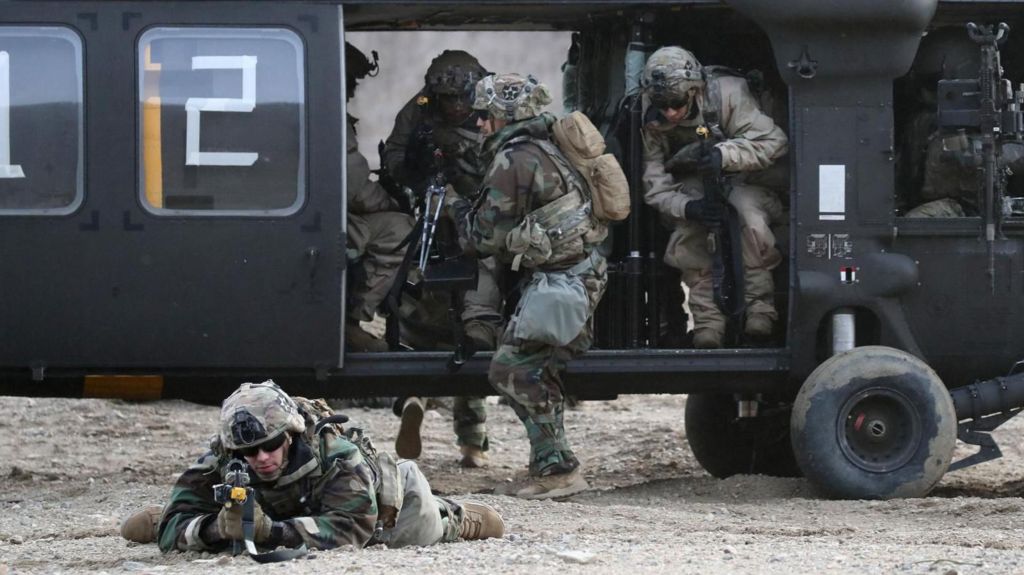
In a move that has rippled through Northeast Asian security dynamics, South Korea’s defense ministry has confirmed that the country’s annual joint military exercises with the United States, the 2026 Ulchi Freedom Shield drills, will be cut six days shorter than originally planned following a formal request from Washington. The adjusted schedule will bring the drills to a close on August 21, instead of the initially planned August 27, with both the duration and overall scope of the training modified in response to the U.S. proposal, according to South Korean officials. The scaled-down exercise comes directly from policy shifts driven by U.S. President Donald Trump, who has repeatedly pushed to reduce joint military activities with South Korea, a position he has tied to his warm personal relationship with North Korean leader Kim Jong Un.
South Korean Foreign Minister Cho Hyun revealed during a parliamentary hearing that neither South Korean nor American administrative officials received advance advance notice of Trump’s planned changes to the drills. Beyond the shortened timeline, the combined field training segment of the exercise will also see partial reductions in its scale, though South Korean authorities note that exact details of the scaling back are still being finalized between the two allies.
The announcement follows reports from the *Wall Street Journal* citing unnamed U.S. officials confirming that Trump has been pressing his closest advisors to arrange a face-to-face meeting with Kim Jong Un. Sources indicate the U.S. president has privately discussed hosting the summit during his upcoming trip to Asia, scheduled for November 2026 to attend the Asia-Pacific Economic Cooperation forum in China.
Over the recent weekend, Trump laid out his public reasoning for cutting the drills in a post on his social platform Truth Social. He argued that the large-scale exercises are unnecessarily expensive, claiming that the U.S. covers the majority of the costs, and that they send an unneeded hostile signal to North Korea. In the same post, he made an unexpected connection to Iran’s nuclear program, revealing that he had recently asked South Korea’s president to join international efforts to denuclearize Iran, and that the request had been rejected outright.
Speaking to reporters in the Oval Office on Monday, Trump doubled down on this link between the drill cuts and South Korea’s refusal to participate in the Iran initiative. “We have 39,000 soldiers over there guarding you from Kim Jong Un, your next door neighbour, and you’re not going to help us on a very easy military operation in Iran,” he told reporters. “That’s strange.”
Just one week prior to the announcement of the adjusted drills, senior military leaders from both the U.S. and South Korea had revealed the exercise plans during a joint press conference, at which they stated the 2026 drills would match the scope of previous years. Roughly 18,000 South Korean troops were expected to take part, with more than 28,500 U.S. military personnel permanently stationed in South Korea also participating in related activities. During that press briefing, leaders also addressed the ongoing issue of North Korea’s deployment of troops to support Russia’s invasion of Ukraine. U.S. military spokesperson Ryan Donald noted at the time that “our training accounts for that threat,” referring to the potential for battle-hardened North Korean troops to return home after combat experience in Ukraine.
In response to the original planned drills, North Korea’s foreign ministry had already issued a sharp condemnation, labeling the joint military exercises “a rehearsal for an aggressive war” against the isolated country.