Nearly a century after its founding, a historic Beijing restaurant remains one of the last guardians of China’s imperial culinary legacy, keeping alive dishes, rituals and handcrafting techniques that trace their roots directly to the palaces of the Qing Dynasty.
One of its most beloved delicacies carries a story that stretches back to the final years of imperial rule. Legend holds that Empress Dowager Cixi once dreamed of a savory pancake late in her reign, and when the identical treat was served to her for breakfast the next morning, she was so delighted that she rewarded her head chef with a silver ingot. Originally named minced pork pancake, the dish was renamed “dream pastry” to honor its connection to Cixi’s vision, explains Zhou Tong, a veteran pastry chef at Beijing’s iconic Fangshan Restaurant.
Founded in 1925 by former Qing Dynasty court chefs inside Beihai Park, a centuries-old imperial garden where dynastic royals once relaxed, conducted state affairs and held sacred rituals, Fangshan’s core mission is written directly into its name: Fangshan translates literally to “imitating imperial cuisine.” While a small number of other Beijing establishments also offer their own interpretations of imperial court dining, and the Palace Museum preserves Qing-era dining artifacts ranging from ornate pastry molds to serving vessels, Fangshan stands out for its commitment to passing down original recipes and techniques from generation to generation of chefs.
Imperial cuisine is far more than a collection of fancy dishes: it encompasses the strict rituals that structured every meal, from the emperor’s daily breakfast to grand state banquets and sacred ceremonial feasts. For example, drinking milk tea was always the formal opening step at Qing Dynasty banquets, notes Teng Deyong, a researcher specializing in court culture at the Palace Museum. During grand events, the emperor would bestow portions of wine and food to assembled princes and high officials, and recipients were required to perform full formal rites of respect before they could partake.
Sacrificial ceremonies, a core part of imperial court life, followed their own separate set of culinary rules. One of the most important Qing rituals, held at the Palace of Earthly Tranquillity inside the Forbidden City, centered on unseasoned boiled fatty pork. After the ceremony concluded, the pork was distributed to attendees, and receiving this sacrificial meat was considered a high honor. This tradition of unseasoned ritual food stretches back even further in Chinese cultural history: Wandi Wang, a professor of Chinese studies at Lehigh University in Pennsylvania, points to the *Book of Rites*, an ancient Confucian text detailing ceremonial customs, which describes an unseasoned meat broth called “grand stew” served during sacrificial rituals.
“The absence of added flavoring was itself meaningful: the unseasoned dish evoked an earlier and simpler way of cooking and thus expressed a ritual ideal of honoring antiquity and remembering cultural origins,” Wang explained.
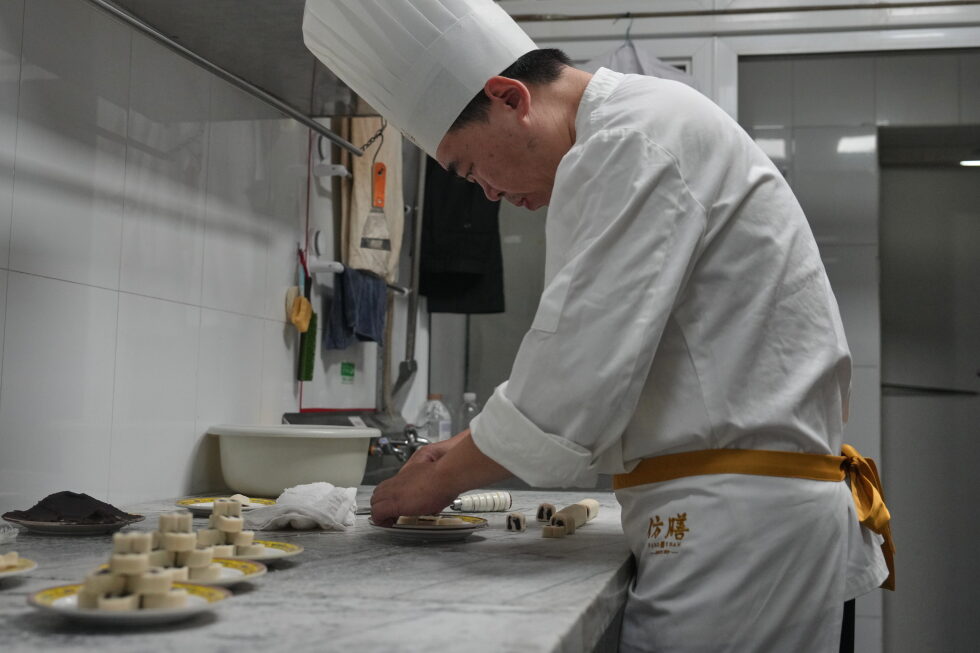
Pastries held a special place in imperial dining, with a dedicated palace institution solely responsible for crafting sweet and savory treats for the court. At Fangshan, Zhou still makes the original imperial versions of dream pastry and small steamed corn buns following century-old recipes, and servers share the dishes’ rich histories with every table. “People enjoy them even more because they carry such meaningful history,” Zhou said.
His craft is passed down through an unbroken line of master-to-apprentice training, and traditional methods strictly require all work to be done by hand — no modern blenders or food processors are permitted. Beans are pulverized by hand using fine sieves, and specialty flours are mixed and aged in custom-made copper pots. “A machine may be more convenient, but the texture is completely different,” Zhou explained. “You lose the delicate graininess and sandy mouthfeel that handcrafted pastries are supposed to have.” That commitment to craft has paid off: pea flour cakes and red bean rolls, two of Fangshan’s most popular pastries, sell more than 200 orders per day during peak tourist seasons.
For Fan Liangliang, Fangshan’s current executive chef, adapting to the restaurant’s traditional standards required unlearning everything he had been taught in modern culinary school. Instead of prioritizing speed and efficiency, he had to master slow, labor-intensive techniques unique to imperial cuisine, such as “Nizihuo” — a method that involves mincing ingredients like fish, shrimp or chicken into a smooth paste, then reshaping the paste into intricate decorative forms like frogs, birds or flowers.
“This is one of the hallmarks of imperial cuisine,” Fan said. “Every dish had to be innovative, visually beautiful, nutritious and worthy of presentation on the imperial dining table.”
As times have changed, the restaurant has made thoughtful adaptations to align with modern norms: rare, protected ingredients like bear paws are no longer served, and other ingredients have been substituted to fit contemporary availability and dietary preferences, all while retaining the core spirit and flavor of each original dish.
Scholars note that Chinese culinary traditions have always carried layered meaning beyond sustenance, reflecting broader cultural, political and aesthetic values that evolve over time. Wang points to a famous poem by Tang Dynasty poet Du Fu, who wrote about cold noodles made from pagoda-tree leaves. “The poem is not simply a description of a dish,” Wang said. “Du Fu turns the verdant, fresh, yet modest dish into an expression of his political loyalty and thwarted ambition to serve the emperor.”
“Preserving a culinary tradition begins with taking its history seriously,” Wang added. “Culinary heritage tells us not only how people ate in the past, but also how people in the present choose to remember and give meaning to that past.”
Fan emphasizes that at its core, Fangshan’s imperial cuisine is a historic fusion of Manchu and Han Chinese culinary traditions, bringing together the food culture of the Qing Dynasty’s Manchu rulers and China’s Han majority. “It’s not simply a collection of dishes from the two cultures,” he said. “It represents the blending of their different approaches to food into a unified cuisine.”
While core techniques like stir-frying, braising and stewing have remained intact, and some ingredients have been updated for accessibility and modern palates, the team’s commitment to preserving this unique cultural heritage remains unshaken. “When people dine at Fangshan Restaurant, I hope they experience more than just a meal,” Fan said. “They experience the weight of history.”