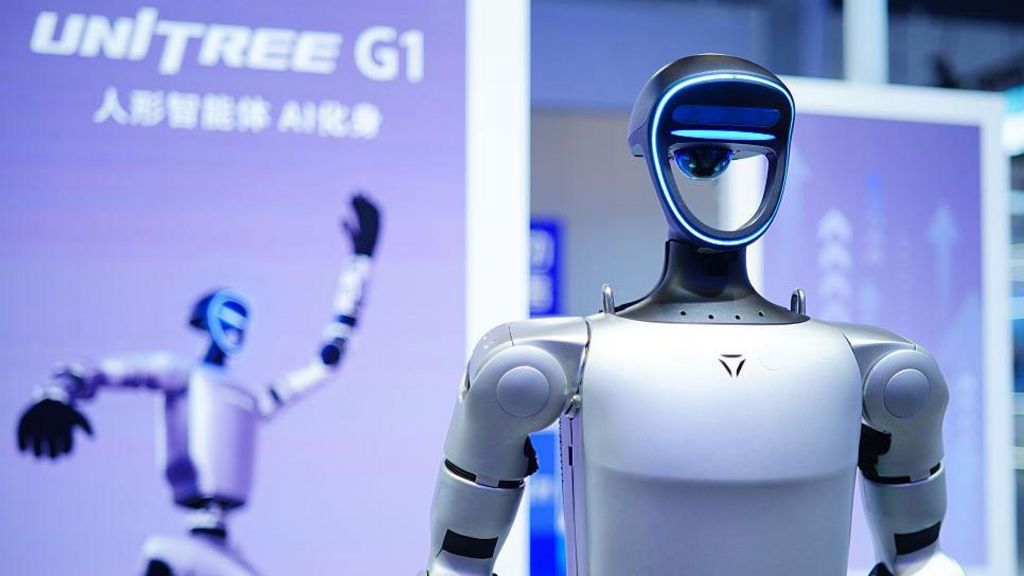
On Wednesday, Unitree Robotics, the world’s largest manufacturer of humanoid robots, made history as the first publicly listed humanoid robot developer on mainland China’s stock exchange, capping a landmark day with shares skyrocketing more than 600% above their initial offering price. Trading on Shanghai’s tech-focused Star Market, often dubbed China’s answer to Nasdaq, the Chinese firm opened at 1,100 yuan ($163.12) per share, a massive jump from the 150.8 yuan initial public offering (IPO) price. The milestone debut comes amid an intensifying global race between the United States and China to dominate the fast-emerging market for humanoid robots and the artificial intelligence systems that power these machines, aligning directly with Beijing’s long-term strategic goal to establish global leadership in advanced robotics technology.
Founded in 2016 and headquartered in Hangzhou, a city at the heart of eastern China’s government-backed robotics industry cluster, Unitree Robotics (officially registered as Yushu Technology Co Ltd) has grown from a startup to a global industry leader in less than a decade. The company offers a diverse product line spanning robotic sensors, automated industrial arms, quadruped robot dogs, and fully functional humanoid machines, and it shipped more than 5,500 humanoid units in 2025 alone amid surging global demand for the technology. Unlike many early-stage robotics firms that operate at a loss, Unitree has already achieved profitability, posting a net profit of 278 million yuan in 2025. A key competitive advantage for the firm is its ability to deliver robots with comparable capabilities to leading U.S. developers at a fraction of the price: Unitree’s entry-level quadruped robot dog starts at just $2,700, while Boston Dynamics’ comparable Spot robot carries a $70,000 price tag. While researchers note the models differ in size and capability, the cost gap remains a major market differentiator. Unitree launched commercial sales of humanoid robots in 2023, releasing its $13,500 child-sized G1 model in 2024 – a milestone that puts it years ahead of major U.S. rivals like Tesla, which has yet to begin commercial deliveries of its own Optimus humanoid robot.
The successful IPO follows a high-profile global marketing push for Unitree’s technology that has cemented its reputation as a trailblazer in the sector. Earlier this year, the company’s G1 robots went viral after performing a coordinated martial arts routine live on China’s national Spring Festival Gala, a display that impressed researchers with the robots’ fluid range of motion and real-time performance. This week, Unitree robots are competing in the 2026 World Humanoid Robot Games in Beijing, where hundreds of teams test capabilities across athletic challenges like running and football, as well as practical everyday tasks such as opening boxes and sorting library books.
Industry analysts frame Unitree’s public listing as a pivotal moment for the global humanoid robotics sector, as it gives retail and institutional investors their first widespread opportunity to invest in the fast-growing emerging industry, and will likely set a valuation benchmark for future robotics IPOs. China has seen explosive growth in its robotics sector over the past five years, with government investment driving a more than threefold increase in the number of domestic robotics firms between 2020 and 2024, according to state-run media China Daily. Beyond technological ambition, Chinese policymakers see robotics as a key solution to demographic challenges, particularly the shrinking workforce caused by the country’s ageing population. Fei Qin, an associate professor at the University of Bath, notes that Beijing has designated the robotics sector a “strategic priority,” arguing that “robots are where AI leaves the screen and enters the economy” across factories, healthcare settings, and eventually residential homes. Unitree’s listing paves the way for a wave of other Chinese robotics firms going public in the coming months; smaller rival UBTech Robotics already listed in Hong Kong nearly three years ago, and drew global attention earlier this year when it unveiled a hyper-realistic humanoid companion robot, with other developers including Leju Robotics and AgiBot expected to launch IPOs soon.
Despite widespread investor optimism, some industry researchers have sounded notes of caution about the timeline for widespread consumer adoption of humanoid robots. Harold Soh, a robotics researcher at the National University of Singapore, points out that practical humanoid robots for home use are still years away from commercial viability, as developers still need to solve key challenges including extending battery life, improving reliability, and building robust privacy safeguards. For the near future, most demand is expected to come from industrial and commercial settings including factories, warehouses, and healthcare facilities.
The growth of China’s robotics industry has become the latest flashpoint in U.S.-China technological rivalry, with the Trump administration announcing a ban on new imports of Chinese-made humanoid and quadruped robots in July, citing unsubstantiated national security concerns and a goal to protect domestic U.S. manufacturing. Beijing has rejected the claims, accusing Washington of politicizing ordinary trade issues, and the ban is part of broader U.S. restrictions on a range of Chinese advanced technology including AI models, electric vehicles, semiconductors, and drones. Christine Wan, an analyst at the Peterson Institute for International Economics, notes that Chinese robotics firms have become deeply integrated into global supply chains, meaning many countries are reluctant to cut ties with Chinese suppliers out of fear of major domestic manufacturing disruptions. So far, Western robotics firms have failed to match China’s impact on both industrial and consumer markets: U.S. developers including Boston Dynamics, Tesla, and Amazon are still in the testing or early production phase for humanoid robots, with full commercial rollouts not expected for years. Many industry analysts agree that China has overtaken the U.S. to become the global leader in commercial robotics development. “We no longer hear about American robotics companies in the news. It’s the Chinese robot companies that are making news today,” said robotics researcher David Hsu. “They have replaced America as the cool kids on the block.”