Nestled among the rolling hills of central Romania, Transylvania’s network of medieval fortified churches stands as a lasting monument to the region’s complex multicultural history. But decades of demographic shift, limited funding, and slow decay have left these iconic heritage sites at risk of disappearing entirely — a threat made starkly visible earlier this June, when an outer wall of the 15th-century fortified church in the small village of Mosna collapsed overnight.
The Mosna church holds deep personal and cultural meaning for the local community: it was visited by Britain’s King Charles III in 1998, draws roughly 4,000 tourists annually, and has been a cornerstone of village life for generations. For 74-year-old Mariana Rempler, the last remaining German-speaking Saxon resident of Mosna, the collapse was a devastating loss. Baptized and married within the church’s stone walls, she described the incident as a personal blow. “I felt a great pain inside me. It was as if I had collapsed at the same time with that wall,” she told AFP, recalling the night of the collapse through tears.
More than 160 fortified churches dot the Transylvanian landscape, all constructed between the 13th and 16th centuries by ethnic German Saxon settlers who were invited to populate the region’s disputed borderlands. Designed to double as defensive strongholds, the churches allowed local communities to take shelter from invading Tatar and Ottoman forces, becoming central to both the physical protection and cultural identity of the Saxon minority for centuries.
Today, that demographic foundation has all but vanished. Before World War II, some 300,000 Saxons called Transylvania home. Decades of outmigration, accelerated by mass escapes from the brutal communist dictatorship of Nicolae Ceausescu in the second half of the 20th century, have left that number at just around 10,000. With few original community members remaining to maintain the sites, many churches have fallen into disrepair, joining hundreds of other historic monuments across Romania — one of the poorest countries in the European Union — that have succumbed to neglect.
Even sites like Mosna, which received partial renovation after the fall of communism in 1989, remain at severe risk, as securing consistent funding for ongoing upkeep and major repairs has grown increasingly difficult. Cristian Cismaru, manager of the non-profit Fortified Churches Foundation, which partners with Romania’s Evangelical Church to preserve the sites using grants and donations (85% of which come from the EU), estimates that only half of the 160-plus fortified churches — around 80 total, including Mosna — have been restored or are scheduled for repairs over the next five years.
“I don’t think we’ll be able to address the other half of our heritage in our lifetime. That will be left for future generations,” Cismaru told reporters at a recent community outreach event for tourists in Cincsor, a village 40 miles southeast of Mosna.
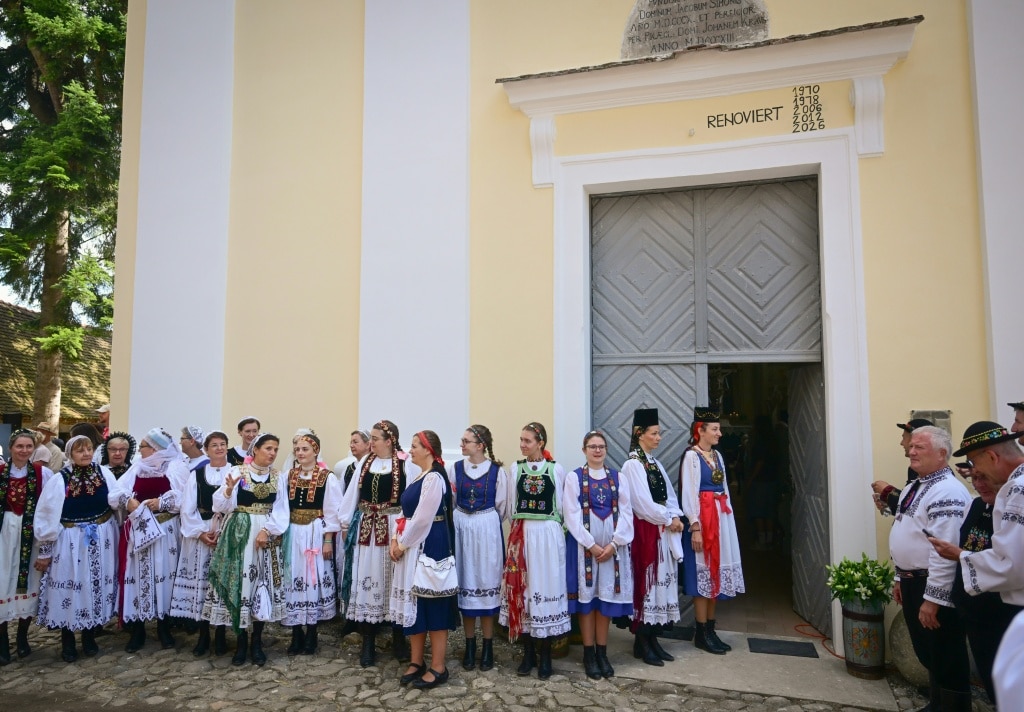
To secure the long-term future of the sites, Cismaru and his team are pushing for a radical new approach to heritage stewardship. No longer able to rely on traditional congregational support, the foundation argues the churches need a “new concept for survival” that repurposes them as active cultural hubs rather than purely religious sites. As part of this strategy, the foundation has launched community tourism programs that direct a third of all ticket revenues to local development projects, tying the preservation of the churches to the economic well-being of the surrounding villages. This year, the annual national festival dedicated to Saxon heritage, centered on the fortified churches, drew a record-breaking 10,000 visitors, a sign that public interest in the sites remains strong.
In Mosna, the wall collapse has actually drawn a small surge of curious tourists to the village’s main attraction, where hundreds of fallen bricks, covered by a plastic tarp, still sit piled at the base of the church’s remaining unsupported tower. The tower was stabilized with wooden beams back in 2017, and Rempler fears it could be next to fall without immediate intervention. She visits the site almost every day to photograph the growing visible cracks, documenting the decay in the hope of spurring authorities and preservation groups to act quickly.
Many tourists who visit the site remain optimistic that repairs will eventually move forward. “The blend of Gothic and defensive elements is always interesting. All in all, the concept of a fortified church is quite intriguing,” said Francois Regis, a 53-year-old French tourist visiting with his wife, who praised the church’s overall condition outside of the damaged northern section.
Rempler shares that hope, saying she prays the collapse of the outer wall will serve as a critical wake-up call for stakeholders to secure funding and save the site. “It would be a shame for us to let it fall into ruin,” she said.