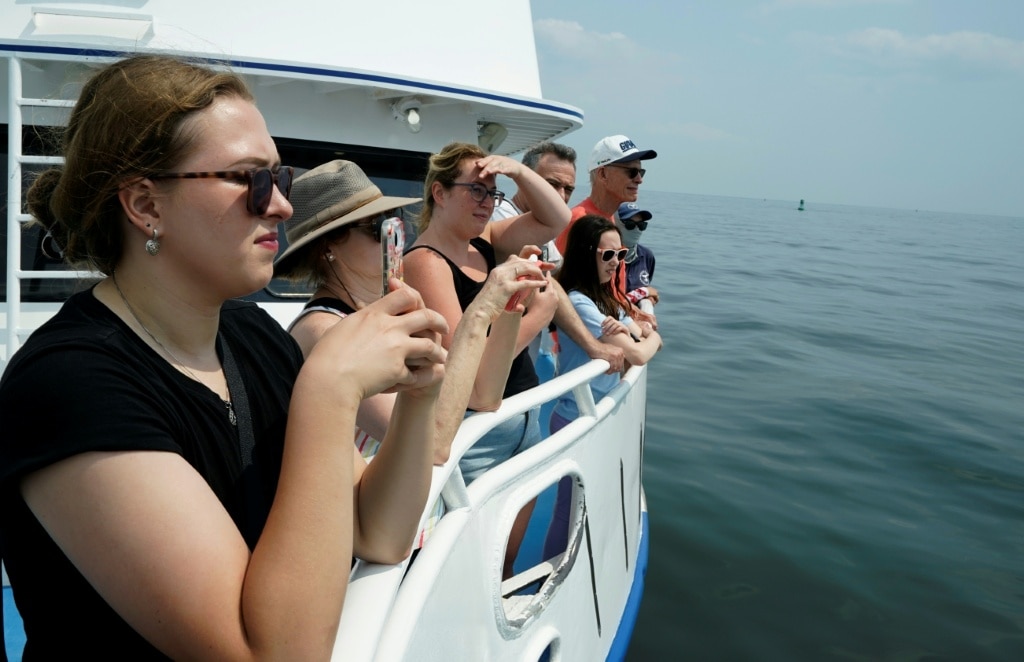
The cry of “whale at one o’clock!” has become a familiar, electrifying sound for cruise passengers exploring New York’s southern shorelines. When a humpback whale breaches the Atlantic surface against the backdrop of Manhattan’s world-famous skyline, crowds rush to the starboard bow, scrambling to catch a glimpse of one of the ocean’s most magnificent creatures. What was once a once-in-a-lifetime rarity is now a regular occurrence in the city’s coastal waters, bringing unbridled joy to wildlife enthusiasts while forcing policymakers and marine experts to confront a growing threat: heavy boat traffic in one of the United States’ busiest port regions.
Decades ago, commercial hunting pushed humpback whale populations to the brink of extinction, and their remarkable recovery today stands as one of the global conservation movement’s most celebrated success stories. A growing population, dominated by young juvenile humpbacks, is now thriving off New York’s coast, where abundant food sources have transformed the area from a temporary migratory stopover into a permanent home.
“People travel across the globe for African safaris, but what most don’t know is that a world-class marine safari is right on our doorstep,” explained Carl LoBue, New York oceans director for The Nature Conservancy. Raised on nearby Long Island, LoBue recalled that whale sightings off the state’s coast were once almost unheard of. Now, he spots marine mammals on virtually every trip out on the water. While humpbacks are the most common visitors, the region also hosts rare sightings of the critically endangered North Atlantic Right whale. For LoBue, this new normal is nothing short of spectacular: “I never dreamed I would see whales this abundant right off New York’s coast.”
Several interconnected factors have driven this population shift, turning the New York Bight—the vast marine region stretching from New York City and Long Island to New Jersey—from a migratory highway into a permanent feeding ground. First, decades of federal protections including the U.S. Endangered Species Act allowed humpback populations to rebound, while stricter air and water quality regulations cleaned up coastal habitats that were once uninhabitable for large marine life. Second, new fishing regulations have supported the recovery of Atlantic menhaden, an oily small fish that serves as a primary food source for whales, dolphins, and seabirds, in addition to being harvested for commercial bait and dietary supplements. An adult humpback, which can grow to the size of a full-size city bus, consumes up to 3,000 pounds of fish every day, making abundant menhaden populations critical to supporting the growing whale community.
Climate change has also accelerated this shift, according to Chris St. Lawrence, a naturalist who leads whale watching tours and works for Gotham Whale, a non-profit marine research organization that monitors whale populations in the New York Bight. Warming ocean temperatures have shifted the distribution of bait fish, pushing whales to abandon traditional migratory routes in search of reliable food sources closer to New York’s coast.
When Gotham Whale launched its formal tracking program in 2012, the organization’s catalog included just five individual humpbacks. Today, St. Lawrence reports the group documents 80 to 100 unique whales every year, and recently identified its 500th distinct individual whale spotted around New York City since monitoring began. Some whales have even become minor celebrities among local whale watchers: NYC0318, a humpback spotted by AFP during a recent outing, regularly delights crowds with dramatic displays of lunge-feeding and full breaching that leave spectators screaming with delight.
Gotham Whale identifies individual whales by their unique fluke prints—distinctive pigment patterns on the underside of their tails that are as unique as human fingerprints, St. Lawrence explained. But many whales are also recognizable by the scars they carry, most often from collisions with vessels ranging from massive tankers and cargo ships to smaller recreational fishing and leisure boats.
For all the abundance of food New York’s coast offers, the region’s extremely heavy maritime traffic creates serious new risks for the growing whale population. While humpbacks in the New York area were removed from the endangered species list in 2016, just one year later the U.S. National Oceanic and Atmospheric Administration (NOAA) declared an Unusual Mortality Event for humpbacks along the entire Atlantic coast. This designation, granted under the Marine Mammal Protection Act, is triggered when unexpected mass die-offs occur, and it initiates formal investigation and response. The Unusual Mortality Event for humpbacks remains in effect today.
Global marine advocacy groups and government researchers confirm that vessel strikes and fishing gear entanglement are the two leading causes of preventable whale deaths worldwide. To address this growing risk in New York, Governor Kathy Hochul recently signed the Whale Awareness Act into law. The new legislation requires that marine mammal protection and education be integrated into mandatory state boater safety courses and vessel registration processes.
LoBue has helped develop new educational resources for the policy, including an online course that teaches boaters of all kinds how to recognize whale behavior, report sightings to regulators, and adjust navigation to avoid collisions. He notes that even experienced commercial fishermen never learned how to operate boats around whales, because the animals were not present in the region for generations. “We all have to learn new skills to adapt to this change,” LoBue said. “And at the end of the day, nobody wants to hit a whale.”