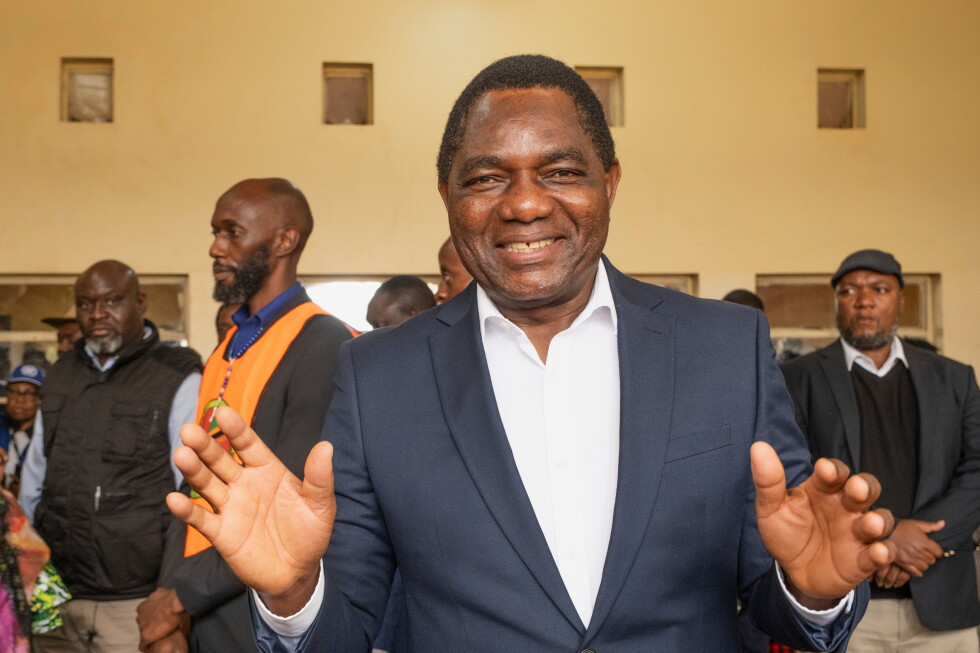
In the early hours of Tuesday, Zambia’s Electoral Commission confirmed a decisive outcome for the Southern African nation’s presidential contest, confirming incumbent leader Hakainde Hichilema has won a second five-year term in a landslide victory. Hichilema secured an outright majority in last Thursday’s election, eliminating the need for a runoff, after capturing 61.4 percent of the more than 5 million ballots cast across the copper-rich country.
Per official commission results, Hichilema amassed 2,965,326 votes, while his closest challenger, opposition leader Brian Mundubile, trailed with 1,856,217 votes. Commission chairperson Mwangala Zaloumis formalized the outcome in a public declaration: “I therefore declare, Hichilema Hakainde S, to be president-elect of the Republic of Zambia this 18th day of August, 2026.”
The result comes after a turbulent electoral process that captured global attention. Just one day after voting concluded on Thursday, vote counting was abruptly suspended after the commission reported targeted attacks on polling station officials and theft of a number of ballots. Counting resumed several hours later following a deployment of additional security forces across affected sites.
In the wake of voting, the Zambian government confirmed that several top opposition figures had been taken into custody on election night, with police alleging the figures posed an actionable threat to national security. Mundubile, the main opposition candidate, alleged that police raided his private residence in what he described as an attempt on his life.
Thursday’s vote was widely framed as a public referendum on Hichilema’s economic recovery agenda. When Hichilema first won office in 2021, Zambia was mired in a crippling sovereign debt crisis that first emerged in 2020. During his first term, the incumbent oversaw a successful restructuring of the nation’s $14.5 billion external debt, brought runaway inflation under control, and stabilized the national kwacha after years of volatile devaluation.
International observer missions, including a delegation from the European Union, have assessed that the voting process itself was largely peaceful, but raised sharp concerns about structural inequities that marred the broader lead-up to the election. “Late legal changes, legal uncertainty, and unequal campaign conditions distorted the playing field,” explained Michael McNamara, chief of the EU observation mission, noting that the operating environment placed meaningful limits on fundamental democratic freedoms.
Domestic institutional critics have also raised alarm over security measures during the counting period. The Zambia Conference of Catholic Bishops issued a formal pastoral statement pushing back on the deployment of the Zambian Army to oversee vote counting, arguing that constitutional and statutory law assigns exclusive responsibility for maintaining election order to the Zambia Police Service.
The result paves the way for a second term of Hichilema’s market-friendly reform agenda, which has drawn close attention from global powers including the United States and China, both of which hold significant economic and diplomatic interests in Zambia’s key copper mining sector.