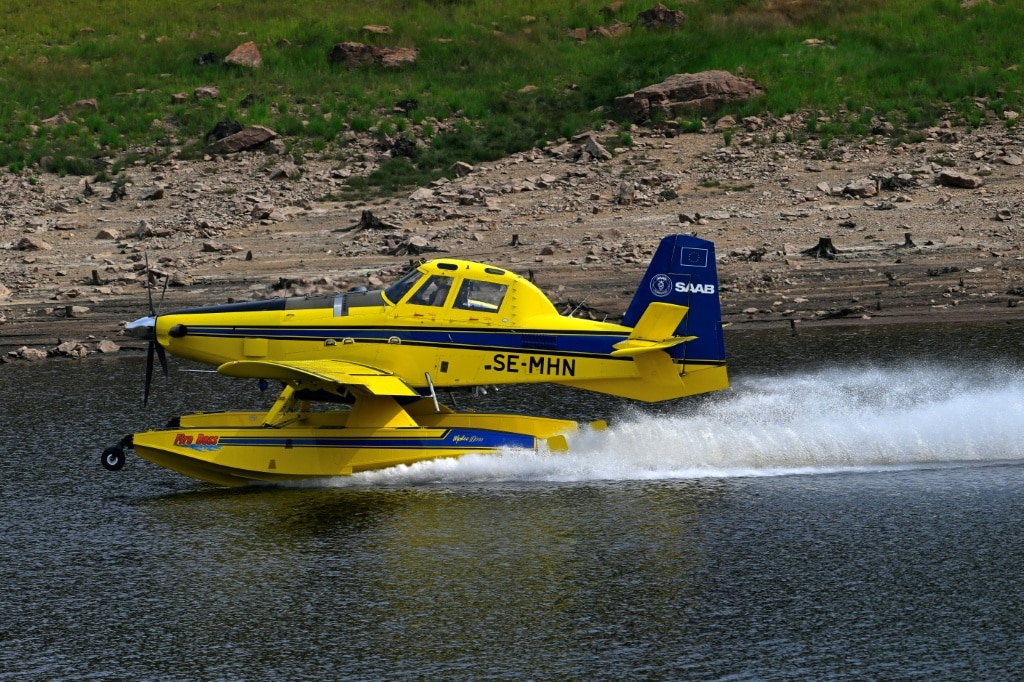
Four days into fighting the most extensive wildfire Belgium has seen in 100 years, emergency crews received a long-awaited boost on Monday when gentle rain fell across the fire zone in the Hautes Fagnes (High Fens) nature reserve, a protected peat bog and forest ecosystem along the country’s border with Germany.
The massive blaze, which ignited on Friday of unknown origin, has already scorched roughly 3,000 hectares (7,400 acres) of protected land — an area roughly half the size of Manhattan. For the past week, a historic heatwave and record-dry conditions have turned much of Western Europe into a tinderbox, triggering a wave of destructive wildfires across France, Greece, Portugal and Spain that have already been linked to thousands of heat and fire-related deaths. This Belgian blaze has emerged as the most active and high-priority fire front on the continent this week.
Around 500 Belgian firefighters and emergency personnel have been mobilized to contain the spread, supported by international resources: two water-bombing aircraft from Sweden, two Dutch military Chinook helicopters, and two additional Belgian aerial craft. Local farmers have also stepped in to assist, using their tractors to haul water tankers filled from nearby lakes to remote parts of the fire line that heavy emergency vehicles cannot reach. The boggy, uneven terrain of the High Fens has created major obstacles for ground crews: heavy trucks risk sinking into the soft peat, forcing firefighters to rely heavily on aerial support and making close-range fire suppression extremely difficult.
By Sunday, the fire had crept close enough to the German border to prompt an evacuation order for the small German border town of Monschau, and two Belgian villages near the ignition point were also cleared as a thick plume of yellow smoke drifted across the region. Smoke from the blaze was detected as far away as eastern France, where local officials issued an air quality warning for affected communities. As of Monday morning, all evacuated residents remain under orders to stay away from their homes for safety.
Crisis management spokesperson Tony Hosmans told reporters on Monday that the fire has stopped advancing toward the German border, a shift that comes alongside favorable wind conditions and the onset of light rain. Additional scattered showers are forecast for the region throughout the week, which officials say is helping slow the fire’s spread. “The wind is favourable and the current rainfall is helping to contain the spread,” Hosmans said. “At present, the fire is contained wherever intervention is possible.” Even so, Hosmans cautioned that the blaze is not yet fully under control, and an aerial reconnaissance mission scheduled for later Monday is expected to provide a full update on the fire’s footprint and remaining hotspots.
Historically, the High Fens region was last hit by a massive wildfire of this scale in 1911, during a similar period of extreme heat and drought. This current blaze is the largest to hit the country since that event more than a century ago. Local residents and business owners, many of whom have mobilized to provide food, water and supplies to on-site crews, say the fire marks a wake-up call for a region that once assumed extreme wildfires were a problem for other parts of the world. “You always think it happens somewhere else. Well, not anymore. It’s happening to us,” Annick Dodemont, a 41-year-old restaurant owner in nearby Eupen who has been supporting firefighting efforts, told AFP.
Belgium, like much of the European continent, has seen a recent surge in extreme summer temperatures, with highs reaching 37 degrees Celsius (98.6 degrees Fahrenheit) in parts of the country last Friday. These high temperatures, paired with weeks of below-average rainfall, have created ideal conditions for wildfire ignition and rapid spread across the region.