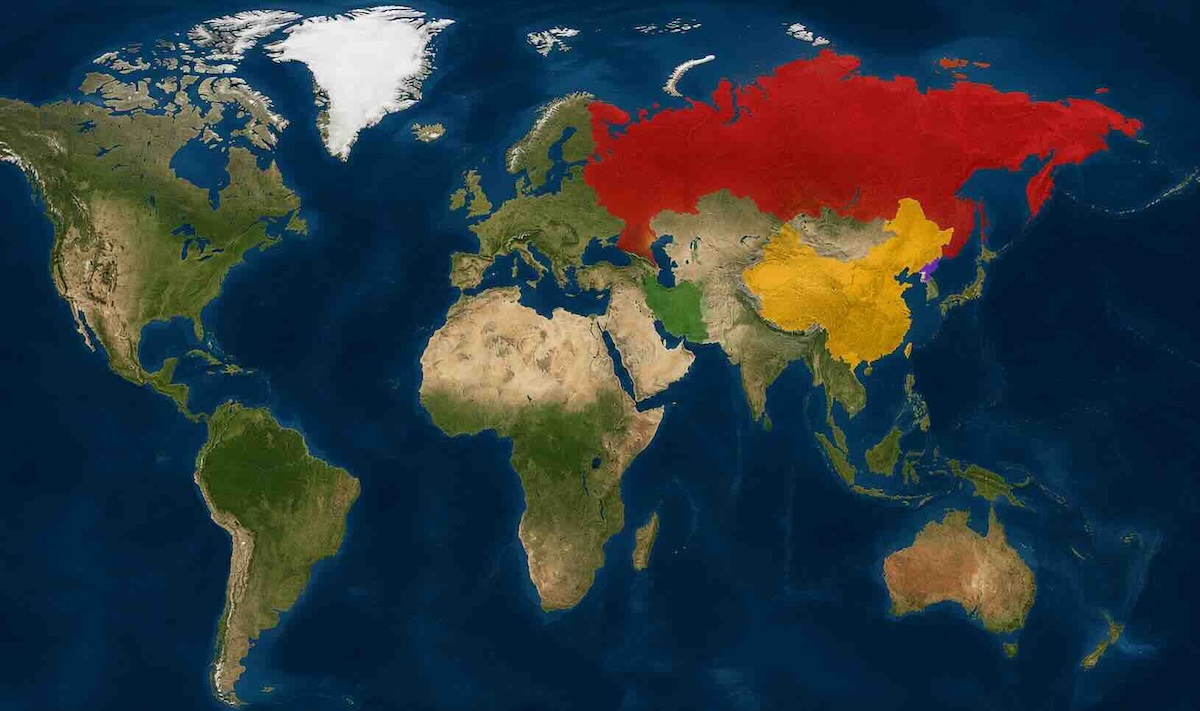
Over the past century, stretching from the United States’ entry into World War I in 1917 through the end of the Cold War, Washington built and sustained a rules-based international order that shaped global politics, economics and security. Today, that system is facing unprecedented strain, driven in large part by the rise of isolationist sentiment embodied by Donald Trump — a shift that Beijing has interpreted as a deeper, irreversible decline of American global centrality. For Chinese policymakers, Trump’s 2016 election and potential return to office are not isolated political anomalies, but evidence of a long-running American turn inward, as a growing segment of the US public grows weary of global entanglements and resents the burdens of maintaining the international order Washington itself built. This shift has already eroded the legitimacy of core US-founded institutions, from the United Nations to the World Trade Organization.
China has never viewed these institutions as fully representative of its interests, values or political system, and has long held that the American-led order does not accommodate its rising global status. From Beijing’s perspective, if Washington is intent on dismantling the system it created, there is no logical reason for China to step in to preserve it. Unlike the Soviet Union during the Cold War, China has not advanced a fully formed alternative global order to replace the US system. Instead, its medium- and long-term strategy centers on insulating itself from the chaos of a collapsing old order, emerging stronger once the dust settles while capitalizing on any opportunities that arise from the upheaval. This framing echoes the analysis laid out in the 2004 book *The New Warring States Period*, written by four prominent Chinese strategists who predicted decades of growing interstate friction following the collapse of the US-led order. The authors, who rooted their analysis in the faltering US intervention in Iraq, warned that unsustainable US debt and the capture of national policy by private corporate interests would eventually cripple American global power — a prediction that many saw validated by the 2008 global financial crisis.
Against this backdrop, current turmoil in Iran offers a key test of this geopolitical framework. For Beijing, instability in Iran, particularly around the strategically critical Strait of Hormuz, is viewed as another symptom of the broader erosion of the American order. If US intervention sparked the current chaos, Beijing questions why it should step in to bail out Washington, asking what concessions the US would offer in return, and whether the moment could open a path for China to help shape a new regional order centered on its own interests. This parallel to China’s Warring States period, when the centuries-old Zhou dynastic order collapsed into fragmented competition between sovereign states, frames Beijing’s view that the age of unchallenged American centrality is already over.
But Iran itself has emerged as a volatile wildcard in this shifting landscape. With nearly 100 million people, a strategically pivotal location between the Caspian Sea and Persian Gulf, and deep internal political fragmentation following the death of long-time Supreme Leader Ali Khamenei, Iran functions today as a failing state, with the Revolutionary Guards holding de facto power but unable to rebuild national unity. As analyst Kamran Bokhari notes, the Iranian regime has survived internal and external pressure not through military strength, but because domestic political constraints in Washington have prevented the US from pursuing full regime change. This survival has come at a steep cost: Iran faces deepening political, economic and security crises that will limit its ability to recover or shape its regional environment for years to come, creating a risk that chaos could spill over to China’s broader sphere of influence.
This dynamic raises a critical, unresolved question: is Beijing’s analysis of American decline accurate? Today, even many US allies share the view that American power is shifting, but emerging evidence suggests that rather than declining, US power is undergoing a reconfiguration. Despite isolationist rhetoric from the MAGA movement, Washington has expanded its influence in key hotspots including Venezuela and Syria. This poses a key risk for Beijing: its cautious, wait-and-see strategy, rooted in the assumption of American collapse, could backfire if US power is merely reorganizing rather than retreating. Unlike China, which frames regional and global chaos as an existential threat to be avoided, the US has historically adapted and reemerged stronger through periods of internal and international disorder.
Adding another layer of complexity, Washington holds its own grievances against Beijing. After opening its markets to China in the 1980s and supporting China’s accession to the World Trade Organization, granting Beijing unprecedented access to global markets, US policymakers argue that China never joined the US-led order as a responsible stakeholder, failing to open its markets and liberalize its currency as previously committed, even as former Premier Zhu Rongji pushed for such reforms in the late 1990s. China’s dramatic economic growth and rising global influence disrupted the old US-led order, leading Washington to gradually conclude that the existing system benefited Beijing at Washington’s expense, creating pressure to dismantle it. This shift was not the product of a single, coordinated secret plan, but emerged gradually from debate and discussion across US government agencies, think tanks, financial circles and diplomatic circles. If Washington does hold a long-term coherent strategy to counter China, Beijing’s current calculations may prove to be fundamentally incorrect.
Beyond Iran, Beijing faces growing geopolitical challenges on multiple fronts in the near term. A new defense pact between Turkey, Saudi Arabia and Pakistan has shifted regional alignments, spurring closer cooperation between Israel and India — two countries with growing tensions with China — that threatens to undermine Beijing’s interests. In East Asia, rising tensions between North Korea and South Korea have spurred deeper security coordination between the US, Japan and South Korea, increasing pressure on Beijing. North Korea’s advancing nuclear program has stoked security anxieties in Tokyo and Seoul, raising the risk that either country could pursue an independent nuclear weapons program, a outcome that runs directly counter to Chinese interests. As Chinese scholar Zheng Jiyong notes, Beijing is increasingly alarmed by the risks of North Korea’s unpredictable behavior, but faces a Catch-22: while Pyongyang can act as a useful wildcard for Beijing in East Asian geopolitics, tighter Chinese control over North Korea would lead any Pyongyang’s actions to be blamed on Beijing. Russia’s growing ties with North Korea have further complicated this dynamic, forcing Beijing into a more constrained position while accelerating North Korea’s nuclear rearmament. This was on full display in mid-August 2026, when Russian President Vladimir Putin visited the disputed Kuril Island of Iturup, claimed by Japan, just one day after North Korea conducted major naval drills and a missile test. The visit, which irritated Japan, has complicated Chinese diplomatic efforts in the region, fueling speculation that Moscow is seeking to needle Beijing amid disagreements over the war in Ukraine, or demonstrate support for North Korea.
On the economic front, rising trade tensions threaten to further escalate, as China is on track to hit a new record annual trade surplus by the end of 2026, putting additional strain on global trade relations and the wider world trading system. Today, China accounts for roughly 28 to 30 percent of global industrial production, up from just 5 percent in 1980, while the US share has fallen from 21 percent to 17 percent over the same period. While China still has theoretical room to expand its manufacturing share before reaching the 40-45 percent share the US held ahead of the 1929 Great Depression, it faces far more acute political and economic headwinds than the US did a century ago. China is currently grappling with massive industrial overcapacity, a problem the US resolved in the 1930s through a wave of bankruptcies that cleared excess capacity, followed by large-scale public works programs to restart growth. In China, however, most large enterprises are state-owned, making politically unfeasible to allow widespread bankruptcies to clear bad debt. Currently, an estimated 200 to 300 million Chinese urban workers are de facto underemployed in the gig economy, accounting for roughly 40 percent of the urban workforce, while mountains of unsustainable corporate debt continue to grow with no clear path to resolution. After 20 years of reliance on public infrastructure investment to drive growth, returns on new projects are steadily declining, creating a deeper economic challenge than the 2008 financial crisis was for the US.
For the US, the path forward requires a return to the kind of bipartisan, long-term consensus that guided Cold War strategy against the Soviet Union. As analysts like Michael Pillsbury and David Goldman have argued, adapting Cold War framework to counter China, including plans for US re-industrialization, is the logical path forward. The biggest barrier to this strategy is building a domestic consensus among US politicians and coordination with US allies, a challenge made more difficult by the ongoing US identity crisis that has polarized domestic politics and disrupted alliances. But history suggests that a sudden shared external threat can rapidly unify a divided US, just as the 1941 attack on Pearl Harbor united a deeply isolationist US overnight. If that were to happen today, the global geopolitical landscape would shift dramatically, catching Beijing off guard if it continues its current wait-and-see approach.
Despite the strain on US global power, it remains the only country with a massive, enduring global military and political presence unmatched since the collapse of the Soviet Union. Replacing that presence would be an enormous, costly challenge for any other power, including China. The burden of maintaining global security through forward troop deployments, which the US and USSR bore during the Cold War, has already stretched Washington thin, a core grievance driving Trump’s isolationist calls for troop withdrawal. Many US allies, including Italy, have been unwilling to increase their own defense spending to offset the reduced US burden, creating a dynamic that resembles the imperial Chinese tributary system, where the central power bore the economic cost of the system while vassal states gained more benefits than they contributed. This raises a critical question for Beijing: would China be willing to bear the enormous cost of garrisoning troops abroad and guaranteeing the security of allied states in regions like Central Asia, given the volatility of local politics? So far, Beijing has shown no appetite for taking on this burden, as it would require massive spending and exposure to unpredictable risk. Without that security commitment, Beijing’s global influence remains rooted primarily in economic leverage, which can be more difficult to sustain than direct military presence that reduces allied defense costs.
In the end, the old US-led order is unlikely to be restored, and a new global order will have to be built. The key open questions are how quickly that transition will happen, and whether it will occur peacefully rather than through widespread conflict. Iran could offer a starting point for building a new, peaceful framework, but that would require proactive dialogue and negotiation between all major powers, including the US and China. For Beijing, while waiting out US political shifts in the near term is a low-risk strategy, it also needs to prepare for unexpected outcomes, particularly if key partners like Russia and Iran continue to falter, creating greater challenges for Beijing than it currently anticipates. It remains unclear which major power faces the greater long-term challenge, but a peaceful transition will require unprecedented engagement and flexibility from both sides.