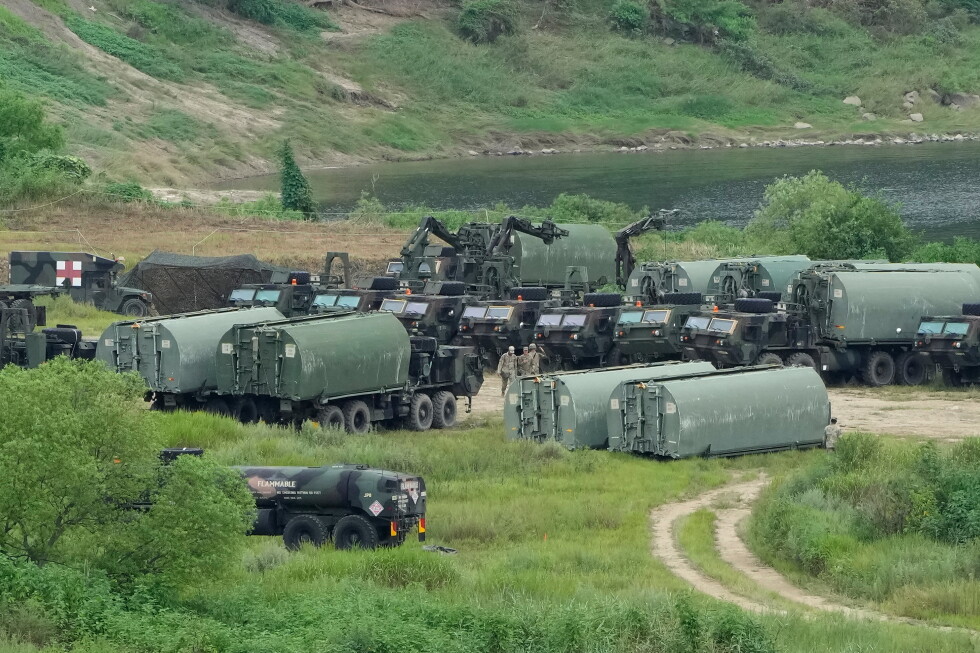
In a sudden, unanticipated announcement that has upended longstanding alliance coordination and rekindled debate over Korean Peninsula security, former U.S. President Donald Trump revealed Monday he had ordered the Pentagon to substantially downscale the annual 11-day Ulchi Freedom Shield joint military exercises with South Korea, which launched earlier that same morning as planned. Citing his positive personal rapport with North Korean leader Kim Jong Un, Trump argued the drills are unnecessarily costly and send an unnecessarily hostile message to Pyongyang, claiming North Korea has remained unthreatening and respectful throughout his tenure in office. The surprise move left many security analysts and South Korean policymakers baffled, particularly at a moment when North Korea has rapidly expanded its nuclear and missile capabilities and deepened strategic military cooperation with Russia amid its war in Ukraine.
South Korea’s liberal presidential administration, led by President Lee Jae Myung, struck a cautiously optimistic tone in response to the announcement, framing the decision as a potential opening for renewed diplomatic engagement between Washington and Pyongyang. Lee’s office said Monday that Seoul hopes the friendly personal relationship between Trump and Kim will pave the way for meaningful dialogue between the two nations, aimed at advancing lasting peace and stability on the Korean Peninsula. The statement added that South Korea would pursue all necessary diplomatic efforts to facilitate such talks, while also noting that Seoul and Washington continue to coordinate closely on joint drill readiness and cooperation to uphold freedom of navigation in the Strait of Hormuz.
This posture aligns with Lee’s broader policy agenda, which has prioritized outreach to North Korea since he took office last year. His administration has already taken concrete steps to de-escalate cross-border tensions, including turning off propaganda loudspeakers along the inter-Korean demilitarized zone that previously broadcast K-pop and international news, and banning South Korean activists from launching anti-Pyongyang propaganda balloons into North Korean territory. Just this past Saturday, Lee publicly offered to hold formal negotiations to end the 1950–1953 Korean War, which concluded with an armistice rather than a permanent peace treaty.
Pyongyang has yet to issue an official response to Trump’s announcement, though it has long condemned all U.S.-South Korea joint military exercises as rehearsals for a planned invasion of the North, and had already threatened unspecified “strong responses” to this year’s drills. Earlier this month, North Korea test-fired two ballistic missiles into the sea in a widely interpreted protest against the exercises, and its Foreign Ministry reiterated last Friday that it would respond to the drills with a new level of strategic deterrence.
Experts warn that despite Trump’s overture, North Korea has little incentive to return to the negotiating table in the near term. Since high-stakes nuclear diplomacy between Kim and Trump collapsed in 2019, Pyongyang has refused all engagement with Seoul and Washington, using the diplomatic stalemate to accelerate nuclear and missile testing, ramp up production of weapons-grade nuclear materials, and strengthen strategic alliances with both Russia and China. In a September 2025 statement, Kim noted he holds positive personal memories of his interactions with Trump, but made clear North Korea will only resume talks if Washington abandons its focus on Pyongyang’s complete denuclearization. Analysts say Kim’s core goal in any future negotiations would be to secure extensive relief from international sanctions in exchange for only limited, incremental steps toward arms control.
Leif-Eric Easley, a professor of international studies at Seoul’s Ewha University, noted that while Trump’s announcement signals clear willingness to reengage with Kim, North Korea is currently focused on advancing its military modernization and benefiting from its alignment with Russia amid the war in Ukraine. Easley added that downsizing the joint exercises carries tangible security risks for the alliance: it can erode joint coordination, slow South Korea’s efforts to take on greater responsibility for its own territorial defense, and weaken deterrence against potential North Korean aggression.
This is not the first time Trump has moved to scale back joint U.S.-South Korea drills. Shortly after his first summit with Kim in 2018, he unilaterally announced a suspension of the annual summertime exercises, calling them unnecessarily provocative and a waste of government funds.
Kim Dong-yub, a professor at Seoul’s University of North Korean Studies, observed that North Korea faces far less pressure to return to negotiations today than it did in 2018, when it first entered diplomatic talks with the U.S. and South Korea. Even so, he predicted Pyongyang is unlikely to completely dismiss Trump’s overture, and will likely acknowledge the announcement while waiting for concrete actions from Washington to prove it is serious about easing hostilities.
The decision has also amplified long-running concerns among South Koreans about the reliability of the U.S. alliance. Trump’s administration has previously prioritized a transactional approach to security, and instigated a trade war with South Korea that has already eroded public trust in Washington. The move also fits a broader pattern of Trump taking positions that favor adversarial leaders at the expense of long-standing U.S. allies, including repeated criticism of NATO allies for what Trump frames as insufficient support for his policy of confronting Iran, even as the alliance works to counter Russian aggression in the Baltic region.