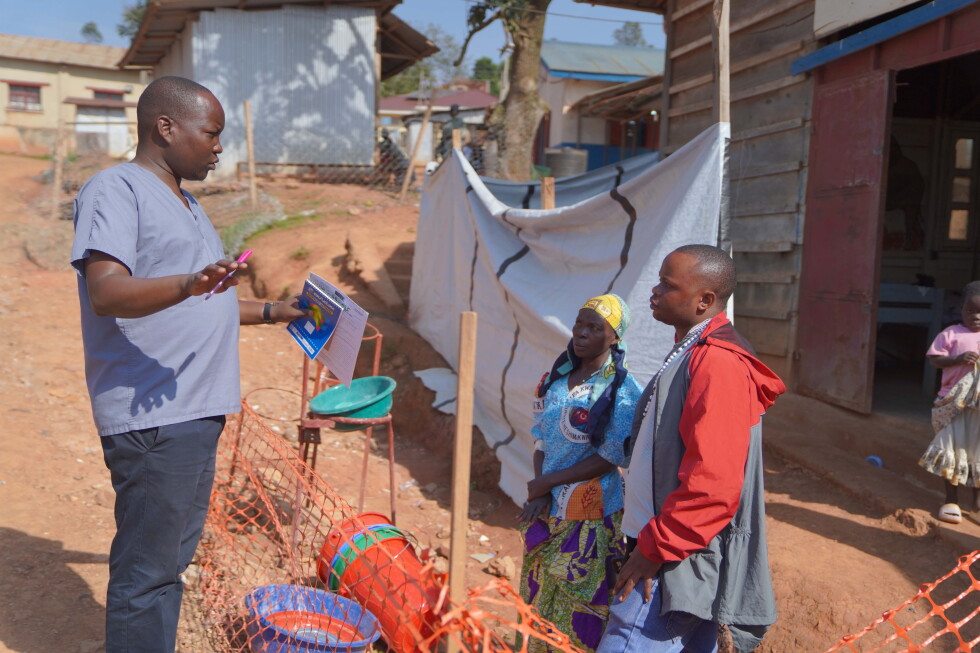
In the conflict-wracked eastern Democratic Republic of the Congo, community health teams led by workers like Gédéon Banga Ngbape wage a daily uphill battle to contain the country’s fastest-growing Ebola outbreak on record. Every dawn, Ngbape and his surveillance crew spread across communities in Nizi, one of the outbreak’s hardest-hit health zones in Ituri province, chasing down alerts of suspected cases, tracking contacts of infected people, and rushing symptomatic residents to care before the virus can jump to new hosts. But this critical frontline work is being undermined by gaps that have left responders racing to catch up to a virus that is already outpacing their efforts.
Latest government data confirms the scale of the crisis: more than 4,700 confirmed cases have been recorded, with over 2,200 deaths. This death toll was accumulated nearly three times faster than the 2014-2016 West African Ebola epidemic, the previous deadliest on record which killed more than 11,000 people over two years. “We are chasing the virus; the virus is ahead of us,” Dr. Mohamed Yakub Janabi, World Health Organization Regional Director for Africa, acknowledged this week, echoing a widespread sentiment among responders.
The most critical flaw in the response lies in the broken surveillance system, the backbone of any successful outbreak containment. Between 60 and 70 percent of new infections are now being detected in people who were never flagged as close contacts of confirmed cases, meaning health workers only identify infections after patients have already circulated in communities and exposed others to the virus. “If surveillance does not work well, the entire response suffers,” Ngbape said. “Surveillance is the engine of a response.”
Frontline workers bear the brunt of these systemic failures, working grueling hours for little pay and lacking even basic protective supplies. Ngbape’s team handles an average of 60 to 70 alerts daily, with shifts that often stretch from 8 a.m. to midnight, followed by additional planning for the next day’s work. “I feel really tired, but what matters to me is always being of service to the community,” Ngbape said.
Community health worker Ana Ndroy Kasime, who conducts door-to-door education and case reporting in Nizi, says teams lack essential protective gear including boots and hospital-grade disinfectant, forcing workers to purchase supplies out of their own meager salaries. Kasime, who earns roughly $50 per month for her high-risk work, calls the compensation totally inadequate for the demands of the job.
Widespread labor unrest has further crippled response efforts. On Thursday, health workers at the Nizi Treatment Center launched a strike and temporarily shut down the facility after going more than three months without pay. Jean Kaseya, head of the Africa Centers for Disease Control and Prevention, called on the Congolese government to immediately disburse back wages, noting funding is already available and paying frontline workers is a core government responsibility. The government has defended the delays, saying it is cleaning up payrolls that were inflated with fake names and transitioning from cash payments to digital mobile money transfers. While community health workers like Kasime have received their salaries, she warns that delayed pay for other response staff puts the entire outbreak response at risk. “They are making sacrifices and taking risks,” she said. “If these workers decide to stop working, the epidemic will spread further into the population.”
Compounding these challenges is the unique danger posed by the current strain of the virus: this outbreak is caused by the rare Bundibugyo Ebola variant, for which no approved vaccines or specific treatments exist, though clinical trials are currently underway. Eastern Congo’s long-running instability also creates insurmountable barriers to contact tracing: dozens of rebel and militia groups, including the Islamic State-linked Allied Democratic Forces, operate across Ituri province, forcing many aid and health workers to flee remote outbreak hotspots for the relative safety of the provincial capital Bunia. As of mid-July, local health authorities have recorded at least a dozen attacks on health facilities and response workers, fueled in part by widespread misinformation claiming Ebola does not exist and anger over public health bans on traditional funeral gatherings, a known driver of Ebola transmission.
Frequent population movement, driven by artisanal mining and people fleeing conflict, also makes it nearly impossible for teams to track exposed contacts before they develop symptoms. Many remote areas are cut off by poorly maintained or impassable roads, and insecurity restricts where responders can safely travel, leaving entire communities without any surveillance coverage. Ngbape notes that cooperation from local residents in Nizi has improved in recent weeks as communities have become more familiar with his team’s work, and widespread concealment of cases is not a major issue in the area. Still, population movement and limited transportation leave many contacts unaccounted for.
Despite exhaustion from endless long hours and constant resource shortages, Ngbape says he has no intention of stepping back. Maintaining surveillance, he argues, is the only way to stop small clusters of infection from growing into large, uncontrolled community transmission. For him, the mission remains clear: “I am here to save the lives of the population.”
In a small bright spot for the response, United Nations humanitarian chief Tom Fletcher announced Friday an additional $30.5 million in emergency funding to scale up Ebola response efforts in the country. The outbreak has already spread to six of Congo’s provinces, according to recent official reports. This reporting was supported by a grant from the Gates Foundation to the Associated Press for global health and development coverage in Africa, with the AP retaining full editorial control over all content.