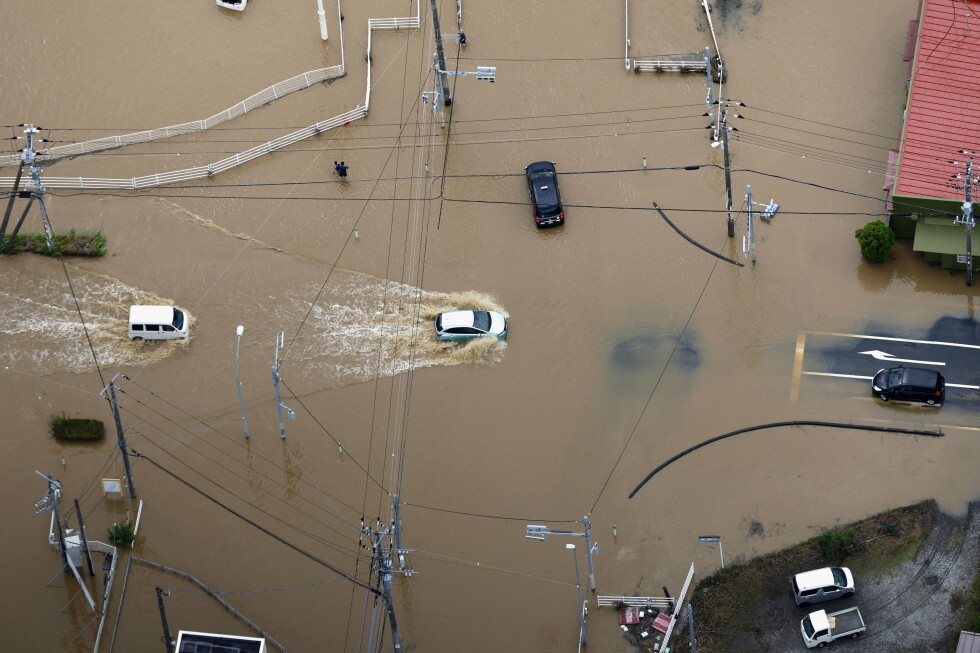
Days after the end of Japan’s annual Bon Buddhist holiday week, devastating record-breaking downpours swept through eastern regions of Tokyo overnight, leaving a trail of destruction across Chiba prefecture that has claimed at least four lives and left one resident unaccounted for. The extreme weather triggered widespread flooding that submerged roads, damaged dozens of residential properties, cut power supplies to tens of thousands of households, and stranded thousands of travelers across the region.
As rain levels began to subside early Friday morning, the Japan Meteorological Agency (JMA) announced it would downgrade its highest-level emergency heavy rain warning for more than 10 municipalities across the prefecture. Even so, forecasters warned of additional precipitation expected later in the day, keeping local disaster response teams on high alert. When dawn broke Friday, aerial footage and on-the-ground reporting revealed the full scale of the damage: muddy floodwaters engulfed ground floors of family homes, swallowed parked vehicles, and submerged sections of regional railway tracks.
In response to the crisis, Japan’s Ground Self-Defense Force launched emergency rescue operations to evacuate stranded residents and travelers. Around 4,000 people who were forced to spend the night at Soga Train Station — a commuter hub that also serves the nearby Tokyo Disney Resort — were picked up by military-arranged buses. Officials confirmed the popular theme park suffered no structural damage or injuries from the flooding. Thousands more holiday travelers were stranded overnight at Narita International Airport, the major air hub serving the Tokyo metropolitan area, after all regional train services out of the affected area were halted. Train operations partially resumed Friday morning, though significant delays continued, while inbound and outbound flights at Narita operated on a normal schedule as travelers headed home following the end of the national holiday week. Hundreds of other residents affected by flooding took emergency shelter overnight at the Chiba prefectural government building.
Prefectural disaster officials confirmed four fatalities linked to the flooding: a man found floating in floodwaters on a road in Ichikawa City, a woman trapped inside a submerged vehicle in Sakura City, and a third person pulled from a flooded car in Kashiwa City who was pronounced dead at the scene. As of Friday morning, one more person remained missing.
Across Chiba, more than 80 residential properties have been fully or partially flooded, and local authorities issued evacuation advisories to nearly 230,000 residents, urging them to move to safer, higher ground. Power outages affected roughly 68,000 households at the peak of the storm, according to TEPCO Power Grid, and that number had dropped to around 23,000 by Friday morning as repair crews worked to restore service.
Meteorological data confirmed the unprecedented intensity of the storm: Chiba City recorded 11.5 centimeters (4.5 inches) of rain in just one hour, while Sakura City hit 9.7 centimeters (3.8 inches) in the same time frame — both new all-time records for the region. “We have recorded rainfall levels that are unprecedented,” JMA forecast official Takuya Hosomi told viewers during a live televised emergency news conference Thursday night.
AP contributes to this report, with additional coverage of Asia-Pacific events available at the AP News Asia-Pacific hub.