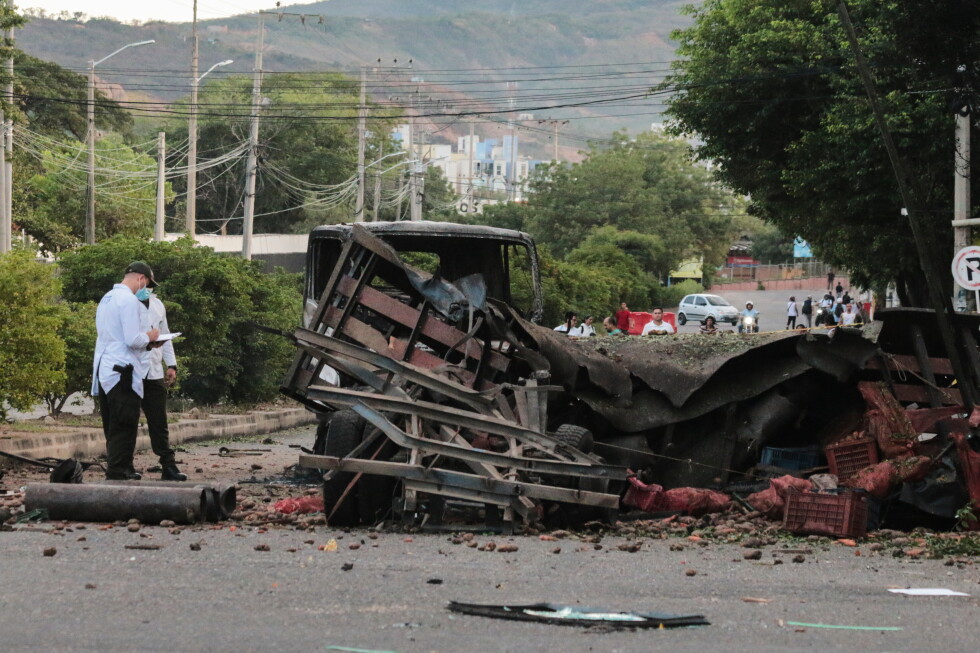
BOGOTÁ, Colombia – A pre-dawn explosive attack targeting a provincial police headquarters along Colombia’s volatile border with Venezuela has left 11 police officers injured and killed a working police dog, with the Colombian government placing blame squarely on the country’s last remaining major insurgent group, the National Liberation Army (ELN).
The blast unfolded Saturday morning in Cúcuta, a strategic border city that has long been a battleground for competing drug trafficking organizations and rebel factions fighting to control lucrative cross-border smuggling corridors. According to General William Rincon, director of the Colombian National Police, the explosive device was hidden in an unoccupied truck parked directly outside the Norte de Santander Provincial Police Headquarters. The powerful detonation destroyed most of the building’s roof and shattered glass across the structure.
Rincon condemned the assault in blunt terms, calling it “a vile terrorist attack” and affirming that law enforcement would not pause operations until all responsible parties are apprehended and held accountable through the judicial system.
Colombian Defense Minister Pedro Sanchez echoed the accusation against the ELN in a post on social platform X, announcing a $60,000 reward for any information that leads to the capture of the bombing’s planners and perpetrators.
The attack comes at a critical political juncture for Colombia, just one week before the inauguration of incoming president Abelardo de la Espriella, an ultra-conservative leader who has campaigned on an explicit promise to end all ongoing peace negotiations with the country’s remaining armed insurgent groups. De la Espriella will be sworn in next Friday in Cali, a city that has also seen recent rebel attacks in recent months.
Founded in the 1960s by a coalition of union leaders, student activists and peasant organizers fighting for structural social change, the ELN has waged a low-intensity insurgency against successive Colombian governments for nearly 60 years. Today, Colombian authorities estimate the group has roughly 6,000 active fighters operating across Colombia and in neighboring Venezuela, and has evolved far from its founding ideological roots. Outgoing President Gustavo Petro, a left-wing leader who made peace talks a core priority of his administration, has repeatedly accused ELN leadership of operating as “drug lords dressed up as guerrilla fighters,” as the group now derives most of its revenue from illegal activities including unregulated gold mining and cocaine trafficking.
Petro, who was elected in 2022, centered his security strategy on a policy called Total Peace, which launched parallel negotiation processes with multiple armed groups across the country. Talks with the ELN collapsed early last year, however, after the group launched a series of attacks in rural areas north of Cúcuta that killed an estimated 78 people and forced more than 56,000 residents to flee their homes.
Critics of Petro’s peace strategy argue that ceasefires granted to armed groups during negotiations allowed many factions to regroup, rearm, and expand their control over illegal smuggling routes and rural territories. The current security landscape was shaped in part by the 2016 peace deal between the Colombian government and the Revolutionary Armed Forces of Colombia (FARC), which led to the disarmament of more than 13,000 FARC guerrillas. While the deal ended decades of large-scale conflict, it also left a power vacuum in many remote rural regions that smaller groups including the ELN have moved aggressively to fill.
De la Espriella, the incoming president, has already laid out a starkly different approach to the ELN and other criminal groups, promising a massive increase in military pressure to counter insurgent activity. He has also pledged to resume the controversial aerial fumigation of coca crops, the raw material used to produce cocaine, a policy that was paused under Petro’s administration out of concern for environmental and public health impacts.