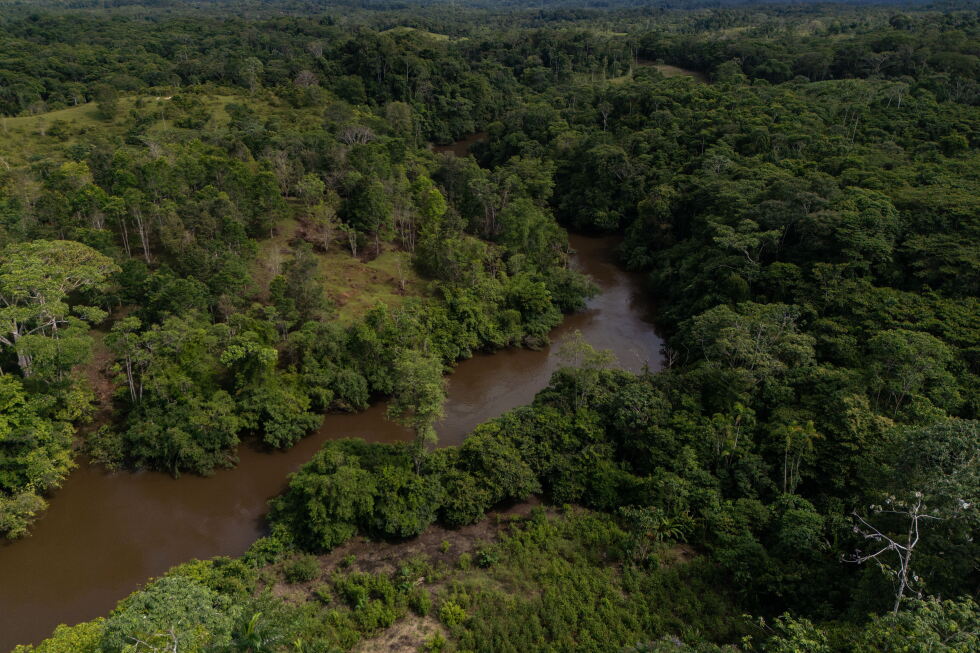
BOGOTA, COLOMBIA — As the administration of Colombian President Gustavo Petro prepares to hand over power to a new government next week, the country’s top environmental and climate agencies have released long-awaited 2025 nationwide deforestation data that paints a mixed picture of progress on the president’s signature Amazon conservation agenda.
Data released late Friday by the Colombian Environment Ministry and the Institute of Hydrology, Meteorology and Environmental Studies (IDEAM) shows the country lost 119,483 hectares (roughly 295,000 acres) of forest cover in 2025 — an area roughly equal to the entire land area of the city of Los Angeles. This marks a 5% uptick in deforestation compared to 2024 levels.
Despite the small annual increase, the outgoing administration has highlighted that it still far outpaced its four-year national deforestation reduction goal. Compared to the 2021 baseline year when Petro took office, total annual forest loss is down 31% — exceeding the administration’s target of cutting deforestation by at least 20% from 2021 levels.
The new numbers, however, also underline a persistent challenge: after achieving dramatic, record-breaking reductions in deforestation in 2023, the country has struggled to maintain those gains. Forest loss rose 43% in 2024, erasing much of the prior year’s progress, and while the pace of growth slowed sharply in 2025, total deforestation remains well above the historic low recorded two years ago.
Pressure on the Colombian Amazon, which holds more than 60% of the country’s total forest cover, has stayed largely unchanged. More than 65% of all 2025 forest loss occurred in the Amazon biome, with 77,805 hectares cleared this year — only a marginal 681-hectare increase from 2024. Government monitors identified 10 active deforestation hot spots concentrated in the northwestern Amazon, clustered in the country’s long-troubled “arc of deforestation” — a swathe of remote rainforest that saw a surge in illegal activity after the 2016 peace deal with the FARC guerrilla group left a power vacuum in isolated border regions. The municipalities with the highest deforestation rates in 2025 were Cartagena del Chaira in Caquetá, Mapiripán in Meta, San Vicente del Caguán in Caquetá, and Calamar in Guaviare — all located within this high-risk zone, where illegal land grabbing, unregulated cattle ranching, and informal infrastructure expansion have remained the primary drivers of forest clearing.
On a more positive note, the data shows deforestation inside Colombia’s protected national parks fell nearly 19% year-over-year, dropping to 9,388 hectares. Officials credited this progress to community-focused conservation programs that pay local residents to protect forest cover, large-scale landscape restoration projects, and the country’s first forestry concession, which grants rural communities long-term legal rights to sustainably manage public forest lands.
Outgoing Environment Minister Irene Vélez framed the 2025 results as a product of shifted policy approaches, including closer collaboration with rural communities, expanded financial incentives for conservation, and a move away from past policies that criminalized small-scale farmers. She also highlighted a recent high-impact investigation in Mapiripán that led to the arrest of 17 people linked to a criminal network engaged in illegal land grabbing, deforestation, and unregulated cattle ranching. Officials reiterated that the core drivers of national deforestation remain illegal land seizure, expansion of extensive cattle ranching, and unplanned road construction — not coca cultivation, which has long been the focus of Colombia’s national anti-drug strategies.
Petro made protecting the Amazon a central pillar of his presidential environmental agenda, and his administration passed a landmark cattle traceability law designed to block beef produced on illegally cleared forest land from entering domestic and global supply chains.
The release of the 2025 data followed weeks of public criticism from incoming Environment Minister Fabio Arjona, who accused the outgoing Petro administration of deliberately delaying publication on the social platform X, claiming the government hid the numbers because it knew the “scenario is tragic.”
The newly released figures set a clear benchmark for the incoming administration of President-elect Abelardo de la Espriella, who has already announced plans to expand oil and mining development across the country and review many of Petro’s signature environmental policies.