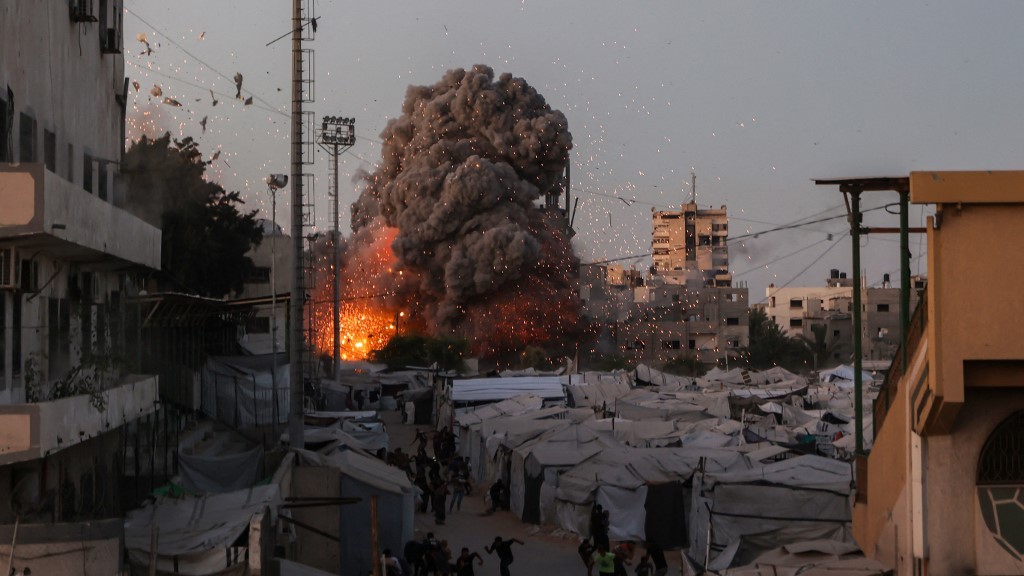
More than 10 months into Israel’s military campaign in Gaza, the country continues to expand its control beyond agreed-upon boundaries, pushing its so-called ‘yellow line’ security boundary deeper into the besieged enclave, forcing hundreds of thousands of displaced Palestinian civilians into an ever-shrinking, overcrowded territory and tightening a crippling months-long siege.
According to on-the-ground reporting from the BBC, residents of the al-Tuffah neighborhood in northern Gaza woke on Monday to find Israeli forces had moved concrete boundary markers westward, deep into Salah al-Din Road — Gaza’s primary north-south transportation artery. Near the repositioned markers, an Israeli flag was raised over a three-meter-high earthen and sand barrier constructed inside the agreed-upon line.
High-resolution satellite imagery has captured the full scale of the new walled enclosures Israel has built across large swathes of the Palestinian territory, confirming months of consistent reports from Gaza residents that Israeli forces are expelling them from their lands and blocking any return with towering earthen barriers.
The creeping expansion of Israeli control has already forced repeated displacement for Palestinian families who already lost their homes to earlier military operations. On Sunday, just one day before the al-Tuffah marker displacement, multiple families whose original homes were destroyed in earlier Israeli strikes were forced to flee again after the Israeli military issued a new attack warning for the area where they had set up makeshift tent shelters. A subsequent Israeli strike destroyed the tent that had become their only source of shelter.
This unilateral expansion of Israeli control directly violates the terms of the October 2024 ceasefire agreement brokered by the United States between Israel and Hamas. Under that deal, Israel was required to withdraw its forces to the original yellow line, while retaining temporary control over 53 percent of Gaza’s total territory.
However, Israeli Prime Minister Benjamin Netanyahu — who currently faces an International Criminal Court arrest warrant for alleged war crimes and crimes against humanity committed in Gaza — has confirmed that Israeli military forces now control more than 60 percent of the enclave. Back in May, Netanyahu stated that his official directive was to expand Israeli control to 70 percent of Gaza by pushing the yellow line further inward.
Official data from Palestinian medical sources puts the total death toll from Israel’s military campaign in Gaza at 73,335 as of recent counts, with at least 174,052 Palestinians wounded since the campaign began on October 7, 2023. Even after the current ceasefire took effect on October 11, 2024, Israeli attacks have killed 1,209 more Palestinians and wounded another 3,943, while rescue teams have recovered 803 additional bodies from destroyed areas.
Since the ceasefire agreement was signed, Israel has constructed more than 42 kilometers of new barriers stretching across roughly 85 percent of the original agreed yellow line. The new fortifications, military outposts and extended earthen embankments signal a long-term Israeli occupation of newly seized territory, while effectively redrawing Gaza’s internal boundaries to shrink the area open to Palestinian civilian residence.
Near al-Mawasi, one barrier extends more than 1.5 kilometers past the boundary line mapped out in the ceasefire agreement. A second barrier in Khan Younis extends more than 500 meters past the agreed line.
This steady advance of the boundary has repeatedly forced Palestinian civilians to abandon new makeshift shelters. On July 18, dozens of families fled the Zeitoun neighborhood after Israel issued a mandatory evacuation order. Witnesses on the ground reported direct gunfire from Israeli military vehicles and drones, as well as heavy artillery strikes on the area. The United Nations’ humanitarian office confirmed that roughly 30 families lost their makeshift tent shelters in the incursion.
Satellite imagery also confirms that Israel has cleared and leveled large swathes of farmland east of Deir el-Balah after giving local Palestinian families just 48 hours to evacuate the area. Israeli forces destroyed all existing civilian structures and uprooted a mature olive grove located more than 500 meters past the original agreed yellow line before installing new, shifted concrete boundary markers in the area.
In Rafah and Khan Younis, Israeli crews have demolished existing residential homes and commercial greenhouses to clear paths for new barrier construction. Satellite data shows that dozens of additional civilian structures were destroyed across Gaza during the month of July alone, including in the densely populated areas of Jabalia, Beit Lahiya, Zeitoun and Deir el-Balah.
Israel has also established 14 entirely new military positions along the expanded yellow line since October 2024, and has expanded the footprint of several older existing military outposts in newly seized areas.
Analysts note that this incremental annexation of Gaza territory has re-purposed the yellow line into a tool of siege, allowing Israel to seize increasing amounts of Palestinian land while forcing the enclave’s population of more than two million into a drastically reduced overcrowded area where access to basic necessities including shelter, food, clean water and medical care remains critically scarce.