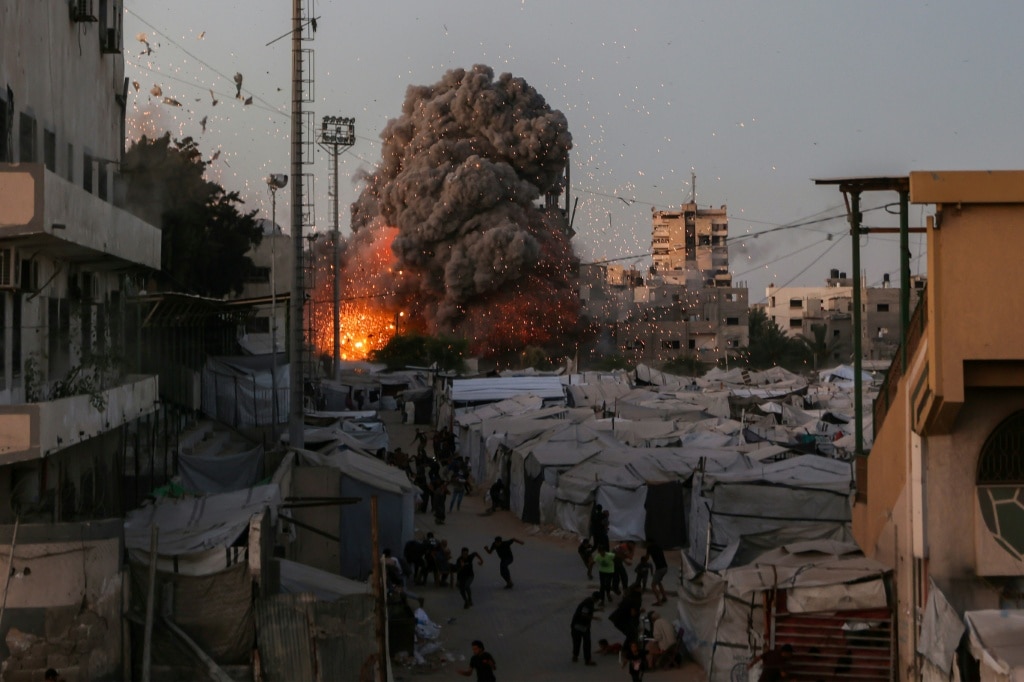
One of the most intractable obstacles to advancing the Gaza ceasefire that has been in place since October has been Hamas’s disarmament — a requirement that has stymied progress for months. On Friday, the Palestinian militant group announced a breakthrough agreement that would see it hand over all its weapons to a newly established Palestinian governing body, paired with a phased withdrawal of Israeli military forces from the Gaza Strip.
The deal forms the framework to advance the long-stalled second phase of the ceasefire brokered by former U.S. President Donald Trump, who celebrated the development on Thursday. In his remarks, Trump called Hamas’s commitment to complete disarmament a transformative and major milestone for Middle East peace. On Friday, during a press gathering at Camp David, Trump maintained that Israel fully supported the arrangement, telling reporters “We do have an understanding with Israel. Israel’s very happy about it.”
That claim, however, has been met with immediate pushback from Israeli officials, who have yet to release an official public statement on the announcement. An anonymous Israeli political source told Agence France-Presse that Israeli forces would not pull back from their current front lines under any circumstances unless Hamas carries out a full, verifiable disarmament — a condition the source emphasized remains non-negotiable. The disagreement deepened with opposition from far-right National Security Minister Itamar Ben Gvir, who denounced the deal as completely unacceptable, arguing it amounted to permitting Hamas to regroup and prepare for future deadly attacks against Israel. The source also added that the Gaza agreement was not raised at all during this week’s White House meeting between Trump and Israeli Prime Minister Benjamin Netanyahu, contradicting Trump’s assertion of Israeli backing.
For their part, Hamas leaders frame the agreement as a compromise made in service of the civilian population of Gaza, which has faced widespread humanitarian catastrophe after months of conflict. Ghazi Hamad, a senior member of Hamas’s negotiating delegation, clarified that Israel would have no role in overseeing the disarmament process. That responsibility, he said, falls exclusively to the National Committee for Administration of Gaza (NCAG), the governing body created under Trump’s peace plan to manage daily civilian and security affairs in the territory.
Hamas also noted that it expects international mediators and Trump’s specially convened Board of Peace to hold Israel accountable for complying with the deal’s terms, including its commitment to a phased military withdrawal. Israel has for months insisted that full disarmament of Hamas is an non-negotiable precondition for any military pullback, a position Israeli officials reaffirmed ahead of Friday’s announcement.
Even with the October ceasefire formally in place, sporadic violence has continued to claim lives in Gaza. On Thursday alone, Israeli airstrikes killed at least four Palestinians, two of them children, according to local Gaza health officials. The new deal requires an immediate full halt to all military operations across the territory, and mandates the deployment of an international stabilization force to create a buffer between remaining Israeli troops and areas under NCAG control.
The Board of Peace formally confirmed the agreement in a post on social media platform X, noting that Hamas had approved a detailed roadmap for advancing the next phases of the ceasefire process. “Our focus now turns to implementation,” the organization stated, adding that the NCAG will soon begin a phased transition to full governing authority over Gaza, with responsibility for internal security falling to the new body.
Nickolay Mladenov, the Board of Peace’s high representative for Gaza, noted that the agreement came after months of grueling, high-stakes negotiations. “What happens next matters even more. Implementation and verification have to be real,” Mladenov wrote on X, adding that “Withdrawal must move in lockstep with decommissioning.”
International reactions to the deal have been largely cautiously optimistic. European Union foreign policy chief Kaja Kallas welcomed the breakthrough, but warned that “a lot needs to fall in place for this to work.” United Nations Secretary-General António Guterres called the agreement a rare positive development amid ongoing regional tensions and spillover from the Gaza conflict, noting “The only good news in recent days is the announcement by the US president of an agreement for Hamas to relinquish their weapons and for Israel to withdraw its forces from Gaza.”
Egypt, one of the key mediators alongside the U.S., Qatar and Turkey, will host an upcoming meeting of negotiating parties to work out implementation details, Egyptian state-aligned Al-Qahera News reported Friday. An anonymous diplomatic source briefed on the roadmap described it as “a balanced and pragmatic path forward, with all weapons decommissioned and a phased transition of responsibilities” to the new governing authorities. The source emphasized that there would be “no exceptions for certain weapons or certain people,” laying out clear terms for the NCAG to take control of and secure all of Hamas’s heavy weaponry, weapons production facilities, storage depots and cross-border attack tunnels, with a new independent compliance verification mechanism put in place to monitor progress.