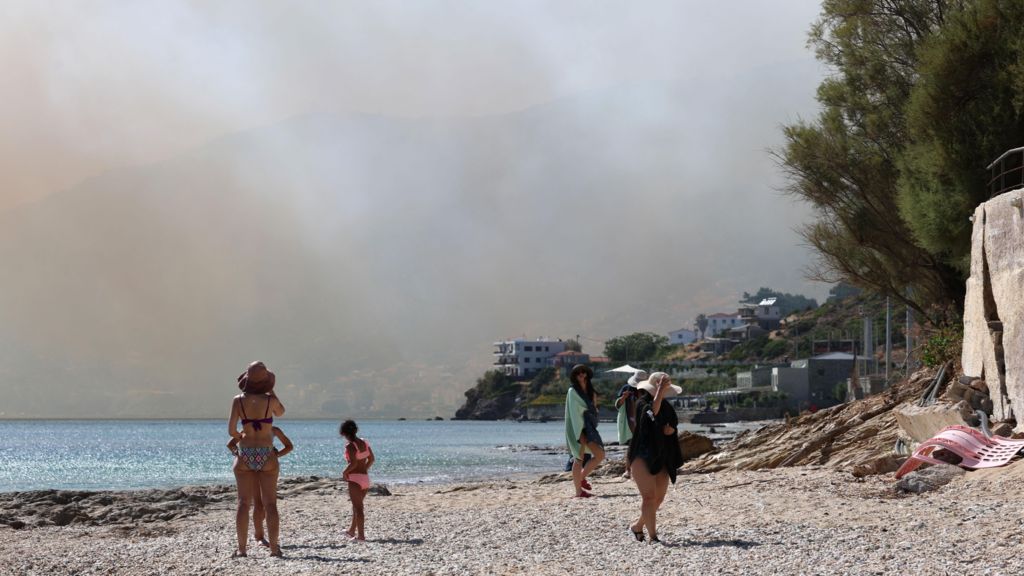
A devastating wave of wildfires fanned by hurricane-force winds has torn through Southern Europe, leaving three firefighters dead and forcing mass evacuations across multiple countries, with the popular Greek tourist island of Crete among the hardest-hit regions.
On the Greek island of Crete, roughly 8,000 residents and tourists were evacuated overnight from the Rethymno region, where an out-of-control wildfire that ignited Wednesday has expanded to a 15-kilometer active front. Wind gusts in the area have peaked at 125 kilometers per hour, reaching level 11 on the Beaufort scale, classified as violent wind. These extreme conditions have hampered suppression efforts, grounding aerial firefighting aircraft on Thursday morning and preventing crews from gaining the upper hand.
The disaster has already claimed three lives: two Crete-based firefighters, 58-year-old Emmanouil Stratidakis and 25-year-old Pantelis Diamantakis, who became trapped and died near Krya Vrysi, and a third firefighter killed near the Peloponnese port of Gytheio. The Greek Fire Service has issued official condolences, and the two fallen Crete firefighters are scheduled for burial Thursday.
As of Thursday, the full scale of property damage remains unconfirmed, though multiple residential structures and large swathes of agricultural land have already been destroyed by the blaze. Roughly 224 firefighters, supported by 53 ground engines, 11 specialized response units and two aircraft, have been deployed to contain the Rethymno fire. Evacuated civilians have been relocated to temporary emergency shelters in neighboring municipalities, with dedicated provisions arranged for visiting tourists who make up a large share of Crete’s mid-summer population.
Crete’s wildfire crisis is part of a broader outbreak of extreme heat and wildfire activity across the European continent, driven by long-term warming that has made the region the fastest-warming continent on Earth, according to data from the Copernicus Climate Change Service. Europe has warmed twice as fast as the global average, fueling more frequent, intense heatwaves, severe drought conditions, and catastrophic wildfire seasons.
The crisis extends far beyond Greece. In Spain, 600 people have been evacuated from a wildfire burning near the Portuguese border in Zamora, while a separate blaze in Ávila province has burned more than 43,000 hectares over the past week, making it the largest recorded wildfire in Spanish history. Fires near Madrid have stopped spreading, allowing thousands of displaced residents to return to their homes. Neighboring Portugal has reported five injuries from a fire in the eastern town of Valpaços.
In Turkey, hundreds of homeowners have been evacuated as wildfires spread across the region, but authorities report most blazes there have now been brought under control. In France, the country’s largest wildfire since 1949, which has destroyed 42,000 hectares of land in the Gironde region, has not spread for three consecutive days. Cooler temperatures and forecast rain for Thursday are expected to further help suppression efforts, though several southeastern French regions have been placed under orange heatwave alerts starting at midday local time.
Meteorological forecasts warn that the high-risk fire conditions currently concentrated in Southern Europe will shift toward central Europe over the coming week, with Greece and Turkey expected to remain among the most severely impacted regions.