Two days after a powerful 7.1-magnitude tremor rocked Japan’s southwestern Kyushu island, disaster response authorities warned Thursday that as many as 23 people may have lost their lives to the disaster. As rescue teams continue combing through the flattened rubble of a destroyed shopping mall for trapped survivors, four bodies have already been recovered from the wreckage, where a massive suspected gas explosion tore through the structure shortly after the initial quake.
According to the latest official update from Kumamoto’s disaster management office, 17 people have already been confirmed dead, with an additional six showing no vital signs. Five more people remain in critical condition across the affected region.
Hundreds of rescue workers spent a second consecutive day Thursday working to reach potential survivors trapped under the debris of the Aeon shopping mall, located in the city of Kashima, Kumamoto Prefecture. A disaster management official confirmed to Agence France-Presse that 10 people have been pulled from the mall so far: four confirmed dead, one with no vital signs, and five others with injuries ranging from severe to minor.
The 7.1-magnitude quake, which struck Tuesday, left a trail of widespread destruction across Kyushu: dozens of residential structures have been flattened, critical transport infrastructure including bridges sustained heavy damage, multiple fires were triggered by shifting ground, and tens of thousands of local residents have been cut off from power and clean water supplies. A 35C heatwave forecast for Thursday has prompted official heatstroke warnings, and repeated aftershocks have compounded the fear and disruption for already displaced local communities.
Though the mall was evacuated immediately after the initial earthquake, a massive explosion gutted the entire building roughly 50 minutes later, when an unknown number of employees were still inside the facility. For 56-year-old local resident Fumihiko Matsuura, the destruction hits close to home — he had watched the latest *Toy Story* film at the mall just one week before the disaster. “I was here. I was just here,” he told AFP. “It’s like I narrowly escaped the danger.”
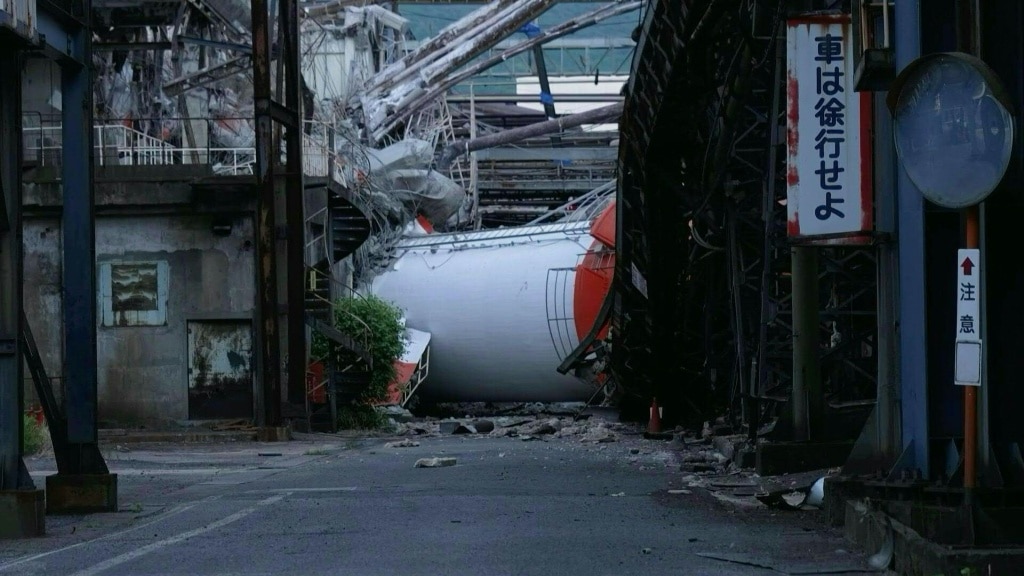
Drone and on-site footage captured by news outlets shows rescue crews in orange overalls and white helmets navigating a chaotic landscape of twisted steel framing, dangling electrical cables and fallen chunks of concrete ceiling to search for signs of life. Separate damage at a Nippon Paper Industries factory in Yatsushiro City has added to the death toll: a government official confirmed Wednesday that five people were killed at the site when a large red-and-white smokestack collapsed, with four more still unaccounted for.
As of Thursday morning, more than 22,600 households and public facilities remain without electricity. Water service disruptions were still affecting roughly 84,000 homes as of Wednesday, and broadcast footage has shown local residents queuing for hours to access emergency supplies of bottled drinking water and petrol.
Notably, the U.S. Geological Survey recorded the quake’s magnitude at 6.8, a lower reading than the 7.1 magnitude officially reported by Japanese seismic monitoring agencies.
Japan sits at the intersection of four major tectonic plates along the Pacific Ocean’s geologically active “Ring of Fire, making it one of the most seismically active countries on Earth. The country of 125 million people experiences roughly 10 percent of the world’s total seismic activity every year, with hundreds of small to medium tremors recorded annually. While most quakes are mild, the risk of catastrophic large events remains a persistent national threat. Kumamoto Prefecture itself experienced two devastating major earthquakes in 2016 that killed 273 people and injured more than 2,800. The worst modern disaster in Japanese memory remains the 9.0-magnitude undersea quake of 2011, which triggered a massive tsunami that killed or left missing nearly 18,500 people and caused the catastrophic meltdown of the Fukushima Daiichi nuclear power plant.