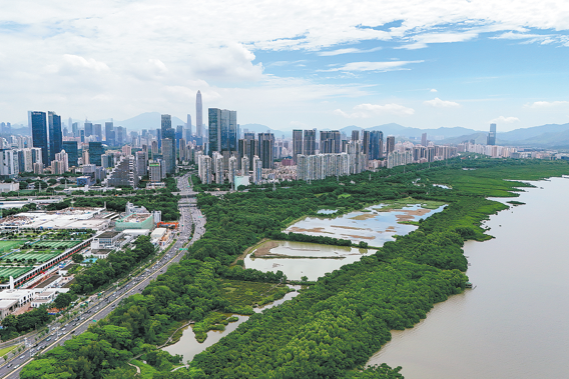
Nestled along the shores of Shenzhen Bay, between one of China’s most densely urbanized regions and a critical migratory bird corridor, the Futian Mangrove Wetland stands as a groundbreaking model of how thriving megacities can coexist with fragile coastal ecosystems. Facing Hong Kong’s Mai Po Nature Reserve across the narrow bay, this urban wetland has evolved into both a national showcase of ecological restoration and a global hub for cross-border cooperation on mangrove protection.
As part of the Guangdong Neilingding-Futian National Nature Reserve, first established in 1984 and granted national-level status four years later, the 367.64-hectare site holds the distinction of being China’s only national-level mangrove reserve located within a major city’s core urban zone. It was officially designated a Wetland of International Importance under the Ramsar Convention in 2022.
Today, the reserve hosts 20 distinct mangrove species across 9 plant families and provides critical habitat for 273 recorded bird species. The 2026 global synchronized census of waterbirds counted 341 endangered black-faced spoonbills in the greater Shenzhen Bay area (including adjacent Hong Kong waters), accounting for approximately 4.4% of the species’ entire global population.
This conservation success story was not a given. Decades ago, the site faced a major threat when the planned Binhai Avenue was originally routed straight through the reserve’s core protected zone. In a landmark decision that prioritized ecological protection over rapid infrastructure development, city authorities shifted the highway alignment 200 meters north to avoid damaging the wetland. That choice kicked off a decades-long series of targeted protections: a 500-meter noise barrier to reduce disturbance to roosting birds, strict height limits for new development surrounding the reserve, a full fishing ban across Shenzhen Bay implemented in 2014, and China’s first bird-friendly urban planning standard released by the city in 2025.
This local progress aligns with national efforts to reverse decades of mangrove loss across China’s coastlines. The country has enacted a national Wetland Protection Law, launched sustained national campaigns for wetland conservation, large-scale mangrove restoration, and control of the invasive smooth cordgrass (Spartina alterniflora) that outcompetes native mangrove species. During the 14th Five-Year Plan period (2021-2025), China exceeded its restoration target ahead of schedule, planting 9,200 hectares of new mangroves and bringing the country’s total national mangrove area to approximately 30,300 hectares.
Shenzhen has expanded this domestic progress to a global stage through the International Mangrove Center (IMC), an initiative first proposed by China at the 14th Meeting of the Conference of the Contracting Parties to the Ramsar Convention on Wetlands in November 2022. As of June 2026, Myanmar became the 21st signatory to the IMC establishment agreement, according to the center’s interim secretariat.
Since 2024, the IMC has organized six international training workshops, bringing together 137 delegates from 30 countries around the world. Each two-week workshop combines classroom lectures, peer discussion panels, and hands-on field visits to the Futian reserve, with participants drawn from government environment agencies, intergovernmental organizations, research institutions, and protected area management teams. Workshop topics cover a full spectrum of mangrove protection priorities: national policy frameworks, ecological restoration techniques, blue carbon accounting, community co-management of coastal resources, and transboundary conservation cooperation. In June 2026, a regional workshop for Asia-Pacific economies hosted 24 delegates from 10 economies, alongside partners from the East Asian-Australasian Flyway Partnership and the Ramsar Regional Center — East Asia.
Based on input from participating member states and workshop attendees, the IMC is currently developing two key global resources: a comprehensive Global Mangrove Status and Key Issues Report, and open-access mangrove conservation datasets for all signatory countries. The center is also conducting research on blue carbon policy frameworks, market-based conservation mechanisms, and best practices for governance, local community engagement, and sustainable conservation financing.
The Futian reserve provides a real-world case study for these global exchanges to draw on. To date, Shenzhen has invested more than 300 million yuan ($44.2 million) into estuary and coastal mangrove restoration, traditional fishpond rehabilitation, and improved habitat management across the Shenzhen Bay region. These investments have covered 220 hectares of coastal land, including more than 30 hectares of new mangrove planting.
Since 2016, the reserve has transformed nearly 40 hectares of abandoned tidal shrimp ponds into high-quality waterbird habitat. Restoration work included clearing invasive reeds and overgrown vegetation, reconnecting historic tidal waterways, creating new intertidal mudflats, and constructing circular deep-water zones that serve as safe roosting spots during high tide. The results speak for themselves: the number of black-faced spoonbills roosting overnight in the restored Futian fishponds now exceeds 150, hitting a record high in recent years. Across the entire Shenzhen Bay area, counted numbers of the endangered species have surged from just 82 individuals in 1994 to 328 in 2025.
Modern digital technology has further refined the reserve’s management practices. Since 2020, the reserve has installed 27 high-definition video monitoring systems and 50 infrared trail cameras. Integrated with AI-powered bird species identification, automatic image sorting, and intelligent sluice gate management, the system allows reserve managers to adjust water levels in real time and continuously track bird population and activity patterns without disturbing wildlife.
Shenzhen has also pioneered new market-based mechanisms to fund conservation and connect mangrove protection to broader ecological value. In September 2023, China held its first ever auction of mangrove conservation carbon credits in the city, with credits selling for 485 yuan per metric ton; all proceeds from the auction are earmarked for future mangrove restoration projects. Public engagement has also been a core priority: by the end of 2025, nature education programs based at the Futian reserve had attracted more than 1 million students from over 300 schools across the country.
As coastal communities around the world face intensifying storm damage, accelerating habitat loss, and growing pressure on fisheries, mangroves are increasingly recognized as natural, cost-effective infrastructure that mitigates climate impacts while supporting biodiversity. China’s experience, from the innovative urban mangrove management model at Futian to the global knowledge sharing and capacity building work of the IMC, demonstrates that effective mangrove conservation succeeds when it integrates legal protection, scientific research, digital monitoring, public education, market-based blue carbon mechanisms, local livelihood support, and cross-border international cooperation as interconnected components of a single holistic system.