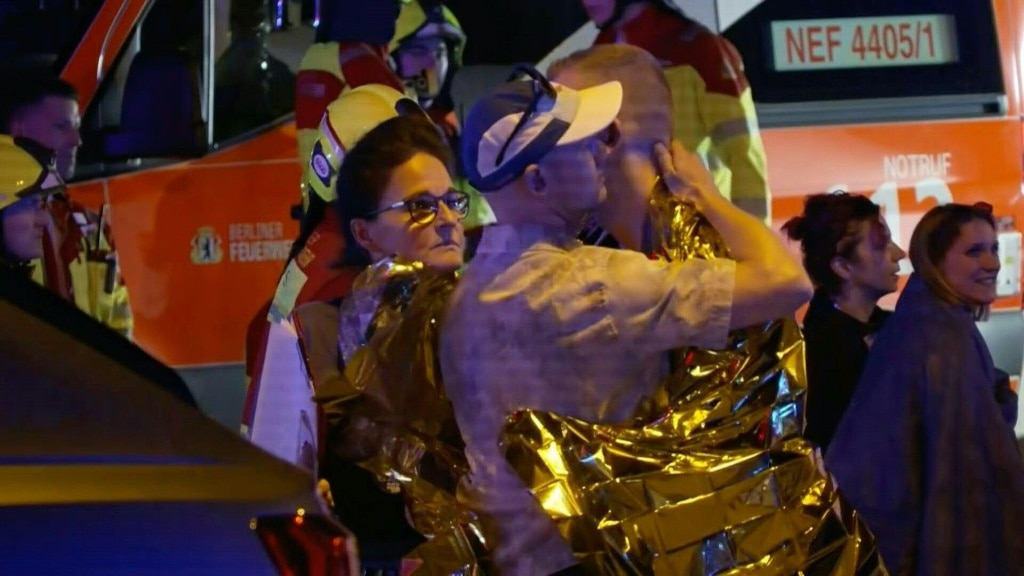
On the evening of Saturday, a devastating vehicle attack cut short a massive annual LGBTQ+ Pride celebration in central Berlin, leaving one person dead and 16 others wounded, three of them in critical condition. As many as 30 additional attendees also required on-site medical treatment for acute shock following the incident, which unfolded shortly before 10 p.m. local time near the heart of Christopher Street Day, one of the largest Pride gatherings in Europe that drew hundreds of thousands of peaceful revelers.
According to German law enforcement officials, a vehicle matching the description of the attacker’s — described as a small minivan or compact SUV — was later found abandoned just a few hundred meters from the attack site in Berlin’s sprawling Tiergarten park. By Sunday morning, a large-scale city-wide manhunt was already in full swing, involving helicopter units equipped with thermal imaging technology and law enforcement officers drawn from multiple German states to expand the search operation.
Police spokesperson Florian Nath confirmed Sunday that investigators have formally identified a prime suspect, who authorities believe has documented connections to Islamist extremist circles. As of Sunday evening, the suspect remained at large, with the search extended across the entire German capital.
Eyewitnesses on the ground described a sudden and chaotic end to the day-long celebration, which had wrapped up its main parade near the iconic Brandenburg Gate just hours earlier. Moments after the vehicle plowed into a crowd of pedestrians in the park, uniformed officers immediately ordered all attendees to evacuate, with emergency responders rushing in to triage and treat wounded victims. AFP reporters at the scene documented dozens of emergency vehicles lined along adjacent roads, with investigators setting up a large command tent as they combed the park for evidence.
The deadly attack has quickly reignited public debate over public space security in Germany, which has faced a string of high-profile violent assaults in public gathering spots in recent years. The incident comes just months after a fatal car ramming attack at a Magdeburg Christmas market in December 2024, where a Saudi anti-Islam extremist killed six people and injured more than 300. In February 2025, a stabbing attack just a short distance from Saturday’s attack site at Berlin’s Holocaust Memorial left a Spanish tourist seriously wounded; the perpetrator, a Syrian man, was sentenced to 13 years in prison in March after a court confirmed he acted on behalf of the Islamic State group. The deadliest such attack in recent German history remains the 2016 truck rampage at a Berlin Christmas market that left 12 people dead.
German Chancellor Friedrich Merz issued a swift condemnation of what he called a “horrific act,” confirming that he and Interior Minister Alexander Dobrindt are receiving regular updates on the investigation. Merz vowed that the perpetrator would be brought to full justice under German law. Berlin Mayor Kai Wegner, who joined Merz in condemning the attack, called it a brutal assault on a gathering that stood for tolerance and peace in the German capital.
More than 2,000 police officers had already been deployed to provide security for the Christopher Street Day event before the attack. Following the incident, additional law enforcement resources from across the country were mobilized to support the manhunt.
The attack comes just two months ahead of Berlin’s scheduled state assembly election, a closely watched race that has already shaped up as a tight contest. Both Merz and Wegner belong to the centre-right Christian Democratic Union (CDU), which polling indicates faces significant challenges from the far-right Alternative for Germany (AfD) and the far-left Linke party. Wegner announced earlier this month that he would not seek re-election, following months of public criticism over his administration’s response to a major January blackout that authorities believe was caused by sabotage.