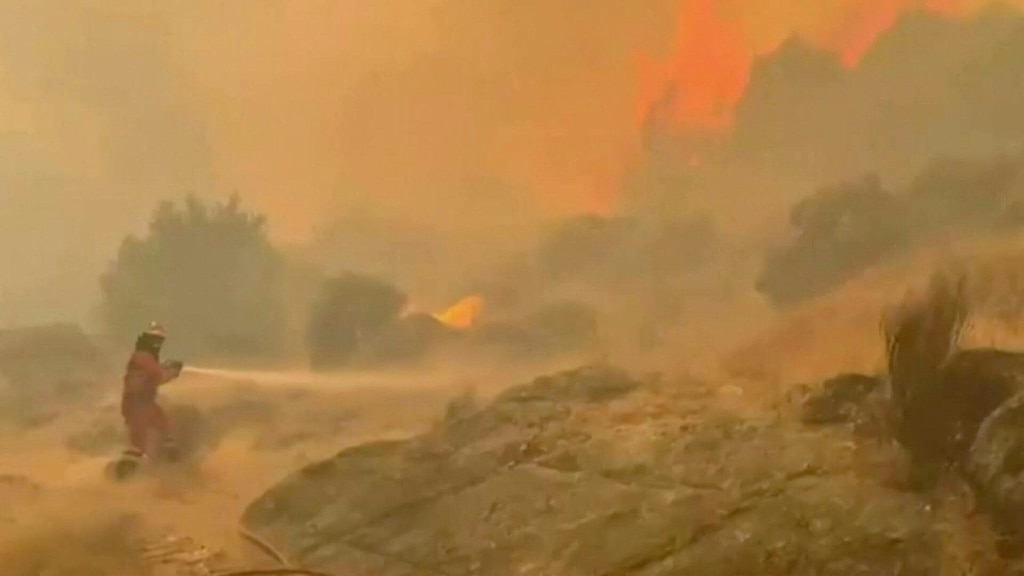
In a devastating outbreak of climate-fueled wildfires that has become one of the most extreme weather emergencies Western Europe has faced in modern history, more than 160,000 people have been displaced across France and Spain, with emergency crews stretched to breaking point and military forces deployed to battle the raging infernos.
The crisis unfolded over three days of relentless burning, with large blazes breaking out simultaneously near Bordeaux in southwestern France and on the outskirts of Madrid, Spain. By Saturday, the scale of displacement had reached staggering levels: 141,000 residents and tourists were evacuated from fire zones in France, while 25,000 more fled the Madrid region, with an additional 39,000 people ordered to shelter in place to avoid toxic smoke. The smoke from the Madrid wildfires drifted as far as the city’s center by early Saturday, a stark reminder of how close the disaster has come to one of Europe’s major capital cities.
The fires have been amplified by exceptionally dry conditions, created by a string of record-breaking heatwaves that have parched forests across the Iberian Peninsula and southern France since May. Climate scientists have repeatedly warned that rising global temperatures are increasing the frequency and severity of droughts and extreme weather events, creating the tinder-dry conditions that allow wildfires to grow rapidly out of control.
In France, officials have described the Bordeaux-region blaze as the largest wildfire the nation has ever recorded. French President Emmanuel Macron ordered military intervention on Friday, and Prime Minister Sébastien Lecornu later announced that 1,000 military personnel would be deployed to support overstretched firefighters who have been working around the clock to contain the flames. To date, the fire has destroyed more than 22,000 hectares of land – an area roughly twice the size of the city of Paris. Authorities also arranged for 1.5 million protective face masks to be delivered to the Gironde department to protect first responders and local residents from toxic smoke inhalation.
The blaze near Bordeaux poses an additional high-stakes risk: it is advancing toward the broader Bordeaux wine region, which is home to many of the world’s most famous and prestigious wineries. Among the hardest-hit evacuation zones is the upscale Cap Ferret peninsula, where 44,000 people fled, hundreds of them escaping by boat as flames closed in on coastal roads. So far, 40 firefighters have been injured battling the Cap Ferret blaze, part of a rising toll that has seen three firefighters killed in wildfires across France and Italy this week alone.
Tens of thousands of evacuees are now sheltering in emergency facilities set up in local schools, gymnasiums, and large public hangars, many unsure if their homes will still stand when they are allowed to return. Ninety-year-old Maria Lalanne, who evacuated from Lege Cap Ferret to a gym in Andernos, told reporters she had left her glasses and hearing aid behind in the rush to escape. Living with pre-existing heart disease and high blood pressure, she said she had no information about the fate of her home. “I don’t know how long all this will last. I don’t know how my house is, whether it has burnt,” she said.
Forty-nine-year-old Caroline Larrode, who fled her home in Saumos with her three cats, said she had nowhere else to go and ended up in a large Bordeaux hangar housing evacuees from the Arcachon Basin. “We had no one to put us up,” she explained.
In Spain, the situation remains equally critical. Two of the three large wildfires burning west of Madrid have already merged into a single massive blaze, which is just kilometers from merging into an even larger inferno on the capital’s doorstep. Carlos Novillo, the Madrid regional government’s environment chief, warned Friday that the fire was “at its peak and… currently beyond the capacity of firefighters to contain” the blaze. Spanish Prime Minister Pedro Sánchez planned to visit the fire-ravaged region on Saturday to attend an emergency response meeting in the fire-stricken village of Cenicientos, followed by a press briefing to update the public on the response effort.
Luis, an audiovisual technician who grew up in a suburban town near the fire zone, had spent an afternoon helping evacuate residents from Pelayos de la Presa when he received his own evacuation order. “I cried at first because it’s where I grew up. But now, it’s more a feeling of anger and resignation, because there’s nothing we can do as long as we’re not allowed to go back and see what we’ll find there,” he told Agence France-Presse.
Francisco Martín, the Spanish central government’s delegate in Madrid, said a forecast dip in temperatures on Saturday offered a small window of opportunity for firefighters. “There is a real opportunity now to tackle this fire with some guarantee of success,” he said, though he warned that the day would still be challenging, with erratic, rising wind gusts expected through the morning.
Spain’s largest active wildfire, burning in Guadalajara province roughly 100 kilometers north of Madrid, has already scorched more than 32,000 hectares of land. Both France and Spain have formally requested assistance from the European Union to support their overwhelmed emergency response teams, as hundreds of firefighters on both sides of the border work to the point of exhaustion to contain the blazes.