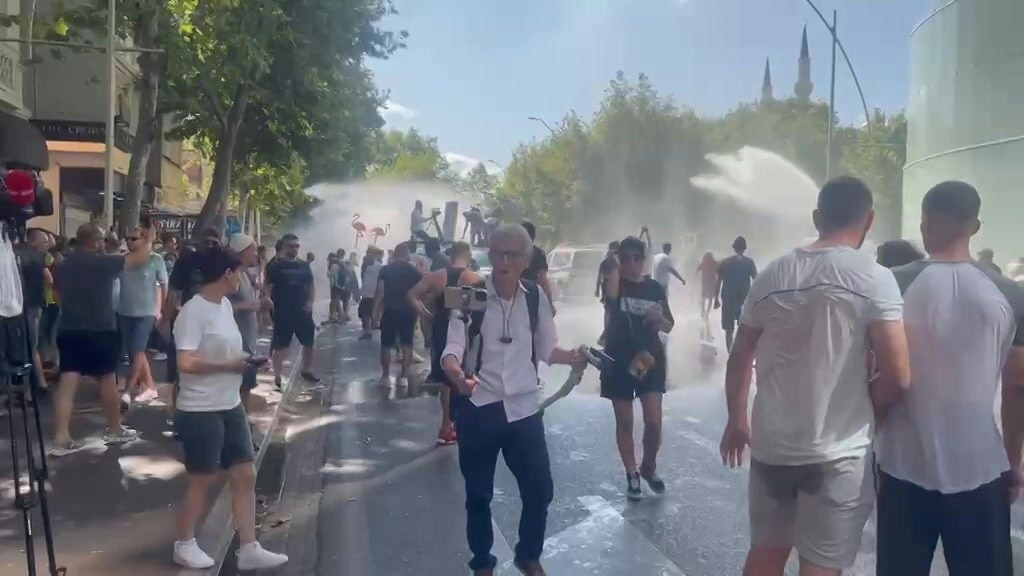
On a tense Thursday in Albania’s capital Tirana, security forces deployed tear gas and water cannons to disperse hundreds of demonstrators gathered outside the country’s parliament building, capping more than a month of sustained public anger over a luxury coastal tourism development linked to the Trump family. What began as a targeted environmental campaign against construction in a protected coastal wildlife reserve has grown into a broader protest over government transparency, public corruption, and misallocated public funds, uniting environmental activists, opposition politicians, and ordinary citizens against the ruling administration.
The wave of daily demonstrations first launched in late May, sparked by plans to build a sprawling luxury resort complex connected to Ivanka Trump and Jared Kushner, the daughter and son-in-law of former U.S. President Donald Trump. The proposed development is located on a protected, unspoiled stretch of Albania’s Adriatic coast, in a protected nature reserve that hosts endangered loggerhead turtle nesting grounds and stable flamingo colonies on an adjacent uninhabited island. Scientists and local environmental activists say preliminary site work has already caused irreversible ecological harm, destroying critical habitats already at risk.
Marine biologist Olsi Nika, who leads the prominent Albanian environmental NGO EcoAlbania, described the damage from early construction activities as “an absolute biodiversity massacre.” The site’s once-pristine coastal ecosystems, scientists confirm, have been permanently altered, eliminating nesting areas for loggerhead turtles, a species classified as threatened with extinction globally. The project’s location inside a protected natural and cultural heritage zone has amplified public outrage, with critics arguing the government bypassed environmental regulations and public oversight to advance a deal that benefits connected interests.
Thursday’s clashes broke out as protesters attempted to push through heavy police security cordons to reach the parliament entrance. By the end of the day, Albania’s health ministry confirmed six police officers and 11 demonstrators suffered minor injuries and were treated at local Tirana hospitals. The demonstration was timed to coincide with a parliamentary vote on a 4 million euro ($4.6 million) public subsidy for a Kanye West concert held in Tirana earlier in July, a decision that further enraged a public already frustrated by the government’s handling of the resort project.
In the chaotic parliamentary session, the subsidy was ultimately approved by 80 votes, all from the ruling Socialist Party, which holds a majority in the 140-seat unicameral legislature. Prime Minister Edi Rama had previously committed to the public funding, arguing it was required to prevent the high-profile concert from being canceled. For protesters, the approval of large public spending for a celebrity concert while pushing forward an environmentally destructive private resort project underscored what they call the government’s lopsided, non-transparent priorities.
The project has become a major flashpoint for discontent in Albania, drawing thousands of nightly protesters through at least mid-July, according to on-the-ground reporting from Agence France-Presse. Clashes between demonstrators and police have occurred repeatedly in recent weeks outside parliament, with protesters previously throwing eggs at lawmakers as they entered the building. The development’s ties to the Trump family have also drawn international attention to the conflict, turning a local environmental dispute into a globally watched case of conservation versus high-profile development.
No official crowd counts have been released by the Albanian government, but AFP journalists on site estimate thousands of people have joined the sustained daily protests through more than a month of action. Critics say the project highlights broader concerns about corruption and lack of accountability in Albania’s government, with environmental harm serving as the most visible trigger for widespread public anger that continues to roil the country’s political landscape.