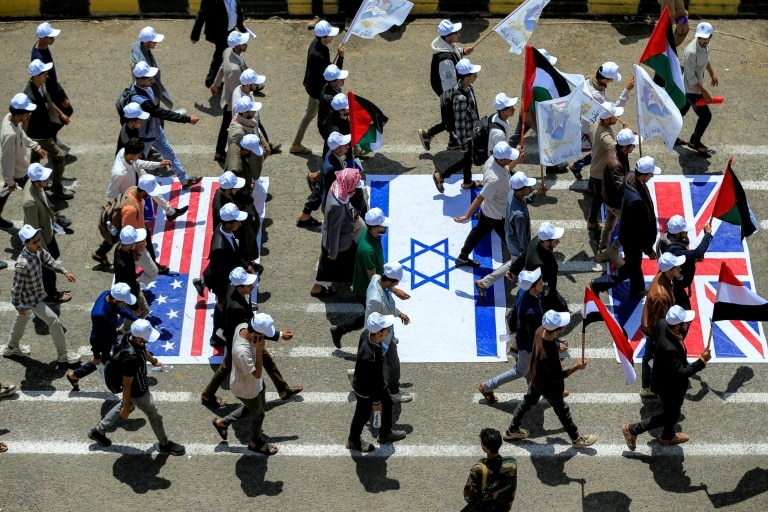
A wave of cross-border military strikes and rising geopolitical friction has swept through the Middle East, with Iran expanding its attacks on US-aligned targets and Washington launching its 12th consecutive night of strikes on Iranian military positions, spurring urgent diplomatic efforts to de-escalate the crisis.
On Thursday, the escalating violence triggered security alerts across the Gulf region. Bahrain, which has faced daily Iranian attacks, activated air raid sirens across the country, with audible warnings heard in the capital Manama by Agence France-Presse correspondents. In an official statement, Bahrain’s Interior Ministry urged all citizens and residents to remain calm and proceed to the nearest designated safe shelter immediately.
Neighboring Jordan and Kuwait also moved to neutralize incoming threats from Iran. The Jordanian military confirmed it intercepted three Iranian missiles launched early Thursday, with a fourth missile impacting an unpopulated area with no reported casualties. Overnight, Kuwait’s armed forces announced they were also intercepting “hostile drone threats,” though the military declined to share additional details on the intended targets of the unmanned aerial vehicles.
Iran’s Islamic Revolutionary Guard Corps (IRGC) and regular army issued separate claims of responsibility for the strikes, confirming they targeted American assets positioned in both Jordan and Kuwait. The IRGC stated it destroyed multiple US military assets in Jordan, including critical components of American air defense systems: a THAAD missile defense radar, a Patriot system radar, a C-RAM counter-rocket defense radar, and a helicopter hangar. In Kuwait, Iranian forces claimed strikes on several major US military installations, including Ali Al Salem Air Base, Camp Udairi, Camp Doha, Camp Arifjan, and a key telecommunications tower.
Amid the cross-border strikes, a new flashpoint emerged in the Red Sea following an attack on a Saudi-owned commercial tanker transiting the vital waterway, according to Saudi state media. The Iran-backed Houthi movement in Yemen claimed responsibility for the attack, just days after the group threatened to blockade Saudi Red Sea ports—a major strategic route for global oil shipments. The five-month ongoing regional conflict has already effectively closed the Strait of Hormuz, another critical chokepoint for global energy trade.
Oman, a longstanding neutral mediator between the Houthi movement and Saudi Arabia, has moved quickly to restart diplomatic negotiations following the tanker attack. The Omani foreign ministry expressed deep concern over the deteriorating Red Sea situation, noting it is coordinating closely with Saudi Arabia, Yemeni political factions, and the UN Special Envoy for Yemen to revive the formal political process and advance a roadmap for long-term regional security and stability.
Iran has signaled it has no plans to halt its current campaign of retaliatory strikes. Speaking to state television Thursday, Iranian army spokesperson Mohammad Akraminia confirmed that retaliatory attacks by Iran’s armed forces will continue for as long as US strikes targeting Iranian infrastructure and coastal areas persist. Akraminia added that Iran’s military is fully prepared to respond to any escalation scenario from enemy forces.
Top US officials have framed the escalation as a result of Iranian manipulation of regional proxy groups. US Secretary of State Marco Rubio, speaking on the sidelines of a Southeast Asian summit in Manila, argued that Houthi rebels had been lured into the conflict by Tehran. “The Houthis largely were smart and stayed out of all this throughout the conflict, but they now apparently have gotten themselves suckered into this, going after Saudi Arabia and their ships,” Rubio said.
For its part, the United States has continued its own campaign of strikes against Iranian targets. US Central Command announced Wednesday that American forces had launched new strikes on Iranian military positions, marking the 12th consecutive night of such operations. Early Thursday local time, Iranian state media reported that missile strikes targeted the southwestern cities of Ramshir and Ahvaz, with additional missile attacks reported in Bushehr province along Iran’s Persian Gulf coast.