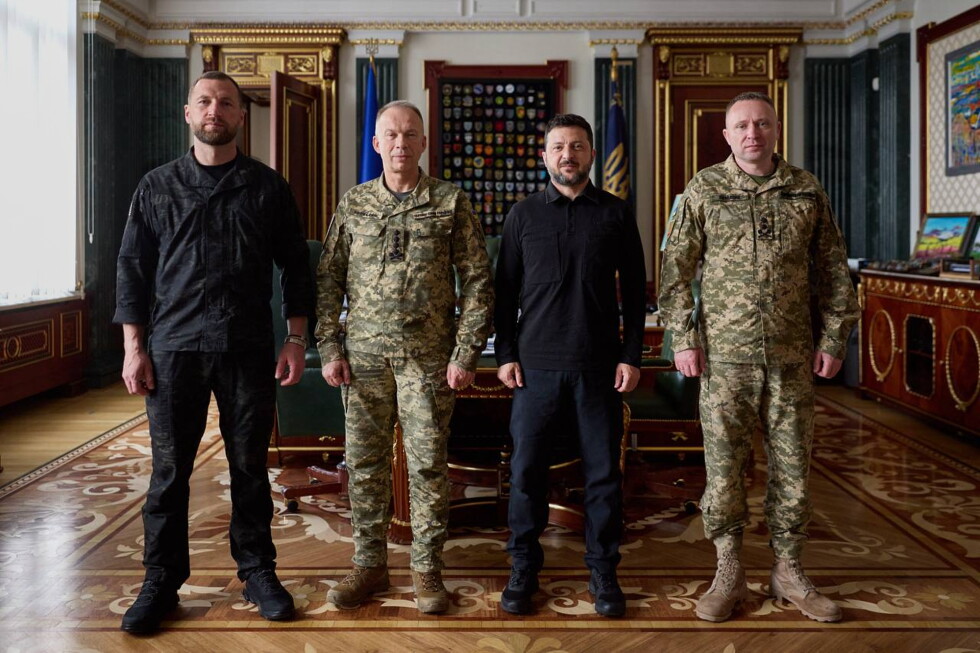
KYIV, Ukraine — In a dramatic week of political and military upheaval, a single leadership decision has triggered a sweeping transformation of Ukraine’s top military command, ousting long-entrenched old-guard figures and clearing a path for a new generation of wartime leaders. What began as President Volodymyr Zelenskyy’s dismissal of popular reformist Defense Minister Mykhailo Fedorov quickly spilled into public demonstrations, shifting public fury to the country’s top military commander and laying bare deep, long-simmering divisions over the future of Ukraine’s armed forces amid ongoing war with Russia.
Protesters united in denouncing Commander-in-Chief Oleksandr Syrskyi, rallying overwhelmingly behind Fedorov, who had emerged as one of Ukraine’s most influential wartime reformers and a standard-bearer for a public hungry for systemic military change. Demonstrators carried signs and chanted demands for Fedorov’s immediate reinstatement, capping months of bitter public and private disagreements between Fedorov and Syrskyi that had divided Ukraine’s military and political establishment.
The leadership shuffle marks the second time in 12 months that a wartime decision by Zelenskyy has sparked significant public backlash, following a mid-2025 move to curtail the powers of Ukraine’s anti-corruption agencies. Mirroring his response to that earlier crisis, Zelenskyy moved swiftly to contain the political fallout, announcing Syrskyi’s dismissal just days after protests erupted. In his place, the president appointed Mykhailo Drapatyi, a disciplined, battle-tested commander who built his reputation defending Ukrainian positions in the years following Russia’s first 2014 invasion of eastern Ukraine.
Drapatyi’s ascension represents a sharp generational and ideological break from Syrskyi, whose career and thinking were rooted in Soviet-era military doctrine. Even with the new command appointment, public support for Fedorov continues to solidify, with the protests catapulting the former minister to new heights of political popularity among the Ukrainian public.
Much of the public anger that followed Fedorov’s dismissal focused squarely on Syrskyi, who had become a symbol for the accumulated frustrations building within Ukraine’s military since Russia’s full-scale 2022 invasion. Drapatyi’s appointment, however, has helped ease a portion of these tensions. Widely respected by frontline troops and fellow officers alike, Drapatyi represents the cohort of younger commanders who earned their credibility through battlefield experience rather than through the rigid hierarchies of the old Soviet military system.
“He enjoys a high level of trust within the military. I think this appointment could boost what is often called morale, that is, strengthen the fighting spirit,” explained Oleksandr Musiienko, a Kyiv-based independent military analyst.
One anonymous Western defense official, not authorized to speak on record to journalists, described the divide between Fedorov and Syrskyi as a chasm “between different planets.” The core of the split lay in their competing approaches to modern warfare: Fedorov championed a data-driven, technology-first strategy focused on preserving troop lives through innovation, while Syrskyi clung to a traditional, large-scale ground forces doctrine rooted in Soviet military tradition.
Analysts note that Drapatyi is uniquely positioned to act as a bridge between these two competing camps. A low-profile but widely respected leader, he has earned the confidence of frontline commanders while embracing the sweeping military reforms that Fedorov championed in Kyiv. “He has shown an ability to adapt to the realities of modern warfare, to changing battlefield conditions and to shifting and reallocating resources,” Musiienko added.
For many Ukrainians, Syrskyi embodied exactly the kind of rigid command structures and outdated Soviet-era thinking that Fedorov’s reforms sought to dismantle. When Fedorov publicly named Syrskyi as the primary barrier to his reform agenda, it brought long-simmering public grievances into the open: the military’s deeply entrenched bureaucracy, Syrskyi’s overly centralized, micromanaging command style, and the persistent, systemic challenges of mass mobilization.
Syrskyi also faced intense public scrutiny over his ties to the 425th Separate Assault Regiment, commonly known as Skelya. The regiment became a national symbol of the costly, reckless tactics that critics say wasted soldiers’ lives in exchange for minimal territorial gains. It was also at the center of a major national scandal after Ukrainian outlet Babel published an investigation alleging systemic abuse, torture in training camps, and dozens of preventable noncombat deaths. The report triggered an official investigation, led to the suspension of the regiment’s commander, and amplified public calls for broader reform of Ukraine’s military command culture.
The series of leadership changes marks the second high-profile reversal for Zelenskyy since mid-2025. To some Ukrainian lawmakers and independent analysts, the episode demonstrates that democratic accountability remains functional in Ukraine despite the imposition of martial law and the suspension of national elections. They argue that Zelenskyy’s rapid response to public pressure proves the presidency remains responsive to the will of the Ukrainian people.
Other lawmakers, however, have warned that the chain of events could set a troubling precedent, allowing public protest rather than structured institutional decision-making to shape appointments to the military’s highest ranks. Tetiana Shevchuk, a board member of Ukraine’s Anti-Corruption Action Center, noted that public protest remains one of the only channels for citizens to express their views amid the absence of scheduled elections.
“Frustrations built up to the point where people felt the only way to be heard was to take to the streets. That’s not a healthy precedent, but it should also be a signal to the government to address problems before they reach that stage,” Shevchuk said.
Ukrainian social media erupted with memes mocking Zelenskyy’s scramble to find a new military chief, a wave of jokes that underscore the significant political cost the president has paid amid the crisis. Many of the viral memes depicted Zelenskyy interviewing absurd candidates, ranging from Game of Thrones character Jon Snow to extraterrestrials and marine mammals, highlighting the sense of chaos that has surrounded the leadership shuffle.
The crisis comes as Zelenskyy is already weathering the political fallout from a damaging corruption investigation that ensnared several of his closest associates, including former chief of staff Andriy Yermak, who was dismissed last year under mounting public pressure.
Shevchuk emphasized that the public protests surrounding Fedorov’s dismissal are not merely a show of personal support for the former minister — they are a clear reflection of broad public backing for the sweeping reforms he championed. “Fedorov was pushing the idea that Ukraine had to preserve every soldier’s life and become more efficient than Russia,” Shevchuk explained. “Over the past six months, people finally felt Ukraine was gaining an advantage. For the first time in a long time, there was hope that this war was winnable — that we weren’t just taking loans while slowly losing territory.” That momentum was upended abruptly when Zelenskyy announced Fedorov’s dismissal.
Even with Drapatyi’s appointment to top command, the political drama is far from resolved. Reports indicate Fedorov has refused to accept any other government position unless he is reinstated as defense minister, a demand that thousands of protesters continue to voice publicly. Fedorov’s next steps, and whether he will return to government at all, will shape the next chapter of Ukraine’s wartime political and military trajectory.
The crisis has also dramatically elevated Fedorov’s national political profile. Once best known as the architect of Ukraine’s pre-war digital transformation and a largely loyal subordinate to Zelenskyy, he now commands a broad, independent base of public support across the country. That new popularity has inevitably sparked widespread speculation about his long-term political future, beyond the current military leadership crisis.
During his six months as defense minister, Fedorov pursued an aggressive reform agenda designed to accelerate Ukraine’s military modernization. He reallocated funds originally budgeted for general personnel costs to expand long-range strike capabilities, fiber-optic drone systems, reconnaissance technology, and other cutting-edge military tools. He also secured new drone acquisitions, finalized new contracts for Patriot air defense systems, oversaw successful domestic ballistic missile tests, and implemented a sweeping overhaul of Ukraine’s notoriously corrupt military procurement system. He additionally proposed a full rewrite of military service contracts designed to make frontline service more sustainable for infantry troops, including higher base pay, expanded leave allowances, and greater service flexibility — changes that resonated deeply with rank-and-file soldiers.