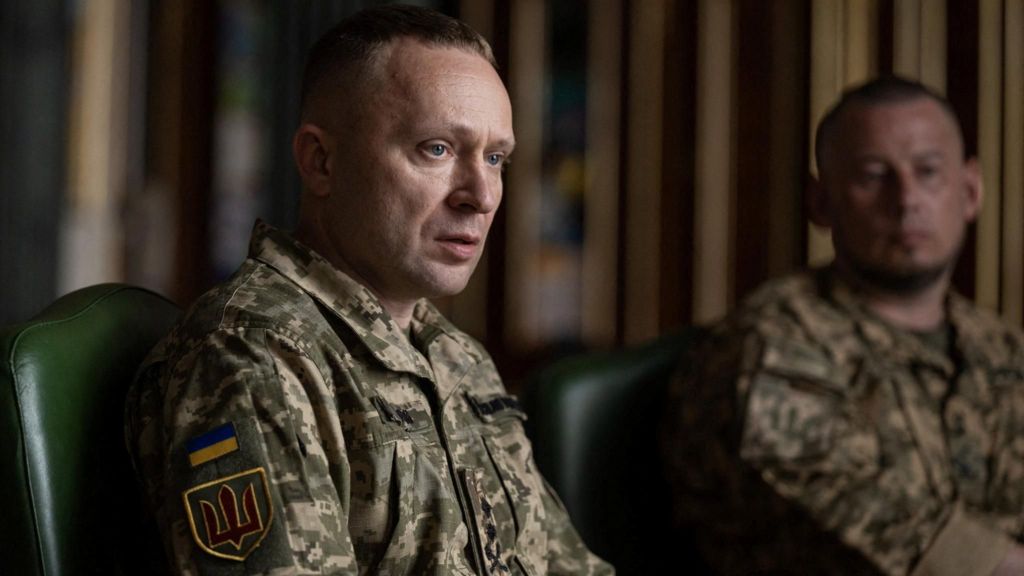
Ukraine has installed a new top military leader amid ongoing conflict with Russia, with 43-year-old Major General Mykhailo Drapatyi taking over the role of Commander-in-Chief from Oleksandr Syrskyi. This appointment marks the third leadership shake-up for Ukraine’s armed forces since Russia launched its full-scale invasion in February 2022, and it has already earned broad backing from both civilian society and rank-and-file military personnel. Drapatyi’s rise to the top position came amid public protests that initially formed to support his ally, former defense minister Mykhailo Fedorov, but eventually shifted to demand Syrskyi’s removal – with crowds chanting Drapatyi’s name in the streets. One frontline Ukrainian soldier told the BBC, “There’s no better person for this position nowadays in Ukraine.”
Drapatyi’s reputation as a “humane and strong” commander has been built over more than two decades of military service in post-Soviet Ukraine. He graduated from the Kharkiv Institute of Tank Troops in 2004, beginning his career as a junior lieutenant, and first rose to public attention in 2014, when pro-Russian separatists seized swathes of eastern Ukraine. That May, Drapatyi led a battalion into the besieged southern city of Mariupol to free hostages held at the city’s police department. When told a kilometer-high makeshift barricade blocked the advance, he ordered his infantry fighting vehicle to smash straight through it, and the footage of the maneuver quickly went viral around the world. “I said, let’s take it by storm. This video flew around the world,” he later recalled in an interview. Later that same year, he earned further acclaim for successfully extracting encircled Ukrainian units from a contested border area in Luhansk Oblast.
In 2021, Drapatyi returned to academic training to deepen his expertise in operational and military strategy, graduating at the top of his class that June. He was awarded a ceremonial sword of honor by then-British Ambassador to Ukraine Melinda Simmons for his performance. When Russia launched its full-scale invasion in 2022, Drapatyi was already serving as deputy commander of Ukraine’s joint forces, and he immediately stepped into frontline leadership roles. He led temporary operational task forces across multiple hotly contested sectors of the front, successfully halting Russian advances toward Kryvyi Rih and overseeing the liberation of dozens of settlements in the Kherson and Dnipropetrovsk regions. By 2024, he had risen to command Ukraine’s entire Land Forces, leading operations in some of the bloodiest combat zones in eastern Ukraine.
A defining moment for Drapatyi’s public reputation came in early 2025, when a Russian missile strike targeted a military training ground in the Dnipropetrovsk region, killing 12 soldiers and wounding 60 more. Drapatyi tendered his resignation that same day, taking personal responsibility for the “conspiracy of silence and impunity” that he said had allowed the tragedy to occur. “An army in which commanders bear personal responsibility for the lives of personnel keeps living. An army in which nobody is responsible for a loss dies,” he wrote in his resignation letter. The move was widely praised as an unprecedented demonstration of accountability among Ukraine’s senior military leadership, and President Volodymyr Zelensky declined to accept his resignation – instead appointing him commander of the Joint Forces of the Armed Forces of Ukraine.
From that point, open speculation about tensions between Drapatyi and Syrskyi grew steadily. A senior unnamed Ukrainian officer told local media in June 2025: “Drapatyi is a relatively young general. He is gifted. He was always sent to places where the situation was extremely difficult. I do not think he has political ambitions. Yet I am sure his ambitions are not confined to the position of commander of the ground forces or the Joint Forces.” Just over a year later, Syrskyi stepped down, and expectations for Drapatyi’s tenure are running high.
Mykola Bielieskov, a senior analyst at Ukrainian NGO Come Back Alive, notes that Drapatyi enjoys widespread popularity among rank-and-file troops, particularly among civilian volunteers who joined the military after the 2022 full-scale invasion. But Bielieskov also cautions that the new commander-in-chief will operate under severe, systemic constraints: “The Commander-in-Chief has a lot of leverage. But war is a combination of government, the president’s office, military suppliers, dependence on [Western] partners… so he’s got a tricky path before him.”
Ceasefire negotiations with Russia remain stalled with no near-term breakthrough in sight, and Ukraine is bracing for another harsh winter of active combat. Drapatyi’s immediate priorities include shoring up Ukraine’s mobilization system to replenish frontline ranks, rooting out systemic corruption that has plagued everything from conscription processes to defense procurement, and leveraging Ukraine’s fast-growing domestic defense tech sector – which has driven key battlefield gains in recent months – to maximum effect.
In his first public address after taking up his new post, Drapatyi acknowledged the enormous weight of his new role, promising to lead “without making loud promises, with responsibility for our decisions, and with respect” for all frontline service members. Many Ukrainians are hoping Drapatyi will bring a sharp break from Syrskyi’s tenure, which was widely criticized for relying on outdated, human-costly offensive tactics that prioritized territorial gains at the expense of troop safety.
Analysts have warned against overestimating how quickly Drapatyi can deliver change, however. “It’s a major role and people will expect change quickly,” Bielieskov said, cautioning against “oversimplification” that can lead to unrealistic demands for sweeping progress in an impossibly short timeline. Oleksiy Kopytko, a former interior ministry adviser, echoed that note of caution, pointing to the fickle nature of public support for senior wartime leaders: “As commander-in-chief, you are worshipped and loved by all today, not loved by everyone tomorrow, and are guilty of everything the day after tomorrow, with none of your achievements mattering.” Valery Zaluzhnyi, who was removed from the post of Commander-in-Chief in 2024, also predicted that “Drapatyi will have a very difficult time. Much harder than he imagines.”
Even so, many ordinary Ukrainians and frontline soldiers share a palpable sense of optimism about the new leadership. Some have gone so far as to say that if Drapatyi’s ally Mykhailo Fedorov is reinstated as defense minister, the pair’s combined leadership would become “Russia’s worst nightmare.” Long before taking on the role of Commander-in-Chief, Drapatyi signaled his willingness to take on entrenched problems within the military: when he resigned from his Land Forces command in 2025, he outlined a series of systemic flaws he had already targeted, ranging from combat training reform to unfair mobilization practices, corruption and broken procurement systems. “There is expected resistance, but efforts need to be stepped up,” he said at the time. Now, he will face those same challenges on a far larger national stage, with the eyes of the entire country fixed on his every move.