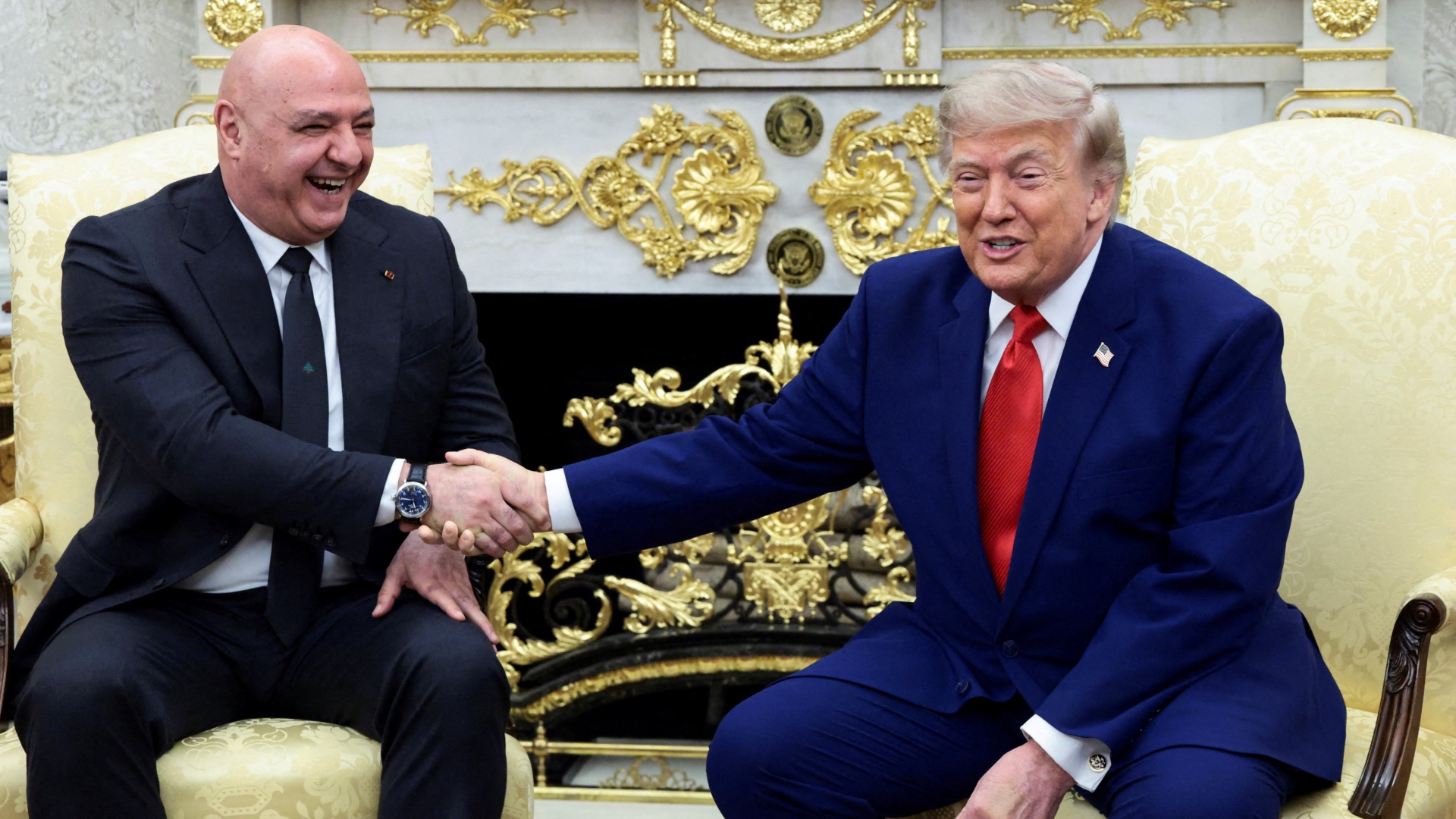
On a historic Tuesday at the White House, Lebanese President Joseph Aoun sat down for his first face-to-face meeting with U.S. President Donald Trump, marking the first Oval Office gathering between leaders of the two nations in 16 years. Aoun, who took office just two weeks before Trump’s 2025 inauguration, had long waited for this high-stakes diplomatic opportunity, with the last Lebanese president to visit the Oval Office being Michel Sleiman alongside former U.S. President Barack Obama in 2009.
Opening the press availability with diplomatic grace, Aoun addressed Trump in English, saying, “Been looking forward to this visit for a very long time, meeting such a great president like yourself.” The remark drew a lighthearted response from Trump, who joked, “See, he knows how to get to me. Now he can have anything he wants.”
Behind the cordial opening exchanges lay stark, urgent priorities that Aoun brought to the table. Lebanon’s new president arrived in Washington seeking three core outcomes: consistent, committed U.S. diplomatic engagement that increases pressure on Israel to end its occupation of southern Lebanon, expanded military financing for the Lebanese Armed Forces (LAF), and substantial international support for reconstructing the war-ravaged southern region of the country. What Aoun left with, however, was far more modest: a White House announcement that U.S. commercial airlines would be permitted to resume direct flights to Lebanon, a service that has been suspended for 40 years.
The ban on direct U.S. flights was first imposed by the Ronald Reagan administration in 1985, after Hezbollah operatives hijacked TWA Flight 847 to demand the release of Lebanese citizens held in Israeli custody. In a post on his social media platform TruthSocial, Trump wrote, “I am hereby directing my Administration to allow all US airline carriers to fly directly to Lebanon so that Americans can easily visit this beautiful land.”
Regional analysts note that even this limited concession carries some upside for Lebanon. “It’s a win [for Aoun] if it’s easier for people to travel to Lebanon in a safe fashion,” Anthony Wanis-St John, a conflict resolution professor at American University in Washington D.C., told Middle East Eye. Still, the practical benefit of restored flights remains contingent on broader stability: until open hostilities between Lebanon and Israel end, American tourists are unlikely to visit in significant numbers.
Like every Arab leader who has met with Trump at the Oval Office over the past 18 months, Aoun has stressed that only Trump holds the unique leverage to curb Israeli Prime Minister Benjamin Netanyahu’s ongoing military campaign in Lebanon. Aoun made his long-term goal clear to reporters, stating, “The ultimate objective [is] ending the state of hostility between Lebanon and Israel forever.” He added, turning to Trump, “I think, Mr President, this will be your legacy.”
The conflict that has ravaged southern Lebanon dates back to October 8, 2023, when Hezbollah launched rocket attacks on Israel in solidarity with Palestinians in Gaza. Since Israel launched its counteroffensive and occupied large swathes of southern Lebanon in March 2025, more than 4,300 Lebanese people have been killed.
In a surprising shift from longstanding U.S. policy, Trump acknowledged Hezbollah’s outsized influence in Lebanese politics and its critical role in any future peace framework, telling reporters, “I would speak to Hezbollah. I speak to everybody. If the president wanted me to speak to Hezbollah – you know he’s lived with Hezbollah for a long time – if the president wanted me to speak to Hezbollah, I would.” However, Aoun’s visit was rooted in a core goal: affirming that the Lebanese state is the sole legitimate authority in the country, making it extremely unlikely he would approve such a meeting. Hezbollah has been classified as a terrorist organization by the U.S. government since 1997.
When pressed on concerns raised by Lebanese Parliament Speaker Nabih Berri that armed confrontation between the LAF and Hezbollah could spark a new Lebanese civil war, Aoun pushed back on the idea of widespread division. Aoun noted that Berri, leader of the Amal Movement, a Shia political party aligned with Hezbollah, is originally from southern Lebanon and has watched the region’s destruction firsthand. “He really wants to see the end of this war,” Aoun said. “He’s actually supporting what we are doing, but we need to be careful. His position as a speaker and as a leader of the Shia community, we have to understand how critical is his position.” Aoun also emphasized that the current negotiation framework falls under the constitutional prerogative of the presidency and does not require parliamentary endorsement.
In the lead-up to the meeting, U.S. Ambassador to Lebanon Michel Issa hinted that Aoun would not leave Washington empty-handed. But after the nearly two-hour meeting, Massad Boulos, Trump’s senior advisor on Arab and Middle Eastern Affairs and a member of the Trump family through marriage, told reporters that the main outcome of the meeting was advancing implementation of the June 26 U.S.-brokered framework for southern Lebanon. Pilot zone operations for the agreement launched just one day before the meeting, in the southern Lebanese villages of Froun, Srifa, and Zawtar Al-Gharbiya, overseen by an international military coordination group.
The core premise of the pilot zones is straightforward: as Israeli forces redeploy out of the area, the LAF will move in to take control and implement disarmament of Hezbollah fighters. But Trump clarified on Tuesday that this is not a full Israeli withdrawal, saying Israeli troops are only “in the process of redeploying to other sections” of southern Lebanon.
That distinction has led many regional analysts to dismiss the pilot plan as a largely symbolic step that fails to address Lebanon’s core demand for full sovereignty. “In other words, the implication is Israel is staying on Lebanese territory,” said Khalil Jahshan, executive director of the Arab Center Washington DC. “It doesn’t solve the issue of sovereignty for Lebanon. It doesn’t solve the issue of foreign occupation for Lebanon. It does not offer the Lebanese government any potential to kind of go back to Hezbollah and say, ‘See, it’s working partially – a small area, but it’s working.’ So it’s basically a small step to nowhere.”
Wanis-St John added that ongoing Israeli violence and occupation in the south is ironically boosting Hezbollah’s popular support among Lebanese, even as the group faces growing backlash over the enormous human cost of the conflict. “While Hezbollah is losing popularity on its own accord among the Lebanese because of the high cost of death and displacement, the Israelis go and make them more popular by staying and being extremely violent,” he explained.
When asked what leverage the U.S. holds to push Hezbollah to comply with the disarmament framework, Boulos hinted at continued punitive action, referencing existing sanctions imposed by the U.S. Treasury Department on entities linked to the group. “There are always options,” he said. “It’s going to take time. This is not easy. Nobody believes for a second that this is going to be an easy task in any way. But we are determined – President Trump is absolutely determined – to see this through. He is the president of peace, as we all know.”
Aaron David Miller, a veteran U.S. Middle East negotiator who served in both Republican and Democratic administrations, wrote on social media ahead of the meeting that unless Aoun could secure a massive expansion of U.S. training, weapons, and intelligence support for the LAF, any agreement would amount to little more than political performance. In line with that speculation, The Wall Street Journal reported Tuesday that the Trump administration is considering a new program to vet and train elite LAF units specifically to counter Hezbollah’s well-entrenched and heavily armed fighters.
Many analysts argue the U.S. is currently pursuing a waiting game tied to Israel’s upcoming legislative elections, scheduled for the end of October. “What the US is trying to do is keep the process alive somehow until the Israeli elections take place, and there is a government – this government or a new one – that can deliver,” Jahshan explained. “In the interim, Lebanon has no choice under its current leadership but to put up with what are essentially promises. Undeliverable promises.” Wanis-St John echoed this analysis, noting, “This is definitely tied to Israeli political and electoral cycles.”
Boulos pushed back on this characterization when questioned by reporters, insisting, “There is no direct link. The agreement is an agreement that is going to be implemented step by step. It’s not a question of specific dates that are cast in stone. There is a verification mechanism. We have to give it a chance. It has to work and it’s going to work.”
The meeting also included a small, awkward unscripted moment: during the press availability, Trump referenced his Middle East envoy Tom Barrack, noting Barrack is of Lebanese descent, but failed to mention Boulos, who is married to Trump’s youngest daughter Tiffany, even after Aoun gestured to Boulos to draw him to Trump’s attention. Boulos was present in the Oval Office for the meeting but did not receive a public shoutout from the U.S. president.