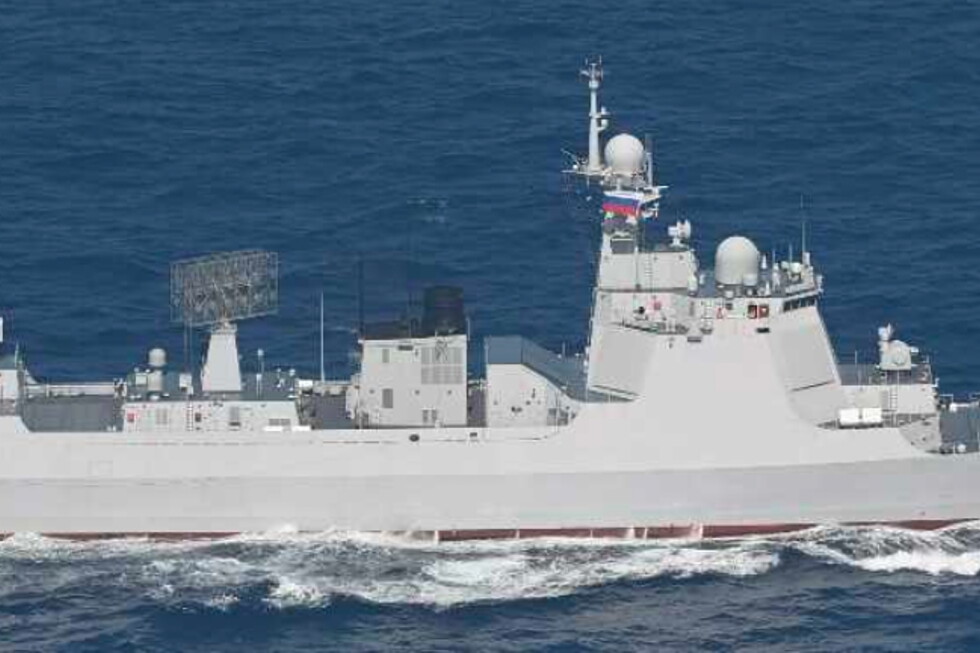
TOKYO — Tensions have flared in the Pacific Ocean after Japanese officials confirmed Tuesday that Tokyo has formally conveyed diplomatic concern to Beijing over a Sunday live-fire exercise conducted by a Chinese navy guided-missile destroyer, held within a disputed maritime zone off a remote Japanese-controlled island.
According to Japan’s Joint Staff, the drill involved a Chinese Luyang III-class guided-missile destroyer, carried out approximately 110 miles southwest of Okinotori, Japan’s southernmost island. The exercise took place within what Japan designates as its Exclusive Economic Zone (EEZ) — a maritime area extending beyond national territorial waters where the country holds exclusive rights to natural resources. Hours before the live-fire activity, Japanese maritime forces detected the Chinese destroyer operating alongside two additional Chinese warships and one Russian frigate as part of a continuing joint Sino-Russian patrol in the region.
Japan’s Chief Cabinet Secretary Minoru Kihara told reporters Tuesday that the Japanese government views the drills as a potential hazard to civilian and military maritime traffic passing through the area. Kihara added that Chinese vessels only issued a safety notification to nearby ships immediately before the live-fire exercise began, leaving little time for vessels to reroute or adjust their courses.
“We will continue to watch China-Russia operations around Japan with concern, while doing utmost for the warning and surveillance of the Japanese airspace and territorial waters,” Kihara said in his official press briefing.
The incident comes amid a steady rise in Japanese anxiety over expanding Sino-Russian military cooperation in the Indo-Pacific. Japanese Defense Minister Shinjiro Koizumi highlighted growing risks during a speech delivered in London on Monday, pointing to Sunday’s drill as clear evidence of deepening military ties between Beijing and Moscow. Koizumi also referenced other recent combined activities, including a Chinese submarine-launched ballistic missile test conducted earlier this month and no fewer than 10 joint bomber flights by Chinese and Russian air forces routed around Japanese territory over recent months.
Tokyo’s concern has been mounting for years over China’s expanding military footprint in the Pacific. Last year marked a notable turning point, when Japanese defense forces detected two Chinese aircraft carriers conducting near-simultaneous operations off Iwo Jima, another southern Japanese island — the first time such large-scale deployments had been recorded so far from China’s mainland, and a move that reinforced Tokyo’s fears of Beijing’s growing strategic reach beyond its claimed borders.
A key layer of dispute surrounds the geography of Okinotori itself. China does not recognize Japan’s EEZ claim around the outcrop, arguing that Okinotori qualifies as an uninhabitable atoll, not a full island, and therefore cannot support a claimed extended economic maritime zone under international law.
Contradictions also remain over the location and purpose of the exercise. Last week, China announced it had concluded formal joint naval exercises with Russia on July 13, with participating vessels moving on to conduct joint patrols across the Pacific. China’s official Xinhua News Agency has stated that recent Chinese live-fire drills with Russia were held off the eastern Chinese port city of Qingdao, hundreds of miles away from the Okinotori area. Beijing has not yet issued an official response to Japan’s specific complaint about Sunday’s activity off the island.
In comments posted online late last week ahead of the latest incident, Chinese Defense Ministry spokesperson Jiang Bin defended Sino-Russian military cooperation as a legitimate contribution to regional and global security. “China-Russia military cooperation plays an important role in safeguarding the two nations’ sovereignty and security and upholding international and regional peace and stability,” Jiang said. He added that Beijing hopes other countries will “view China-Russia military cooperation objectively and rationally, and stop making groundless speculation and cease smearing and hyping.”
Japanese defense officials confirmed that while the live-fire drill took place in the EEZ Japan claims, it did not violate existing international law. This marks the first time Tokyo has publicly confirmed detecting Chinese live-fire drills within its claimed EEZ. Prior to the off-island exercise, the four-vessel Sino-Russian combined fleet sailed south through the water gap between Japan’s main islands of Okinawa and Miyako, according to the Japanese Joint Staff.