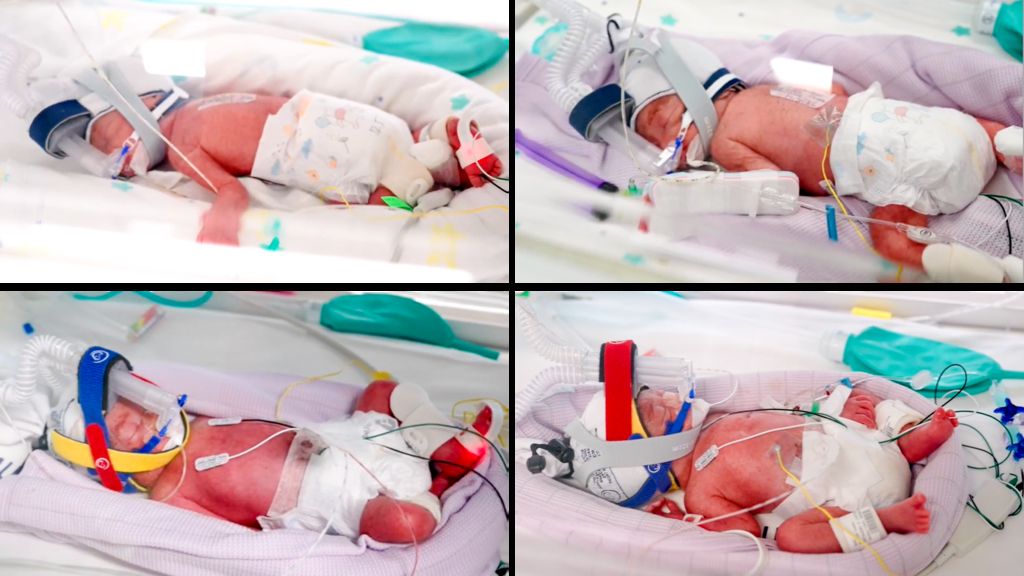
In an extraordinarily rare medical event, a 34-year-old Australian mother has given birth to four identical quadruplets conceived naturally, a milestone that medical professionals describe as nearly unheard of. Jenitar Na’amoana and her husband Jortham, who already share four children between the ages of one and 10, received the life-changing news of their quadruplet pregnancy with overwhelming surprise, according to officials from Brisbane’s Metro North Health, which oversees the Royal Brisbane and Women’s Hospital where the birth took place.
The four baby girls, delivered via caesarean section on July 14 at 28 weeks and four days gestation, are monozygotic quadruplets, meaning they developed from a single fertilized egg that split into four separate embryos. What makes this case even more exceptional is that all four fetuses shared the same placenta—a combination that maternal-fetal medicine specialist and obstetrician Dr. Alexa Bendall, who managed Na’amoana’s care from the earliest stages of pregnancy, calls unprecedented. Medical data puts the odds of naturally conceived identical quadruplets at roughly one in 15 million pregnancies, with naturally conceived quadruplets of any type already carrying odds of just one in 700,000 births globally.
From the outset, the pregnancy was classified as extremely high-risk. To ensure constant monitoring of both mother and fetuses, the hospital admitted Na’amoana as an inpatient when she reached 25 weeks gestation. “We always said that if we could get her to 28 weeks, we would be doing well,” Bendall explained in a statement following the birth. “So the fact that we’ve got four beautiful, healthy babies born at 28 weeks and four days is incredible and we’re very happy to be a part of it.”
Remarkably, Na’amoana avoided every major complication that typically comes with such a high-risk pregnancy, defying all medical expectations. “Jenitar has taken everything in her stride from day one… she has somehow dodged every complication and risk for both herself and her babies,” Bendall added.
In a touching tribute to the medical team that guided her through the pregnancy, Na’amoana named one of the four girls after Bendall. The newborns are called Emily, Harriet, Catherine, and Alexa—and Bendall says the honor left her deeply moved, calling it “a beautiful tribute.”
Currently, all four infants are being cared for in the hospital’s neonatal intensive care unit, where they will remain until they reach full term development. Bendall confirmed that as of the latest updates, all four babies “are currently doing extremely well.”
In the wake of the births, Na’amoana has launched an online crowdfunding campaign via GoFundMe to cover the cost of a new 10-seat van, a necessary adjustment to accommodate her expanded family of 10. Already, the campaign has raised more than 37,000 Australian dollars, equivalent to roughly 19,261 British pounds. In her message accompanying the fundraiser, Na’amoana expressed that while the family is overjoyed by their new additions, caring for four newborns at once has brought unforeseen practical challenges. “Our four precious miracles have arrived safely, and while our hearts are overflowing with gratitude, the reality of caring for four newborns at once has brought challenges we never could have imagined,” she wrote. Both parents have said their gratitude to the medical team and the community that has supported them is overwhelming.