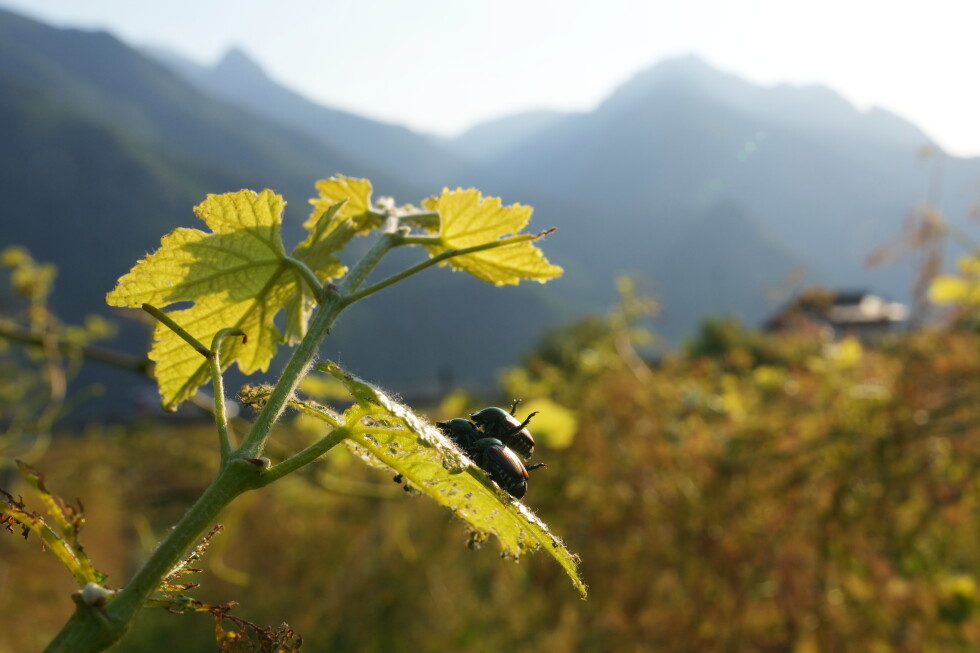
In the terraced mountain vineyards of Donnas, a small Italian town nestled along the Alpine edge, a quiet but devastating invasion is unfolding. Iridescent green Japanese beetles, an invasive species with no natural enemies in Europe, are steadily climbing the slopes, leaving a trail of damaged crops and anxious producers in their wake. This destructive pest, which has plagued American agricultural landscapes for more than a century, is a relatively new threat to the continent, first spotted in 2014 near Milan’s bustling Malpensa Airport.
Since that first detection, the species, formally named *Popillia japonica*, has spread rapidly across northern Italy. It has already established robust populations in the northeastern regions of Lombardy, Piedmont, and Valle d’Aosta, reaching Donnas’ historic terraced vineyards just last year. For local winemaker Luciano Zoppo Ronzero, who grows prized Nebbiolo grapes on these centuries-old mountain plots, the invasion is progressing at an alarming rate. “We’re seeing the popillia steadily advance from terrace to terrace across our historic vineyards,” he explained. “We’re now about the 10th terrace and can already see the popillia attacks. This means they’re consuming and gradually moving up the mountain.”
What makes the Japanese beetle such an extraordinary threat to European agriculture is its insatiable appetite and ability to spread rapidly. The pest feeds on more than 300 different species of plants, trees, and grasses, and travels in massive swarms when foraging. Adult beetles easily hitchhike across long distances on passenger trains, private cars, and commercial airplanes, helping the species colonize new regions far from their original point of introduction. After feeding through the summer months, adult beetles mate and lay eggs that hatch into larvae, which live underground feeding on grass roots before maturing into adults and restarting the destructive annual cycle.
Thanks to its rapid spread and wide-ranging damage potential, the Japanese beetle has been added to the European Union’s list of priority invasive pests, requiring member states to implement active measures to contain and eradicate confirmed outbreaks. As of 2024, the beetle has become permanently entrenched in Italy, Switzerland, and Germany, where management efforts now focus on slowing expansion rather than full eradication. By contrast, population levels in France and Spain remain low enough that experts still hold out hope for eliminating the pest entirely, according to Daniela Lupi, an entomologist at the University of Milan.
Italy’s agricultural sector is particularly vulnerable, as the beetle advances through the Po River Valley — the country’s most productive agricultural heartland often called Italy’s breadbasket. The full economic damage of the invasion is still difficult to calculate: unlike pests that kill plants outright, Japanese beetles eat away the soft leaf pulp, leaving behind a telltale lacy skeleton that weakens plants and reduces yield without immediately killing healthy specimens. Even so, Coldiretti, Italy’s largest agricultural lobby, warns the pest poses an existential threat to the country’s iconic farm production.
“In some areas, the beetle has destroyed the harvest,” said Lorenzo Bazzana, head of economic affairs at Coldiretti. Beyond commercial crops, the larvae, commonly called grubs, cause widespread damage to grassroots, ruining recreational turf including lawns, golf courses, and public playing fields. For viticulturists like Ronzero, the damage goes beyond just lost yield. By stripping vines of their leaves, the beetles not only cut the plants’ ability to photosynthesize but also expose developing grape clusters to dangerous excess sun exposure. “What scares me is the fact that in the end the grapes don’t ripen,” Ronzero said. “If the don’t ripen, it means we’re not bringing home a splendid harvest, as we had hoped, but something unusable.”
Researchers and farmers are testing a range of control strategies to slow the beetle’s advance. Agricultural experts point to targeting larvae as the most promising path for long-term suppression. After the beetle was recently detected near Verona’s Valerio Catullo Airport, scientists began experimental releases of a microscopic parasite that targets beetle grubs in the surrounding area. Pheromone traps, which lure adult beetles to their capture, are also widely deployed across at-risk regions. In Donnas, wine producers have turned to pesticide treatments to protect their vines, though the benefits are short-lived, and applying chemicals on the region’s steep mountain terraces is extremely labor-intensive.
Lupi emphasized that without coordinated, aggressive action, the beetle population will continue to grow, causing widespread harm to fruit crops, grasses, and ornamental plants across the continent. She noted that the pest poses no direct risk to human health, but the impact on agricultural production could be severe. “There are no problems for the human population, because they are not so dangerous, but the production is really, really lowered,” she said.