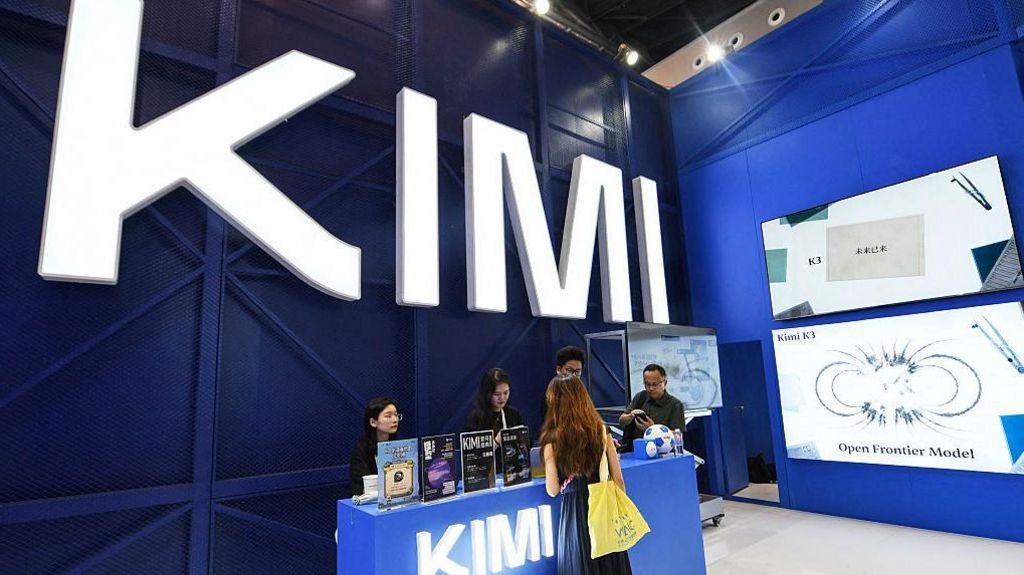
At the 2026 World Artificial Intelligence Conference held in Shanghai on Friday, Chinese artificial intelligence startup Moonshot AI made a landmark announcement that is shaking up global AI development: the official unveiling of Kimi K3, an advanced generative model packing 2.8 trillion parameters, a metric that defines a model’s scale and computational processing capacity. Backed heavily by Chinese tech giants Alibaba and Tencent, Moonshot AI positions Kimi K3 as the most capable flagship model the company has ever built, and it is set to upend long-held industry assumptions about the global AI capability gap.
Kimi K3 is scheduled to be released as an open-source model on July 27, marking a major milestone for the global AI ecosystem: it will become the world’s first open-source model in the three-trillion-parameter range, meaning developers around the world will be able to freely download, run, and customize the model for their own use cases. Unlike closed, proprietary AI systems developed by leading U.S. firms such as OpenAI and Anthropic, Kimi K3’s open architecture enables global users to modify the framework to support advanced reasoning tasks and complex software development projects. Moonshot AI also highlights a unique design feature: the model is engineered to operate with minimal human supervision, making it well-suited for sustained long-horizon tasks in engineering and large-scale coding work.
Independent third-party evaluations from leading AI benchmarking bodies Artificial Analysis and Arena.ai confirm that Kimi K3 delivers performance on par with top-tier U.S. AI models, including OpenAI’s GPT series and Anthropic’s Claude family. In blind human-preference testing, the new Chinese model even outperformed Anthropic’s Fable system to claim the top rank in web interface engineering, a key practical capability for modern software development.
The unveiling of Kimi K3 comes at an extraordinarily sensitive moment for the global AI sector. Just weeks prior, the U.S. government forced American AI developer Anthropic to temporarily pull its flagship Fable and Mythos models from circulation over severe cybersecurity concerns. While Washington has since reversed that withdrawal order, the incident underscores how the U.S. now frames cutting-edge AI as critical national infrastructure, labeling frontier AI models as core national security assets that fall under strict export controls, particularly for advanced AI hardware and software.
Despite these U.S. restrictions on AI-related hardware sales to Chinese firms, Kimi K3’s rapid development makes clear that Chinese AI companies are advancing independently and effectively navigating regulatory barriers set by Washington. The breakthrough also challenges long-standing Western narratives that Chinese AI developers lag significantly behind their American peers, showing that China’s domestic AI ecosystem is closing the capability gap at a far faster pace than many analysts predicted.
While Kimi K3’s unprecedented size means that running the model locally requires substantial computing infrastructure, its open-source release is already expected to deliver a major disruption to the commercial AI business models that dominate Silicon Valley. The announcement has already triggered immediate market shifts: shares of Moonshot AI’s domestic Chinese competitors Zhipu and MiniMax tumbled sharply on the Hong Kong stock exchange following the reveal, dropping approximately 27% and 16% respectively as investors reassess the competitive landscape for Chinese generative AI.