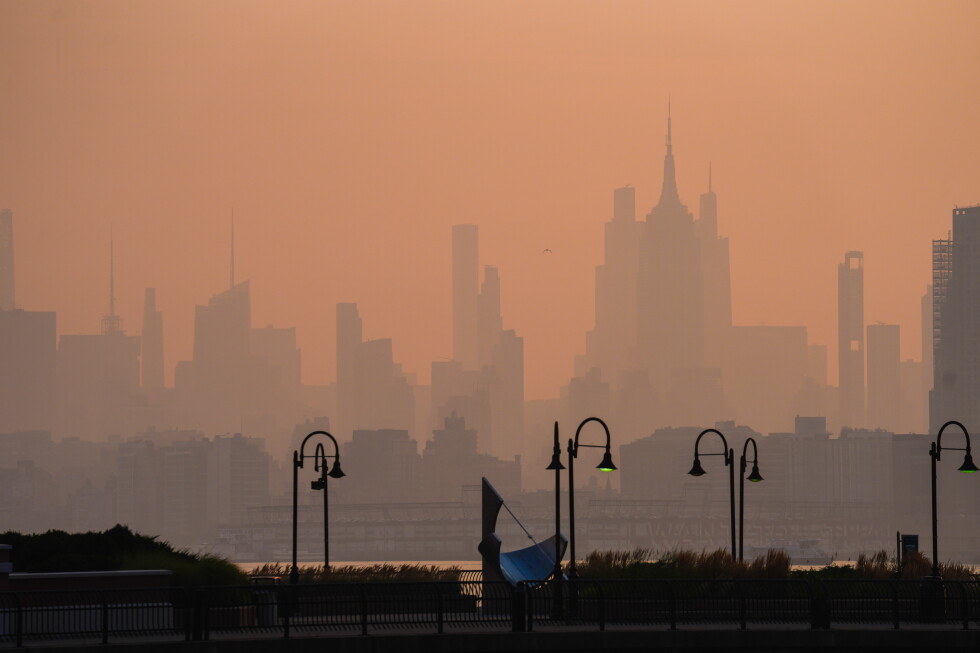
EAST RUTHERFORD, N.J. — As the highly anticipated World Cup final between Spain and Argentina approaches Sunday, a shroud of uncertainty from distant Canadian wildfires hangs over the match, with hazy conditions and unpredictable air quality threatening to disrupt one of soccer’s biggest global stages.
Spanish midfielder Mikel Merino acknowledged Friday that the acrid scent and visible haze from the wildfires, which have spread across large swathes of the eastern U.S., are impossible to miss, but his team is working to tune out the disruption. “For a game that is as important as a World Cup final, you have to be able to shut out external factors as much as possible,” Merino said. “Luckily, we are being careful with every detail thanks to the federation and the organizers of the World Cup.”
At present, the full impact of the smoke on Sunday’s match remains unclear. The World Health Organization projects that air quality in East Rutherford, the host city for the final, will improve to the “moderate” range by game day. However, that forecast is complicated by incoming weather and shifting wildfire activity.
A controversial misstep last week amplified concerns over team safety: Spain held a full outdoor practice in East Hanover on Thursday, when local air quality fell into the hazardous range. Environmental and health experts have criticized the decision, noting the session should have been moved indoors. Requests for comment sent to FIFA and the Spanish Football Association asking whether an indoor practice was considered or logistically possible went unanswered.
Air quality did show measurable improvement across the region on Friday, forecasters say, but shifting conditions could change the outlook rapidly. Up to 1.25 inches of rain is expected to fall across northern New Jersey on Saturday, but a second mass of smoky air is projected to move in behind the storm system.
“If the fire intensity really picks up again through Saturday, it’s possible it puts more smoke into the atmosphere that then might quickly follow that rain event,” explained Mark Parrington, senior scientist at the Copernicus Atmosphere Monitoring Service. “Following that, it looks like there is another smoky air mass following in behind that system, but it’s not clear right now how much or how it might reach New York or New Jersey, when it comes to actually Sunday.”
Beyond the disruption to the match, health experts warn that wildfire smoke poses significant risks to attendees and athletes alike, a threat amplified by rising global temperatures that have driven larger and more intense wildfire seasons across North America. Multiple medical studies have confirmed that wildfire smoke contributes to tens of thousands of premature deaths annually, impacting nearly every organ system in the human body.
Within hours of smoke exposure, particulate matter can trigger severe asthma flare-ups and increase emergency ambulance dispatches. Medical researchers explain that smoke irritates the body, triggering widespread inflammation that targets a person’s pre-existing vulnerable areas, setting off a cascade of immune system responses that can lead to serious cardiovascular and respiratory complications. As a general rule, Parrington noted, public health guidance advises limiting strenuous outdoor activity when pollutant levels are high, a warning that carries extra weight for at-risk attendees with pre-existing conditions.
White House officials confirmed Friday that former President Donald Trump is scheduled to meet with FIFA President Gianni Infantino later that day to discuss the situation. Senior members of the White House FIFA Task Force, including executive director Andrew Giuliani, have been in ongoing talks with soccer’s governing body to monitor the wildfire impact and coordinate preparations, according to an anonymous official familiar with internal discussions.
Sunday’s final is expected to draw roughly 80,000 fans to the open-air MetLife Stadium in the Meadowlands, the shared home venue of the NFL’s New York Giants and New York Jets. Organizers have not yet announced any plans to postpone, move, or modify the match schedule as of Friday’s update.
This report was assembled with contributions from SNTV videographer Davidde Corran (East Hanover, N.J.), AP White House reporter Seung Min Kim, AP Science Writer Seth Borenstein (Washington, D.C.), and AP Sports Writer Jim Vertuno (Austin, Texas).