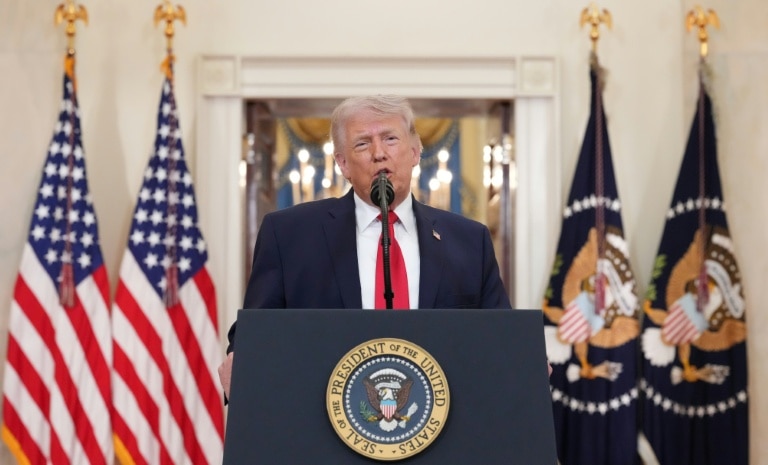
Nearly six years after his disputed 2020 presidential election loss, second-term U.S. President Donald Trump is preparing to deliver a primetime national address Thursday focused on what the White House frames as protecting election integrity, a move that has amplified partisan friction and stoked unease within his own Republican Party. The 80-year-old commander-in-chief has spent years amplifying unsubstantiated claims that widespread voter fraud cost him victory in the 2020 race, and this televised speech marks his latest high-profile push to advance that narrative ahead of November’s critical midterm congressional elections.
White House spokeswoman Karoline Leavitt confirmed the core focus of the 9:00 pm ET (0100 GMT Friday) address in comments to reporters, framing it as a necessary intervention to address widespread voter concerns about electoral processes. “President Trump will deliver a major address to the nation on protecting the integrity of our elections, and we encourage every American to tune in,” Leavitt said, adding that the speech would include what she described as fact-backed claims that would “shock” viewers. She did acknowledge, however, that Trump will likely open his remarks with brief mentions of two top voter priorities: the ongoing Iran war and soaring U.S. cost of living, issues that Republican leaders worry Trump has largely neglected in recent public messaging.
The path to Thursday’s address has been shrouded in incremental reveals. Trump first announced he would deliver a national speech this week on Monday, offering no details on its topic. A day later, he teased “really big news” related to “free and fair elections” but still declined to share substantive specifics about the address’s content.
New reporting from CBS News has shed light on underreported elements of the speech’s planned content: according to the outlet, Trump will lay out previously unrevealed allegations that China interfered in U.S. elections, including claims that Beijing gained unauthorized access to American voter data. He is also expected to accuse U.S. intelligence agencies—including the Central Intelligence Agency—of failing to disclose knowledge of the alleged Chinese interference to him during his first presidential term. CBS added that the heads of the CIA, FBI, Office of the Director of National Intelligence and Department of Homeland Security have all been invited to attend the speech in person.
A core policy priority tied to the speech is Trump’s push for Congress to pass the SAVE America Act, a sweeping piece of legislation that would install new voting restrictions across the U.S. Despite Trump’s aggressive lobbying, the bill has garnered little support even among congressional Republicans, who hold majority control of the chamber ahead of the midterms. Many of the bill’s requirements, such as proof of citizenship to register to vote, are already mandated by federal and state election laws. The proposal also adds new requirements for photo ID at polling places and imposes stricter limits on mail-in voting, a voting method Trump has repeatedly attacked since 2020.
Trump’s refusal to accept the results of the 2020 election, in which he lost to Democrat Joe Biden, has had lasting consequences for U.S. politics. In January 2021, months after the election was called, Trump incited a crowd of his supporters to storm the U.S. Capitol in an attempt to block the certification of Biden’s victory, an act that led to his second impeachment during his first term. Now, as the country prepares for midterm elections that will determine control of the House and Senate for the final two years of Trump’s second term, the president faces a new threat: if Democrats retake control of the House of Representatives in November, he could be impeached for a third time.
This speech marks Trump’s first major national address since April 1 of this year, when he delivered his first full public justification for the U.S.-Israeli military campaign in Iran, more than a month after the operation launched. For many congressional Republicans, the decision to center a primetime national address on election integrity, rather than top voter priorities like the Iran conflict and cost of living, has sparked deep concern that the party is misaligned with what ordinary voters care about ahead of the high-stakes midterms. For their part, Democrats have pushed back hard against the speech, arguing that Trump is spreading unproven voter fraud claims to tilt public opinion in his party’s favor ahead of the November vote.