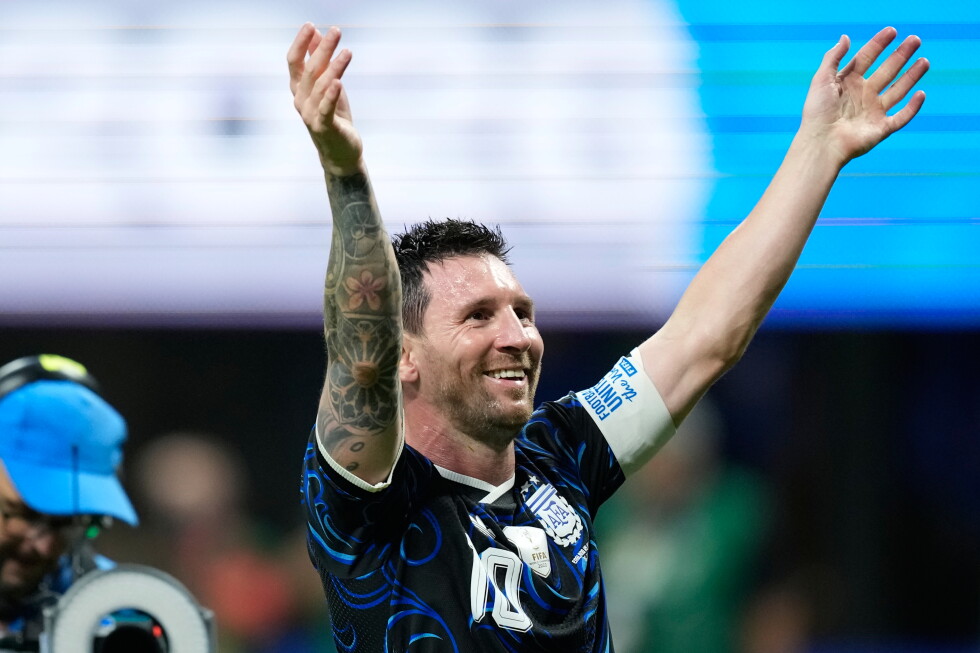
Reigning World Cup champion Argentina has booked its spot in a second consecutive World Cup final, capping off another stunning late comeback with a 2-1 semifinal win over England on Wednesday. But the Albiceleste’s run to the final has been overshadowed by persistent claims of biased officiating and systemic favoritism from defeated opponents and critics online, leading star captain Lionel Messi to issue a sharp, public rebuke of his team’s detractors.
Trailing 1-0 until the 85th minute of Wednesday’s match, Argentina pulled two late goals to secure a place in Sunday’s final against Spain, marking the latest in a string of dramatic late comebacks throughout the tournament. The 2-1 win sent tens of thousands of jubilant Argentines flooding into the streets of Buenos Aires to celebrate the historic achievement, one that puts the nation 90 minutes away from becoming the first men’s team in decades to win back-to-back World Cup titles.
This run of comeback victories is not new for Argentina in this tournament. Earlier in the competition, Argentina defeated Cape Verde and Switzerland in extra time, and pulled off an nearly impossible 3-2 win over Egypt after erasing a 2-0 deficit in the final 11 minutes of regulation. But each of those wins sparked immediate controversy, with the opposing managers and federations publicly accusing match officials and global soccer governing body FIFA of tilting the playing field in favor of Messi and Argentina.
Egypt manager Hossam Hassan went as far as to call his side “the victim of a soccer establishment” that prioritizes keeping the global superstar and defending champion in the tournament. Swiss manager Murat Yakin echoed those frustrations after his side’s exit, pointing to a controversial call that saw star striker Breel Embolo sent off for a second yellow card, after replays suggested Argentina’s Leandro Paredes made minimal contact before Embolo fell. The Egyptian Football Association released a formal statement saying it “cannot remain silent” over what it calls unfair, biased officiating in its narrow loss.
These on-field controversies have fueled widespread chatter across social media, where unsubstantiated claims have spread that FIFA deliberately structured the tournament bracket to benefit Argentina and that the governing body is pushing for a second consecutive title for Messi’s side, one of the sport’s most marketable and popular teams.
Until after the England win, the Argentine camp had downplayed the ongoing criticism. Head coach Lionel Scaloni previously brushed off questions about the claims, advising reporters “not to consume so much social media,” and reiterated after the semifinal that the complaints do not bother the squad. “This talk of ‘help’ will always exist… With VAR today, it’s very difficult to get help; it would have to be glaringly obvious. We knew there was no help,” Scaloni said.
But Messi chose to push back directly on the accusations after sealing a place in the final. “Nothing was handed to us,” the eight-time Ballon d’Or winner said. “We’ve been the best over these past four years, either you like it or not, and no matter what anyone says. Once again, we’ve established ourselves among the top two teams in the world. That proves that everything we’ve done is no fluke and that nothing was handed to us. Reaching two consecutive World Cup finals is something very few achieve, and this group did it. If we had lost to England, there would have been people coming out to spout some nonsense, but we didn’t give them the chance.”
Midfielder Enzo Fernandez, who scored Argentina’s game-tying goal against England, also acknowledged his celebration was a direct response to critics. After equalizing, he first cupped his hands to his ears, a common soccer gesture to taunt critics, then opened and closed his hands to invite more criticism. “There was a lot of talk; it was a mix of euphoria and frustration,” Fernandez explained.
The semifinal against England also carried political tension that extended beyond the pitch, due to the long-running sovereignty dispute over the Falkland Islands (known as the Malvinas to Argentina, which claims the territory as its own). After the win, the British government called on FIFA to launch an investigation after Argentina players posed with a fan banner reading “Las Malvinas son Argentinas” (“The Malvinas are Argentine”).
Argentina will now face Spain in the World Cup final this Sunday, vying for the first men’s back-to-back World Cup title since Brazil won in 1958 and 1962.