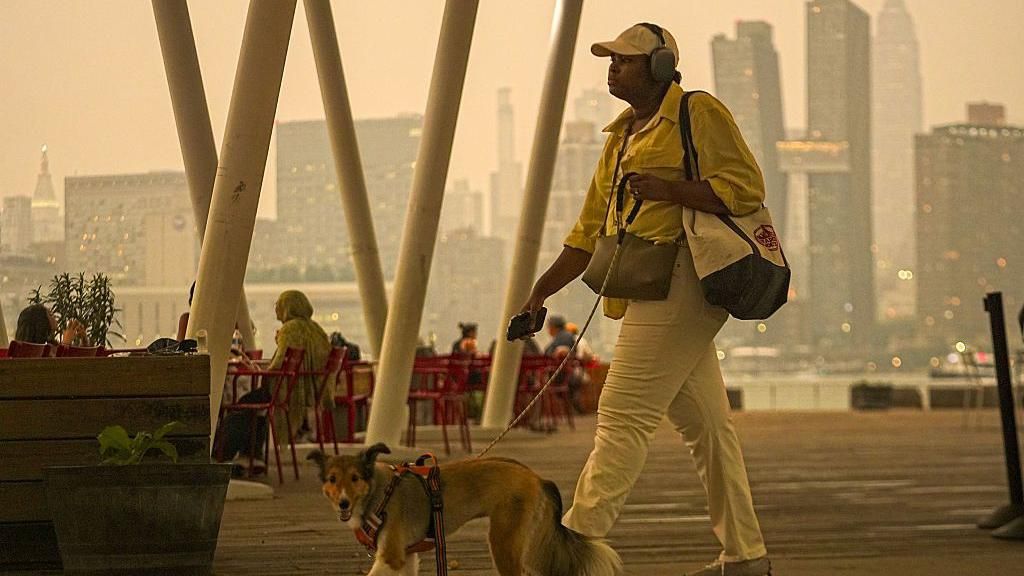
A historic outbreak of extreme wildfire activity across Canada has sent thick plumes of toxic smoke south into the United States, triggering widespread air quality emergencies across more than a dozen states and disrupting daily life for millions of people. As of Thursday, data from the Canadian Interagency Forest Fire Centre confirms 857 active blazes are burning across the country, with 23 new ignitions recorded in just 24 hours. The Canadian Wildland Fire Information System reports that the overwhelming majority of these fires remain completely out of control, leaving firefighting crews stretched thin across vast swathes of forested land.
The worst cluster of blazes is concentrated in northwestern Ontario, where raging flames have already disrupted regional transportation and forced emergency responses. On Wednesday, dramatic footage captured a freight train operated by Canadian National Rail completely surrounded by fast-spreading wildfire near the small northern town of Armstrong, prompting an urgent rescue call for the crew on board. In a follow-up statement, the railway confirmed all workers were evacuated safely, but rail operations through the affected region have been paused indefinitely to avoid further risk to staff.
Smoke from these Ontario blazes has drifted hundreds of miles south, creating dangerous air conditions that stretch from the Upper Midwest through the Great Lakes and into the Northeast U.S. The U.S. National Oceanic and Atmospheric Administration (NOAA) issued updated air quality alerts Thursday covering thousands of square miles across this entire corridor. The U.S. Air Quality Index has classified conditions in large parts of Michigan, Minnesota, and the Minneapolis-St. Paul metropolitan area as “hazardous,” the most severe rating on the scale. Official guidance urges all residents in these zones to limit outdoor activity and keep windows closed, with sensitive groups including children, the elderly, and people with respiratory conditions advised to remain indoors entirely.
Independent air quality monitoring group IQAir currently ranks Detroit, Michigan as the city with the worst air pollution on Earth, with Minneapolis and Toronto claiming the second and third spots respectively. In New York City, cameras captured hazy, orange-tinged skies on Wednesday as lower concentrations of smoke settled into the upper atmosphere. The smoke has also altered natural light conditions, bringing vivid red sunrises and darker orange sunsets to cities across the Northeast and Great Lakes.
Meteorologists forecast that northwesterly wind patterns will continue pushing smoke south into U.S. states through the end of the week and into the weekend, raising concerns that poor air quality could reach New Jersey, the host location of Sunday’s World Cup final. While widespread thunderstorms are forecast for Ontario over the next several days, NOAA analysts note that the projected rainfall is unlikely to be heavy enough to fully extinguish the deep-rooted wildfires. A projected shift in wind direction by early Monday is expected to steer smoke plumes east toward Quebec, which should bring gradual improvement to air quality across the affected U.S. regions.