One of the deadliest wildfires in recent Spanish history, which claimed at least 12 lives as residents and visitors fled its rapid advance in southern Spain’s Andalusia region, has been fully contained, officials announced Sunday. The containment order clears the way for roughly 1,500 displaced people to return to their properties over a phased timeline.
Juan Manuel Moreno, president of the regional Andalusian government, confirmed to reporters that the blaze has been locked within its burned perimeter with no remaining risk of spread. “This marks, in a sense, the beginning of the end of a terrifying wildfire that set records for the speed of its advance,” Moreno said.
The first wave of returning residents, made up of around 600 people evacuated from Almeria province’s high-risk fire zone, were allowed to go back to their homes Saturday evening. The remaining 1,000 evacuees will follow in staged groups to ensure safety, Moreno added.
Scorched, abandoned vehicles still sit along rural roads where many victims became trapped as the fire raced through the landscape at speeds of up to 100 meters per minute. All 12 confirmed fatalities were people who became trapped in their vehicles or while attempting to escape on foot, according to official accounts.
Jerome Navarro, a French tourist who arrived at his Spanish holiday home just as the fire advanced, described the chaotic speed of the blaze to French media Saturday. “I said to my wife ‘Get out quick, leave everything. Get out.’ And the time it took to say that I was engulfed in a ball of fire,” a tearful Navarro recalled. Navarro survived by throwing himself into a ditch and crawling to safety, but his wife remains missing.
Officials have kept the official death toll at 12, noting that the full number of missing people cannot be confirmed until autopsies and DNA identification of recovered remains are complete. Many of the victims are believed to be foreign nationals, a detail that has slowed identification work as officials wait for DNA samples from relatives traveling from overseas.
Spain’s Civil Guard is conducting a final, comprehensive search of the fire-ravaged area Sunday to account for all missing residents and visitors. Civil Protection Secretary-General Virginia Barcones told Spain’s public broadcaster that officers have already cleared more than 250 homes to confirm no one was trapped inside, and the final sweep will confirm no unaccounted victims remain. “I sincerely hope they don’t find anyone else, but we need to carry out one final thorough search to make sure that’s the case,” Barcones said.
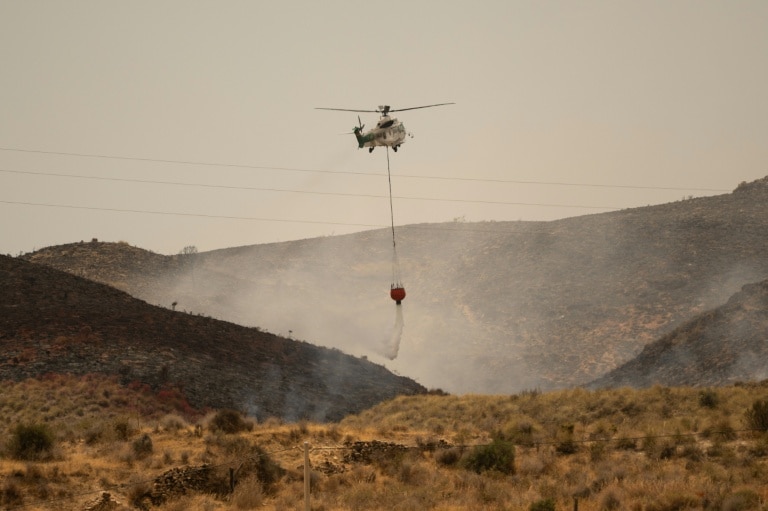
A shift to calmer winds and higher atmospheric humidity allowed firefighters to launch direct assaults on the blaze for the first time Saturday, bringing the fast-moving fire under control after days of difficult conditions. Around 500 firefighters, supported by water-dropping helicopters and aircraft, have worked around the clock to contain the blaze that broke out Thursday in the Gallardos area, a region popular with foreign retirees and holiday homeowners.
Authorities suspect the fire started when a power line snapped amid an prolonged extreme heatwave that has pushed regional temperatures above 40°C for weeks. Unusually wet winter and spring conditions spurred dense vegetation growth across the region, which then fully dried out in successive heatwaves, creating ample fuel for a catastrophic blaze. So far, the fire has destroyed roughly 7,000 hectares of land.
Manoli Ramos, a 72-year-old city councilor in the small village of Bedar where multiple victims were found, described the scene as apocalyptic. “We were absolutely terrified. We could see the flames. It was horrific, it was like hell,” Ramos told AFP.
Spanish Prime Minister Pedro Sanchez is scheduled to visit the fire-stricken area Monday to meet with first responders and displaced residents. Scientists have widely documented that human-caused climate change from fossil fuel emissions is increasing the frequency and intensity of extreme heat events that drive major wildfires across Southern Europe. Last year, wildfires burned nearly 400,000 hectares of land across Spain — the highest annual total recorded by the European Forest Fire Information System in the country’s history.