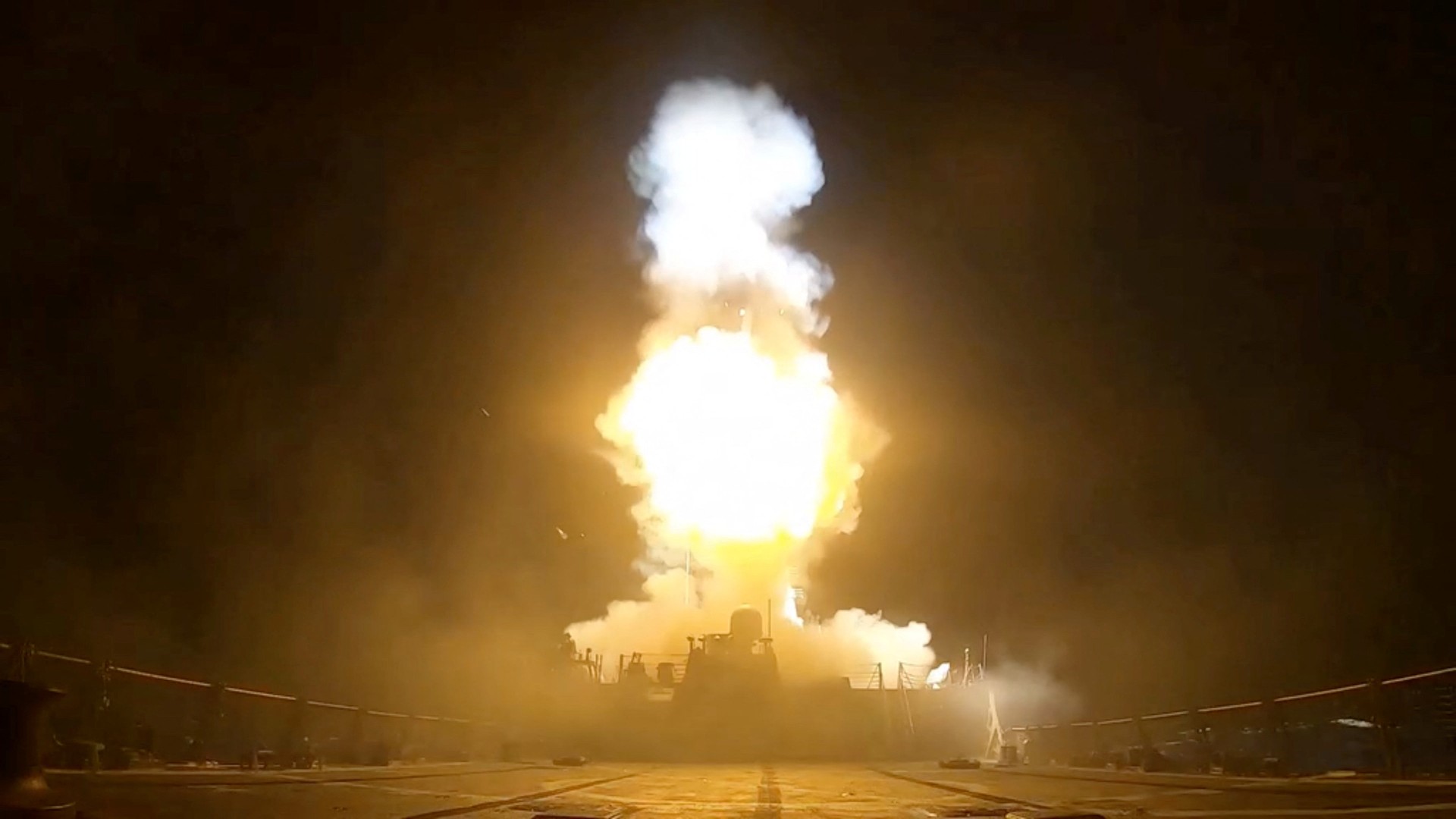
A rapidly escalating cycle of retaliatory violence has plunged the Persian Gulf into chaos this week, after the United States launched a third consecutive night of airstrikes targeting Iranian assets across Iranian territory, prompting Tehran to launch sweeping missile and drone counterattacks across multiple Gulf states and announce the immediate closure of the strategic Strait of Hormuz.
The latest escalation traces back to an early Sunday strike by U.S. forces, launched after Iran’s Islamic Revolutionary Guard Corps (IRGC) opened fire on a Cyprus-flagged container vessel that the Iranian force claimed was traversing the Strait of Hormuz via an unapproved shipping route. The IRGC confirmed shortly after that it had targeted a second commercial vessel, accusing it of also violating regional maritime regulations.
Local Iranian media reported multiple large explosions across key Iranian locations within hours of the U.S. Sunday strike, including the southern port city of Bandar Abbas, the coastal towns of Sirik and Jask, Qeshm Island off Iran’s southern coast, and the southwestern Khuzestan province — regions that host critical Iranian military and energy infrastructure.
The conflict quickly spilled across national borders as air raid sirens blared across Bahrain and the United Arab Emirates (UAE) just hours after the initial strikes. Qatar reported that it had intercepted incoming Iranian missile fire, with three people including one child wounded in the attack. Kuwait confirmed it was also working to intercept incoming hostile projectiles, while Jordan announced that three Iranian missiles had impacted inside its territory.
In official statements carried by Iranian state media, the IRGC claimed responsibility for all cross-border attacks, stating it had destroyed a command and control center and drone storage hangars in Jordan, targeted a U.S. radar installation in Kuwait, and taken out a fighter jet maintenance hub and command facility in Qatar. The force also claimed it had destroyed U.S. naval logistics support centers and aircraft carrier refueling infrastructure at Oman’s Port of Duqm. The UAE later clarified that all missile threats detected earlier in the day had fallen outside its national borders, causing no damage or casualties on its territory.
Per Iran’s official state news agency IRNA, the IRGC issued a formal announcement of the Strait of Hormuz closure shortly after the initial vessel attacks, stating: “Following this incident … the Strait of Hormuz will be closed until further notice and until the end of American interventions in this region.” The U.S. Central Command (Centcom) pushed back against this announcement immediately, confirming that commercial shipping traffic continues to move through the critical waterway, which handles roughly 20% of global oil trade.
Details of the initial vessel attack have slowly emerged: Centcom confirmed the Cyprus-registered container ship GFS Galaxy was disabled by fire and structural damage to its engine room, with one crew member unaccounted for. The United Kingdom Maritime Trade Operations (UKMTO) agency reported the entire crew abandoned the damaged vessel and took shelter on a life raft, noting the incident occurred roughly 17 kilometers east of Omani territorial waters. India’s Ministry of External Affairs later confirmed that the missing crew member is an Indian national; of the 11 Indian citizens on board the vessel, 10 have been successfully rescued, and the Indian government has formally condemned the attack.
U.S. defense officials laid out the scope of the three-night campaign this week, noting that U.S. forces struck 140 Iranian targets on Saturday alone, bringing the total number of targets hit to more than 300. Centcom says the strikes are intended to degrade Iran’s capacity to attack civilian mariners and commercial vessels moving freely through the strait. U.S. Defense Secretary Pete Hegseth issued a blunt warning following the counterattacks, stating: “Iran made a poor choice. Now they pay.”
The rapid escalation of violence has effectively ended a weeks-long ceasefire between the U.S. and Iran, a development confirmed by U.S. President Donald Trump. The breakdown of the truce has thrown deep uncertainty over ongoing diplomatic efforts to reach a long-term ceasefire and de-escalation agreement, which had been progressing slowly in recent weeks.
Iran’s top parliamentary speaker and leading nuclear negotiator Mohammad Bagher Ghalibaf reinforced Tehran’s hardening stance in a post on the social platform X, writing: “The era of one-sided deals is OVER. We told you: keep your word or pay the price. Reality is knocking.”
Interestingly, the large-scale fighting broke out just one day after a round of diplomatic talks held in Oman on Saturday, which brought together Iranian Foreign Minister Abbas Araghchi and his Omani counterpart Badr Albusaidi. Iranian foreign ministry spokesperson Esmail Baqaei confirmed Sunday that the talks were focused on coordinating new shipping and transit rules for the Strait of Hormuz, with legal and technical delegations from both sides discussing maritime security and safety standards. A Qatari delegation also attended the talks, and Baqaei added that both sides agreed to continue political and technical talks to reach a shared understanding on the issues.
The escalation also comes on the heels of a formal statement from Iran’s new supreme leader, Ayatollah Mojtaba Khamenei, who issued a written threat Saturday to avenge the death of his father and predecessor, Ali Khamenei.