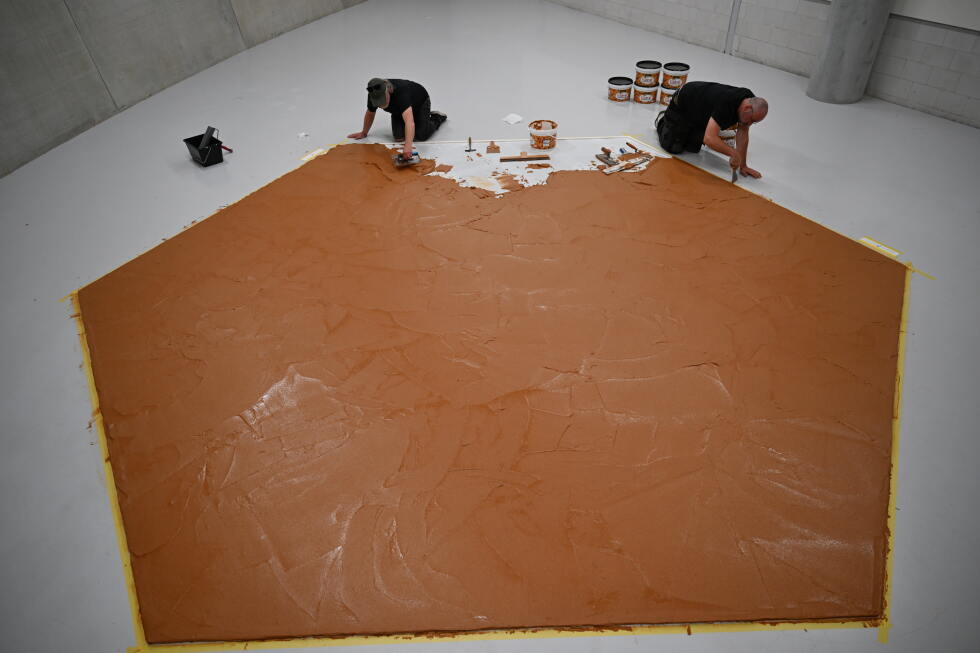
In a heartfelt tribute to groundbreaking Dutch conceptual artist Wim T. Schippers, who passed away last month at the age of 83, Rotterdam’s Museum Boijmans Van Beuningen has recreated one of his most iconic and absurdist works: an entire exhibition floor covered in 800 pounds of creamy peanut butter. Enough to make roughly 15,000 peanut butter sandwiches, the sweet, sticky installation — known originally by its Dutch name Pindakaasvloer, or Peanut Butter Floor — first debuted to public audiences in 1969, when Schippers first challenged long-held conventions about what qualifies as fine art. The new iteration of the work will open to visitors this Friday and remain on display for a two-month special engagement.
Schippers, a cultural pioneer whose career spanned decades, was far more than a visual conceptual artist. He also lent his voice to two beloved characters for the Dutch-language adaptation of the iconic children’s television series *Sesame Street*, portraying both Ernie and Kermit the Frog for generations of Dutch viewers. Throughout his career, he built a reputation for creating playful, thought-provoking works that upended traditional assumptions about art’s purpose and form. The Peanut Butter Floor was not an isolated experiment: it was part of his broader Floor Covering Series, which also included equally unorthodox installations featuring floors covered in broken glass shards and granular salt.
When Pindakaasvloer was exhibited for the second time at Utrecht’s Central Museum in 1997, Schippers summed up his delight in the work’s ability to spark conversation and confusion. “Isn’t it fantastic that we are all standing here looking at peanut butter?” he asked a crowd of gathered reporters at the time.
For visitors who saw that 1997 showing, the work left a far more visceral impression beyond its conceptual novelty. Mieke Weismann, a food photographer and writer who attended the exhibition as a teenager, recalled the overwhelming sensory experience for the Associated Press. “The thing I remember is the smell,” she said, noting that the thick, nutty aroma of the peanut butter drifted through every corner of the museum.
Recreating the legendary installation was no small feat for Museum Boijmans Van Beuningen’s staff. Last week, two full-time employees spent multiple days smearing 40 buckets of peanut butter across a 270-square-foot hexagonal section of the exhibition floor. Using ordinary drywall trowels, the pair worked the creamy spread into an even layer roughly 0.8 inches thick, matching the loose spirit of Schippers’ original work rather than strict technical specifications: the artist never laid out exact requirements for the installation’s size, shape, thickness, or even what type of peanut butter to use. For this tribute, Dutch peanut butter brand Calvé stepped in to donate hundreds of pounds of its signature smooth product.
Over the decades, the interactive nature of the work has led to unexpected moments of audience participation that Schippers always embraced. During a 1997 showing, a group of visitors “vandalized” the installation by placing 12 slices of bread and several bags of hagelslag — a popular Dutch chocolate sprinkle topping commonly eaten on breakfast bread — across the peanut butter surface. Far from being upset, Schippers reacted with characteristic good humor when speaking to Dutch newspaper *Volkskrant* at the time. “It doesn’t look bad,” he said. “The sprinkles have been applied with a sense of proportion and a skillful hand.” On another occasion in 2011, multiple visitors even stepped directly onto the sticky surface, leaning into the work’s invitation to break down barriers between art and audience.