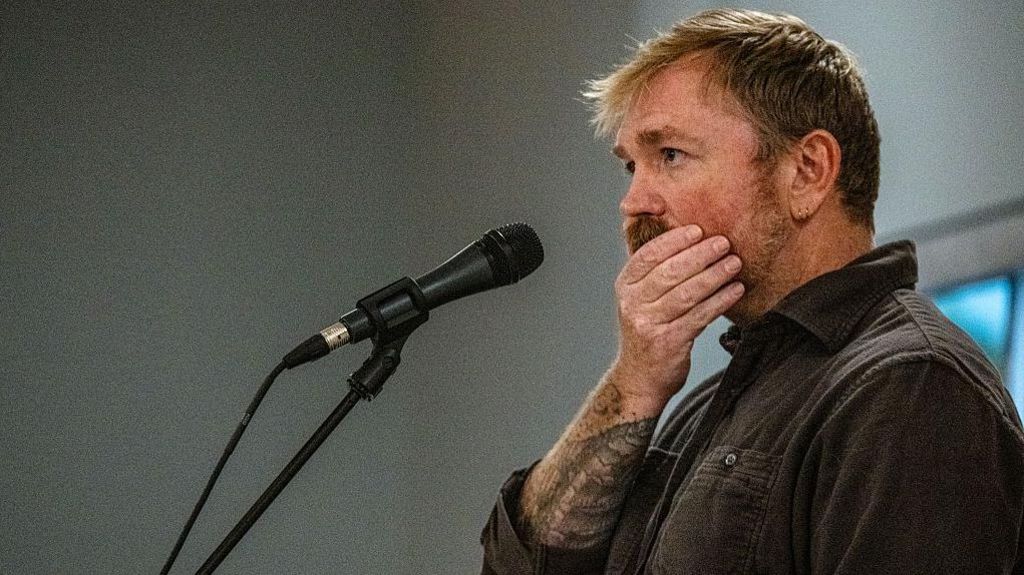
In a sudden and dramatic turn that has upended one of the nation’s most competitive congressional contests, Graham Platner, the Democratic nominee for Maine’s high-stakes U.S. Senate race, announced Wednesday night he was suspending his campaign. The exit comes just 48 hours after a bombshell report from Politico detailed a sexual assault allegation from Platner’s ex-girlfriend, who accuses him of entering her home uninvited while intoxicated in 2021 and assaulting her — claims Platner has forcefully denied.
Platner, an oysterman and former U.S. Marine who pulled off one of the most shocking primary upsets in recent Democratic politics, saw his rapid ascent from political obscurity collapse into chaos this week. After defeating popular sitting Maine Governor Janet Mills, a candidate hand-picked by party establishment leaders, Platner built a grassroots movement of more than 15,000 supporters across the state and earned endorsements from progressive icons Senator Bernie Sanders of Vermont and Senator Elizabeth Warren of Massachusetts. He was tapped as the party’s official challenger to five-term Republican incumbent Susan Collins, a race widely viewed as make-or-break for Democrats hoping to flip control of the U.S. Senate in November’s midterm elections.
This latest allegation is not the first controversy to trail the first-time candidate. Since he launched his campaign last August, reports have emerged of offensive past social media posts, a chest tattoo with documented Nazi ideological ties, sexually explicit text messages sent to women after his 2023 marriage, and multiple accusations from former partners of threatening, toxic behavior. Despite these repeated red flags, 72% of Maine Democratic primary voters backed Platner in June’s nominating contest, a testament to the appetite among the party’s base for anti-establishment, working-class progressive candidates.
But in the wake of the new sexual assault allegations, political support evaporated within hours. Every major institutional backer, including Sanders and Warren, withdrew their endorsements, and the national Democratic Party cut off all campaign funding. By midweek, it was clear Platner’s campaign could not survive. In his 11-minute pre-recorded announcement video posted to social media, however, Platner pushed back against the narrative that he was stepping down over the allegation. “We went toe to toe with one of the most entrenched political systems in the history of the world, and we won,” he said. “And now they are not going to let us have it, not if it’s me.” He added he would not formally file withdrawal paperwork until he secures guarantees that his replacement will be chosen through an open, democratic process, rather than picked behind closed doors by party leaders.
The sudden exit has thrown Maine Democrats and national party strategists into panic mode. To win a Senate majority this November, Democrats must flip four Republican-held seats while defending all of their own incumbents, making the Maine seat a critical must-win target. Platner’s departure has not only derailed months of campaign planning but also re-opened deep, long-simmering rifts between the party’s progressive grassroots wing and moderate establishment that could have ripple effects all the way to the 2028 presidential election.
State party leaders are now rushing to select a new nominee before a mandatory July 27 deadline, announcing this week that a convention of hundreds of delegates will pick a replacement within the next two weeks, with a promise of public input to avoid accusations of a closed-door power grab. The process has already sparked open friction: state party chair Devon Murphy-Anderson accused Platner’s campaign of attempting to manipulate the selection process, a claim Platner’s allies rejected, countering that they only want an open process that blocks an establishment-backed candidate from being anointed without input.
Political observers warn that mismanaging the nominee selection could alienate Platner’s passionate base, a group Democrats desperately need to turn out in November. “So much of Platner’s base, whose passion Democrats are going to want to have, will sit on their hands and be very angry if it looks like this is another case of the establishment triumphing over what the people want,” said James Melcher, a politics professor at the University of Maine at Farmington.
Multiple established Maine political figures have already signaled interest in stepping into the race, including former Maine Senate leader Troy Jackson, former gubernatorial candidate and state epidemiologist Nirav Shah, and current Maine Secretary of State Shenna Bellows, who was the Democratic nominee against Collins in 2014. Still, former state Senator Lynn Bromley, who backed Mills in the primary, warned that uniting voters around a new candidate in just three months will be an uphill battle. “The thing I’m the most worried about is we run somebody and he or she loses, and then we spend the next four years pointing fingers at whose fault that was,” she said.
Platner’s campaign represented a key test of a growing national trend among Democratic voters: the embrace of outsider candidates who promise uncompromising progressive policy, including universal healthcare, a wealth tax, and expanded affordable housing, and appeal to working-class rural voters that have increasingly abandoned the party in recent cycles. A Platner win in November would have cemented the case that left-wing, working-class candidates can win competitive battleground seats, a precedent that would have boosted prospects for a progressive presidential nominee in 2028. That opportunity is now all but gone.
Analysts note that Platner’s survival through multiple earlier scandals underscores how hungry Democratic voters are for a new kind of political representation, but it also highlights the major risks of nominating charismatic political newcomers who have not undergone rigorous vetting before running for high office. While some Maine Democrats argue the upheaval could be a blessing in disguise, allowing the party to put forward a more vetted, traditional candidate, the clock is ticking, and five-term incumbent Collins — a proven tough competitor who has defeated Democratic challengers for 30 years, including overcoming poll deficits to win in 2020 — waits for whoever emerges. “It’s not as though it was going to be easy before, and now it’s hard,” Melcher noted. “Beating Collins was always going to be hard.”