MIAMI GARDENS, Fla. — The expanded 48-team 2026 FIFA World Cup has reached its final eight teams, and the competition’s historic power dynamic remains largely intact. Six of the eight remaining quarterfinalists call Europe home, with just one spot filled by a South American side and one by an African representative. Unless Morocco can pull off two consecutive upset wins to claim the trophy, the world championship will once again go to a nation from either Europe or South America — a trend that has held for nearly 100 years of World Cup history.
Since the first tournament kicked off in 1930, 22 editions of the World Cup have concluded. All 22 championships have been split exclusively between European and South American teams: 12 titles have gone to European sides, while 10 have been claimed by South American squads. No nation from any other confederation has ever reached the top of the podium. This year’s quarterfinal lineup, with only two non-European/South American teams in the field, does little to upend that long-standing status quo.
Even for Europe, this tournament has delivered stronger-than-expected results, according to some of the continent’s top stars. Erling Haaland, the talismanic Norwegian striker, notched a brace to lead his nation past Brazil and secure Norway’s first-ever World Cup quarterfinal berth — a result he called surprising. “I thought it was not possible to do some things,” Haaland said. “I guess I’m wrong.” Haaland’s unexpected success stands in sharp contrast to the disappointment suffered by this year’s joint tournament hosts, the United States, Mexico, and Canada, all from the North American, Central American and Caribbean Football Confederation (CONCACAF).
Expanded to 48 teams for the first time, this World Cup gave North America three chances to break the European-South American stranglehold on the late stages of the tournament. All three hosts navigated the group stage and the newly introduced round of 32 with impressive form, posting a combined 9 wins, 2 draws, and 1 loss across those early matches while outscoring their opponents by a 20-goal margin. Early optimism quickly evaporated when the round of 16 kicked off, however.
England eliminated Mexico 3-2, Belgium rolled to a lopsided 4-1 win over the U.S., and Morocco cruised to a 3-0 shutout of Canada. All three hosts exited the tournament in that round, finishing with a combined 0-3 record and being outscored by seven goals across their three knockout matches. The result extended a long drought for CONCACAF: no North American side has reached the World Cup quarterfinals since Costa Rica’s 2014 run, and the region’s most recent deep run before that was the U.S.’s historic third-place finish in 1930, followed by a quarterfinal appearance in 2002. Canada has never advanced past the round of 16, while Mexico has reached that stage eight times in its last nine World Cup appearances — and never moved further.
“We need to get over that next hurdle,” U.S. star Christian Pulisic said in a post-elimination televised interview. “Trying to compete and beat the world’s best, that’s our next step … There’s still another step that we have to take.” Mexico midfielder Erik Lira echoed that sentiment, saying “Everyone gave everything. But, in the end, it wasn’t enough.”
That refrain has become a familiar one for every region outside of Europe and South America. Only once in the last two decades has the quarterfinal field featured broad representation from across the globe: the 2002 tournament saw five different confederations — Europe, South America, Asia, Africa, and North America — all claim spots in the final eight. That tournament remains a rare outlier: across the six World Cups held since 2002, Europe has claimed 30 of 48 total quarterfinal spots, South America has taken 14, Africa has earned three, and North America has secured just one.
This year, Africa entered the knockout stage poised for a potential breakthrough, sending 10 teams to the expanded tournament with nine advancing to the round of 32. Morocco is the only African side that remains, after most other African nations were eliminated by late, devastating goals. Ivory Coast, South Africa, and Congo all conceded match-deciding goals in the 86th minute or later to bow out of the competition. Cape Verde’s surprising run ended with an own goal against defending champion Argentina in extra time. Senegal and Egypt suffered particularly heartbreaking exits: both held 2-0 leads late in the second half, only to collapse to 3-2 defeats at the hands of Belgium and Argentina, respectively.
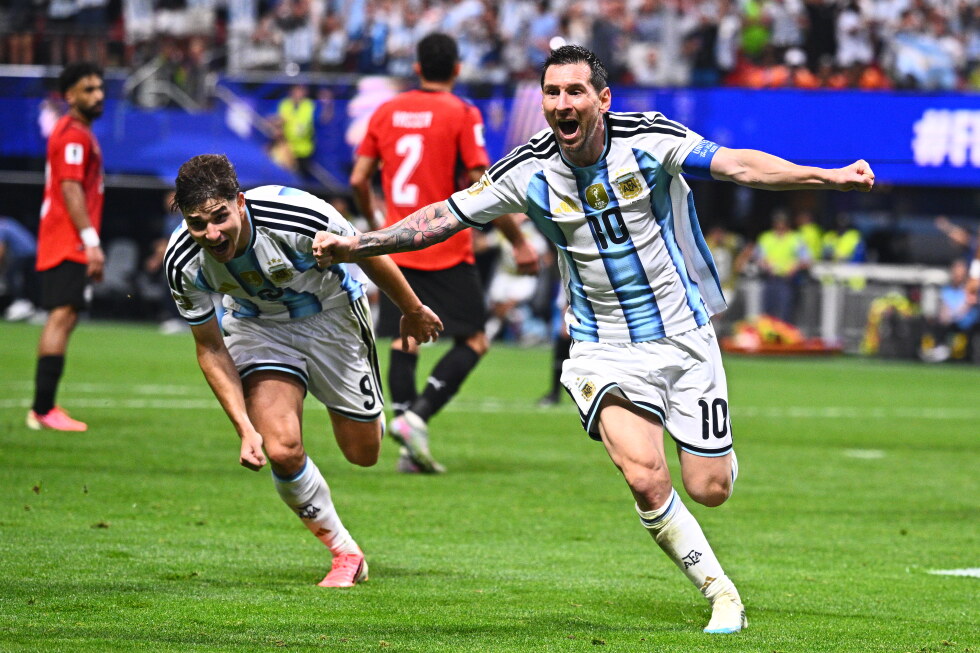
Egypt’s coaching staff has alleged that biased officiating cost their team the win. “Perhaps they wanted to keep the world champion in the competition,” Egypt coach Hossam Hassan said. “Perhaps they wanted Messi to stay in the competition.” For Argentina and Messi, the comeback win simply延续了 the consistent success that elite powerhouses have enjoyed at the World Cup. Messi’s side has reached the quarterfinals in five of the last six tournaments, a reminder that some hierarchies remain hard to shift.
“It wasn’t easy to come back from a 2-0 deficit in a World Cup knockout match — especially given how games are going these days, where no one gives you anything for free,” Messi said after the match. “But thank God, we did it once again.” As the tournament enters its final two weeks, all eyes will be on Morocco to see if it can finally rewrite the World Cup’s long-standing narrative.