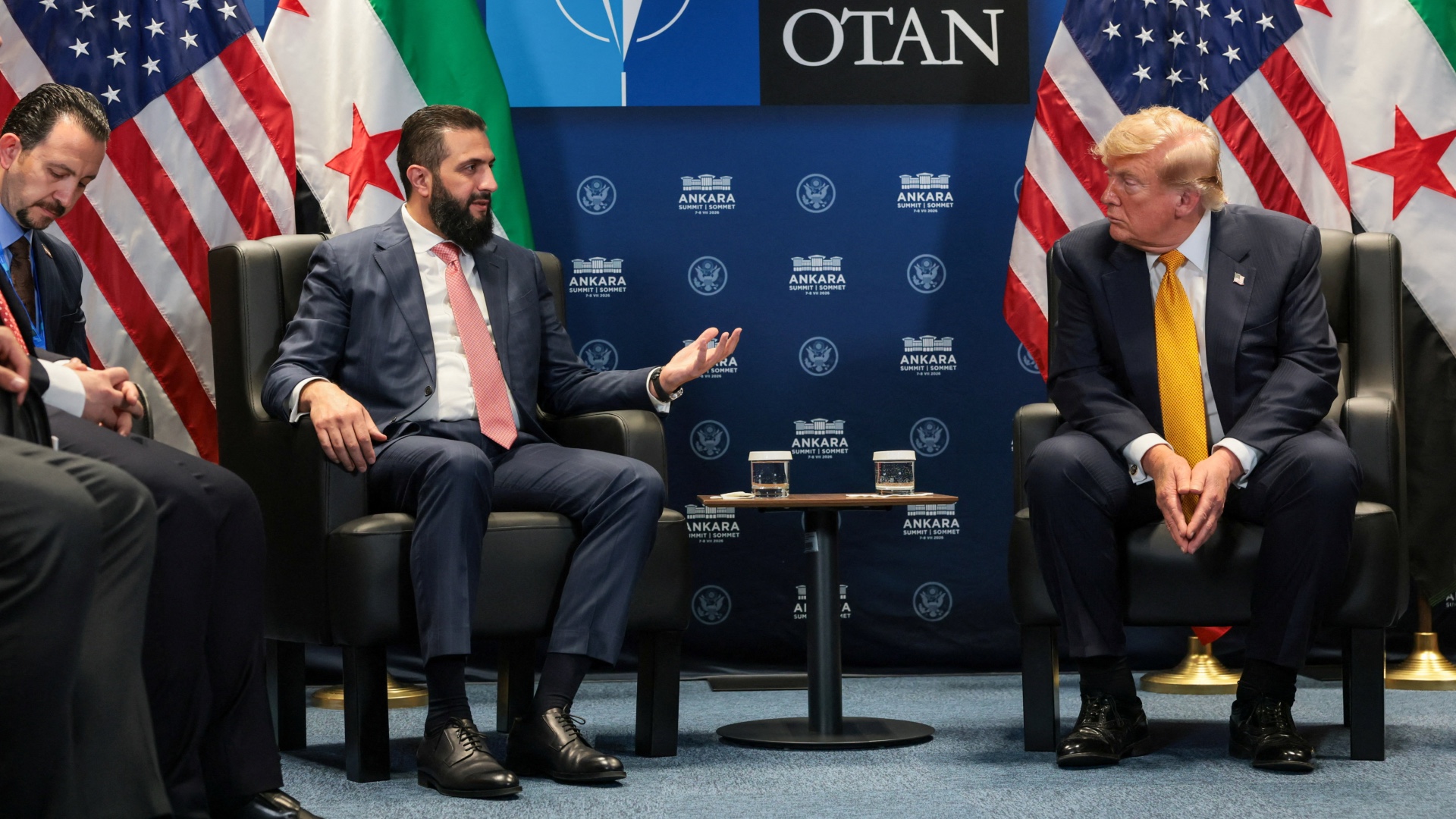
On the sidelines of the NATO summit held in Ankara, Turkey, Wednesday marked a historic milestone in U.S.-Syria relations: former U.S. President Donald Trump offered unusually glowing public praise to Syrian President Ahmed al-Sharaa, branding him a fantastic and highly respected global leader following their closed-door meeting.
This high-profile encounter represents another major breakthrough for al-Sharaa, whose rapid political ascent on the international stage has unfolded at breakneck speed over the past 18 months. Just over a year ago, he was first introduced to Trump during a gathering in Riyadh, Saudi Arabia. By November of that same year, he had stepped into the Oval Office to exchange diplomatic gifts with the U.S. president — a moment no Syrian leader, particularly one once labeled a terrorist by Washington, had achieved in decades.
Turkey has been the primary architect of al-Sharaa’s rise to power since December 2024, with Ankara pursuing a clear geopolitical goal: establishing a friendly Syrian government in its neighboring country that falls firmly within Turkey’s regional sphere of influence. Trump’s quick diplomatic embrace of al-Sharaa has already emerged as one of the most consequential and eye-catching foreign policy shifts of his current term.
Speaking directly to reporters while seated beside al-Sharaa, Trump doubled down on his positive assessment of the Syrian leader. “He’s done a really fantastic job as president. He’s unified the country in a very short period of time, I’d say like a year and a half, about a year and a half, and right from the beginning it was a real mess, very disjointed place, and he’s brought it together,” Trump said. He added, “He’s a strong person. He’s a great leader. He’s respected by everybody, including me, and we’re proud to have him.”
Notably, Trump’s warm remarks toward al-Sharaa stand in sharp contrast to his consistently harsh rhetoric toward many of America’s long-standing traditional allies, most of whom are core members of the NATO alliance hosting this very summit. Trump has repeatedly scolded the leaders of major European powers including the United Kingdom, France, Germany, and Spain, accusing them of weak leadership on defense policy and immigration. He has also launched public attacks on Denmark over the country’s claim of sovereignty over Greenland, and is currently engaged in a very public, escalating feud with Italian Prime Minister Giorgia Meloni. Since March, he has further ramped up critical rhetoric targeting any nations that have refused to join his hardline campaign against Iran.
Just 14 months ago, al-Sharaa — who once had a $10 million U.S. bounty placed on his head over his former extremist ties — saw Trump announce the historic lifting of crippling economic sanctions on Syria. That landmark policy shift was largely orchestrated by Saudi Arabia, with Gulf states now committing the bulk of funding needed to rebuild Syria’s war-ravaged infrastructure and institutions.
For al-Sharaa, the top remaining diplomatic priority is securing two key wins: removing Syria from the U.S. State Sponsors of Terrorism (SST) blacklist and opening the door to broad international investment in the country. When asked about this goal Wednesday, Trump turned to U.S. Secretary of State Marco Rubio before signaling his clear support for the move, saying “I think we should. Yeah. We’re proud of the job he’s doing. Syria has become very stable.”
The meeting also touched on Trump’s controversial proposal from last month that suggested Syria could take the lead on disarming the Iran-aligned militant group Hezbollah in neighboring Lebanon. Asked about the plan Wednesday, Trump told reporters, “They could help. We’ll find out. I think we’re making a lot of progress.”
While al-Sharaa had previously publicly stated that the proposal was not a feasible option, his foreign minister Asaad al-Shaibani made a high-profile visit to Lebanon last week to meet with Nabih Berri, parliament speaker and leader of the Amal Movement — Hezbollah’s closest political ally. A senior Lebanese official who participated in talks during al-Shaibani’s visit told Middle East Eye that the trip was coordinated with Lebanese authorities to send a deliberate, calming message about Syria’s regional intentions. The official noted, “The visit was very much needed to reassure Lebanon and ease concerns about the possibility of a military intervention pushed by the United States.”