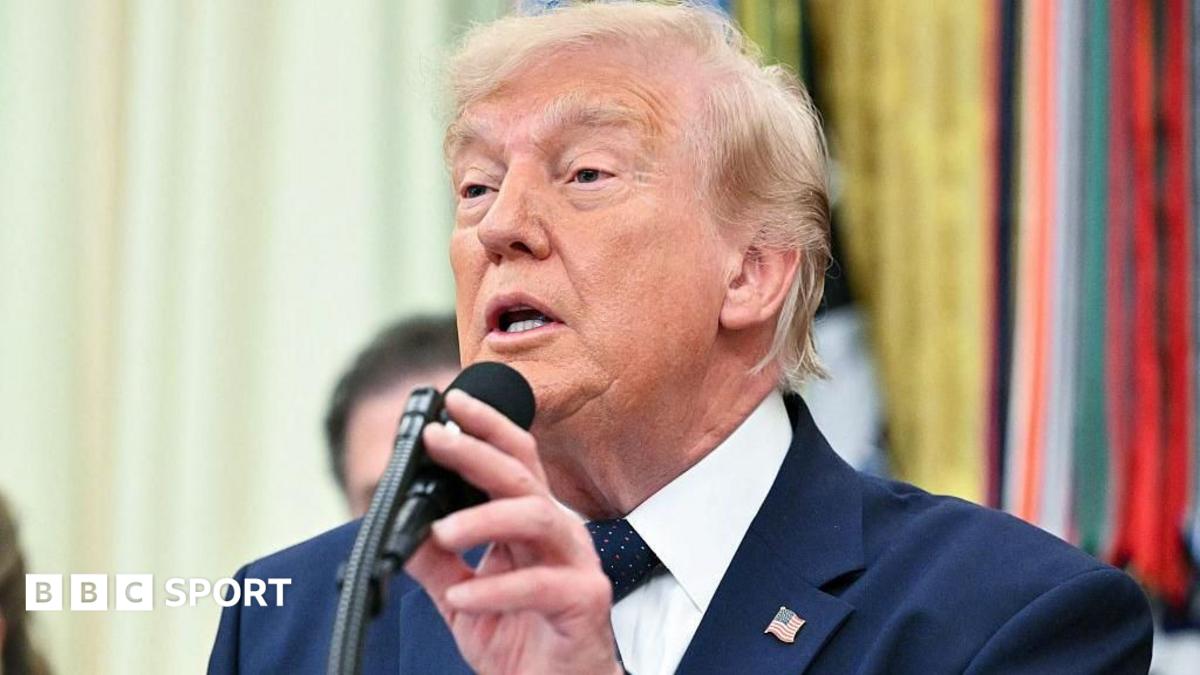
A major controversy has rocked the 2026 FIFA World Cup after global football’s governing body took the unprecedented step of suspending a mandatory one-match suspension for United States striker Folarin Balogun, a decision that came after former U.S. President Donald Trump confirmed he personally requested a formal review of the red card ruling.
The 25-year-old American forward, who has notched three goals for the host nation through the early knockout stage, was initially set to miss the USA’s high-stakes round of 16 clash against Belgium after receiving a straight red card for a foul on Bosnia and Herzegovina defender Tarik Muharemovic in the final group stage match. Under standard FIFA rules, an automatic one-match ban would have immediately barred Balogun from the next fixture.
In a move that has drawn widespread condemnation from football governing bodies and coaches across the globe, FIFA instead opted to suspend the ban for a 12-month probationary period, clearing Balogun to be selected for the Seattle match, which is scheduled to kick off at 17:00 local time on Monday (01:00 BST Tuesday).
Speaking from the White House on Monday, Trump confirmed he had reached out to FIFA to review the original red card decision, arguing the foul did not merit a sending off. “I didn’t think it was a foul,” Trump told reporters. “If they had put through the ban, it would have left a big stain on this entire tournament. They made the right decision.” The former president also confirmed he spoke directly to FIFA President Gianni Infantino, but claimed he only requested a review and did not pressure the governing body to overturn the ban. “I can’t tell them what to do,” Trump said. “I believe it was the independent commission that made the final call, and it was the right decision.” Trump also lashed out at referee Raphael Claus, a Brazilian official who issued the red card, calling Claus’s decision “horrible” and claiming the referee was “a little bit suspect.”
The Brazilian Football Confederation (CBF) quickly issued a formal defense of Claus’s professional integrity, pushing back against Trump’s claims. “There is nothing in his professional record that discredits him or gives any grounds for suspicion,” the CBF said in a statement. “He is an exemplary professional.”
Infantino released his own statement following the call, clarifying that when he received Trump’s request, he informed the U.S. President that the matter would be handled by FIFA’s independent judicial bodies through established legal processes, and that a ruling would be issued in due course by the competent authorities. Later, the FIFA chief emphasized the autonomy of the governing body’s judicial bodies, noting that regardless of personal agreement with a ruling, decisions must be respected. “Respect for independent institutions and the rule of law is what protects the integrity of our competitions and the credibility of FIFA at all times,” Infantino said. When asked by BBC Sport to respond to Trump’s comments about Claus, FIFA declined to add any further comment.
The decision has sparked fierce backlash from across international football. The Royal Belgian Football Association (RBFA) said it was “astonished” by the ruling, while European football governing body UEFA warned that the decision puts the fundamental integrity of the sport at risk. Belgium filed an official appeal against FIFA’s decision to allow Balogun to play, but the appeal was dismissed by FIFA’s appeal committee, which ruled Belgium had no legal standing to challenge the ruling as the team was not a party to the original disciplinary proceedings against Balogun, only the USA’s next opponent.
RBFA reiterated its commitment to challenging the outcome regardless of the match’s result, saying in a statement: “Regardless of the sporting outcome of this match, the RBFA is deeply concerned by the course of events and will continue to fight in the coming hours, days and months in defence of the fundamental principles of ethics, fair competition, and the interests of football as a whole.”
England head coach Thomas Tuchel, who recently had defender Jarell Quansah sent off in England’s dramatic 3-2 group stage win over Mexico, warned the ruling sets a dangerous precedent for future competitions. “Where to draw the line is the question that I ask,” Tuchel said. “Do we appeal if a yellow card is not a yellow card? Do we think it is not a red card or who thinks it? Where does this start and where does this end? It’s my question. I don’t have an answer.”
UEFA went further, saying that political intervention to effectively cancel a mandatory suspension mid-tournament “crossed a red line.” Historical context adds to the controversy: out of the 189 red cards issued in men’s World Cup history prior to this match, only one other player has avoided an automatic suspension. That case, involving Brazil’s Garrincha at the 1962 World Cup, occurred before automatic suspensions were formally codified, and the decision to waive the ban was long dogged by allegations of political interference.
FIFA has cited Article 27 of its disciplinary code, which grants the governing body authority to partially suspend disciplinary measures for a probationary period, as the legal basis for its decision. However, the organization has yet to release a specific public explanation for why it chose to apply this rule to Balogun’s case, further fueling criticism over transparency and fair play.