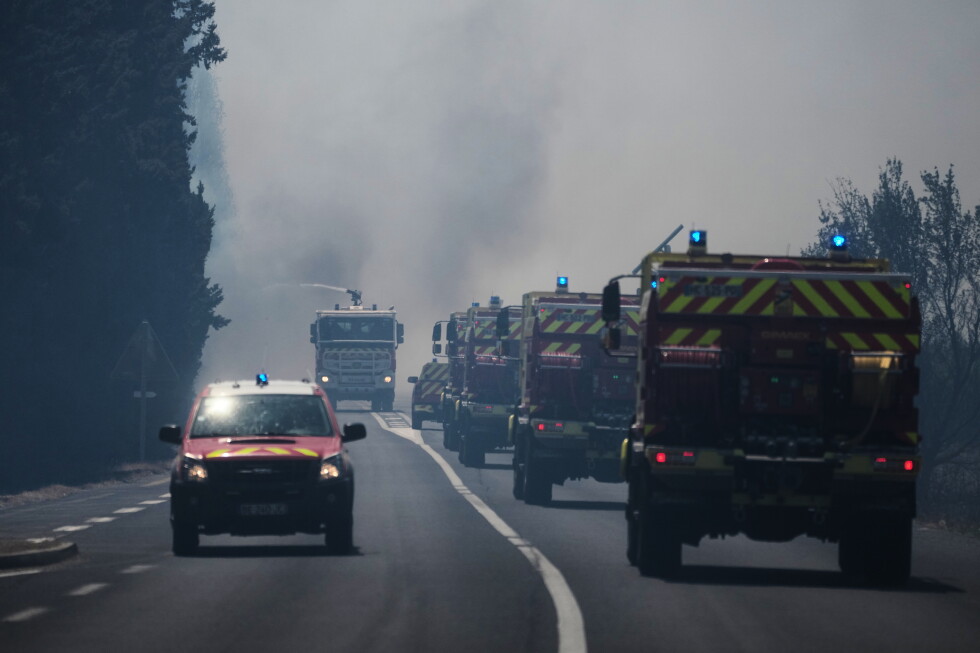
A massive wildfire raging in southern France has forced major last-minute changes to the 2025 Tour de France, becoming the most high-profile disruption of a summer season defined by record heat and spreading wildfires across southern Europe. The world’s most prestigious cycling race, which had completed its opening two legs in Spain, crossed the border into France on Monday for the third stage, a mountain route ending in the Pyrenees town of Les Angles. The blaze sits just 37 miles from the stage finish line, having already scorched more than 4,500 acres of vegetation and land.
Tour de France organizers announced sweeping restrictions to the route for the final 25 miles of the stage, after local authorities confirmed that containing the wildfire required the full mobilization of firefighting crews, security forces and government resources. “The top priority remains the protection of people, property, and natural areas, as well as bringing the fire under control,” local authorities said in a statement.
Under the new rules, the iconic 6-mile publicity caravan of branded sponsor vehicles that precedes the main peloton has been canceled for this section of the route. Only competing riders and race-essential official vehicles are permitted along the course, and spectators were explicitly instructed to avoid gathering along the roadside or at the finish area to reduce security risks and free up resources for fire response efforts.
The ongoing wildfire crisis spans far beyond France, as climate change-fueled extreme heat pushes multiple southern European countries into a state of emergency. Across the border in Greece, 96 separate wildfires ignited across the country in the 48 hours leading up to Monday, according to government spokesman Pavlos Marinakis. While most blazes were contained quickly before spreading, one large fire in the Mandra region west of Athens required an emergency deployment of 29 water-bombing aircraft and more than 200 ground firefighters to contain before nightfall, when aerial firefighting operations are impossible. As of Monday morning, the fire had diminished in intensity but had not been fully extinguished.
Strong winds across much of Greece kept wildfire risk at high or very high levels on Monday. A separate blaze on the southern island of Crete, burning through primarily agricultural land, forced the evacuation of an entire village near Ierapetra as gusty winds pushed the fire forward.
On the Iberian Peninsula, a second major heatwave is sweeping across Spain and Portugal, with hundreds of firefighters already working to contain scattered blazes. Spain’s national weather agency AEMET warned that the heatwave, which began on Sunday, will persist through at least Thursday, bringing record-high daytime and overnight temperatures. Across most of the country, including the capital Madrid, daytime highs were forecast between 99°F and 108°F for Monday and Tuesday, with overnight temperatures remaining above 68°F. These so-called “tropical nights” prevent people’s bodies from cooling down and recovering from daytime heat exposure, increasing the risk of heat-related illness.
In Portugal, inland areas saw even more extreme temperatures on Monday, while coastal capital Lisbon reached 91°F, with a cool-down forecast for later in the week.
The broad crisis aligns with long-standing climate warnings from scientists and European climate agencies. The European Union’s Copernicus Climate Change Service confirms that Europe is warming faster than any other continent on Earth, with average temperatures rising twice as quickly as the global average since the 1980s. 2025 is already the third-hottest year ever recorded globally, bringing repeated severe heatwaves across the European continent. Climate researchers warn that rising temperatures are worsening drought and dry conditions, increasing the frequency and intensity of wildfires across southern and southeastern Europe, while also raising public health risks for local populations and visitors alike.