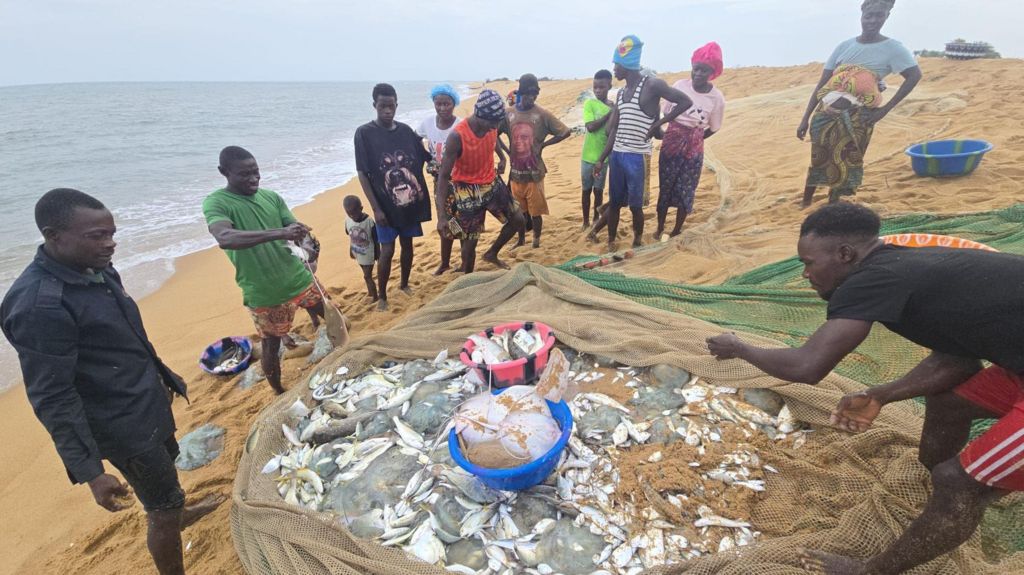
On sun-baked beaches along Sierra Leone’s Sherbo Island, 120 kilometers south of the capital Freetown, the age-old ritual of collective shore fishing unfolds much as it has for generations. A dozen villagers strain against thick ropes, shouting in coordinated bursts as they haul a heavy net bulging with snapper, mackerel, barracuda and rays out of the Atlantic surf. But where this communal work once yielded enough to feed local families and earn steady incomes, today’s hauls tell a story of growing crisis: small-scale local fishermen across the country say their catches have plummeted in recent years, and they point to one clear culprit – large, unregulated foreign trawlers operating illegally inside protected coastal waters.
Marie Pierre, one of the local workers sorting sardines from discarded jellyfish after the net comes ashore, says illegal international vessels have been violating the country’s official seven-mile exclusion zone – an area reserved exclusively for small-scale domestic fishing – in growing numbers. For many fishermen, the incursions go far beyond just stealing fish. Musa Gassimo, a local Sherbo Island fisherman, alleges that foreign trawlers deliberately cut the lines of small-scale fishing nets when local crews return to shore overnight. Each replacement net costs up to $250, a catastrophic expense for low-income artisanal fishermen who rely on their gear to make a living.
West Africa has long been recognized as the global epicenter of illegal, unreported and unregulated fishing. A 2024 global analysis estimates that 40% of the world’s unlicensed fishing catch is harvested from the region’s waters, costing West African governments a combined $10 billion in lost annual revenue while putting the food security of more than 30 million people who depend on local fishing at risk. Industry observers note that little progress has been made to reverse the crisis in the two years since the report was published.
Thomas Turay, president of Sierra Leone’s Fishermen’s Union, confirms the severity of the decline, saying average catches for local members have dropped by roughly 40% since illegal incursions surged. Speaking from Tombo Harbour near Freetown, Turay points to large foreign vessels anchored just outside the exclusion zone, saying these ships slip into protected coastal waters almost every night under cover of darkness. Multiple local fishermen who spoke with reporters shared personal accounts of damage and loss: 70-year-old Abou Waisissé described an incident where dozens of small local boats had their nets cut in a single incursion, while 55-year-old Mohamedi Kamara said his small fishing craft was badly damaged in a collision with a large international trawler.
When asked about the nationalities of the illegal vessels operating off Sierra Leone’s coast, Steve Trent, CEO and co-founder of the global advocacy group Environmental Justice Foundation (EJF), says the vast majority are flagged to China. While vessels from South Korea, Taiwan and European countries have operated illegally in the region in the past, Trent says Chinese trawlers now overwhelmingly dominate unlicensed fishing activity across West Africa.
Local fishermen say they have repeatedly reported illegal incursions to Sierra Leone’s Ministry of Fisheries, but their complaints have gone unanswered. Turay blames systemic corruption for the lack of enforcement, saying operators of illegal trawlers bribe government officials to avoid penalties. “I know that somebody who is doing this illegal business has the money to bribe and pay,” he says. “Government authorities are afraid to help the local fishermen.”
These allegations of widespread unenforced regulation are strenuously denied by Sheku Sei, director of Sierra Leone’s Ministry of Fisheries. Sei acknowledges that illegal fishing was once a major problem, but argues that new regulatory measures have reduced incursions significantly. He says all international vessels operating in Sierra Leone’s waters are now required to carry transponders to track their movements, and government inspectors conduct routine checks on foreign fleets. When asked about the common global practice of vessels turning off transponders to avoid detection of illegal activity, Sei claimed this does not happen in Sierra Leone’s waters. He also argued that steep financial penalties for violating the seven-mile exclusion zone act as a strong deterrent, but could not name a single instance where penalties had actually been applied over the past 10 years.
The Chinese Chamber of Commerce in Sierra Leone did not respond to BBC requests for comment on the allegations. Last month, however, the Chinese Foreign Ministry issued a blanket denial after similar claims of illegal Chinese fishing in Latin American waters, saying “China is a responsible fishing nation, strictly enforcing the regulation of its distant-water fishing activities and engaging in mutually beneficial fisheries cooperation with relevant countries in accordance with international law.”
Trent from EJF rejects this claim, arguing the Chinese government has adopted a deliberate “head-in-the-sand” approach to the crisis. “It’s simply not credible for them to carry on in this way. China, to date, still is not doing nearly enough to control its fleet. In fact, I would say they’re enabling it, through subsidies, through a lack of oversight and control.”
Trent says the solution to the crisis requires two key changes: improved global tracking of commercial fishing vessels, and increased international pressure on the Chinese government to enforce regulations on its distant-water fleet. He notes that fish illegally harvested from West African waters are sold to consumers around the world, giving everyday shoppers the power to drive change by choosing only legally and sustainably sourced seafood, a choice that protects the livelihoods of vulnerable small-scale fishermen in poor coastal nations.