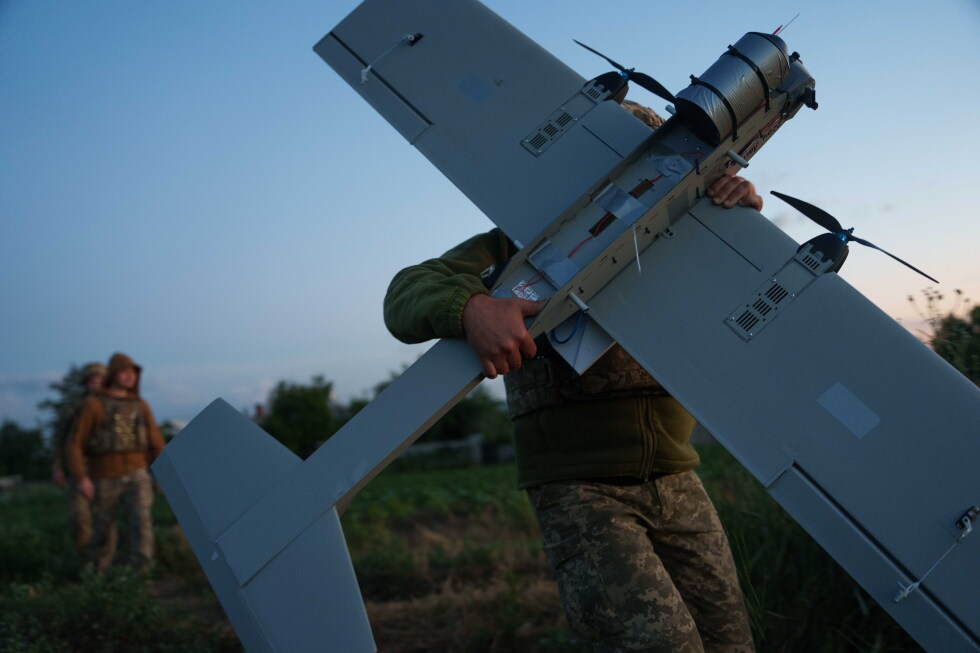
Deep in a basement command post in Ukraine’s northeastern Kharkiv region, a team of elite Ukrainian drone pilots lean in toward glowing computer screens, their eyes tracing grainy black-and-white thermal footage streamed from unmanned aircraft flying hundreds of kilometers deep inside Russian-occupied territory. This is the front line of a new, rapidly evolving aerial campaign that has upended long-standing battlefield dynamics, centered on a fleet of fixed-wing midrange drones built to choke off Russian military supply routes.
The mission is straightforward, explains Kat, commander of Ukraine’s elite K-2 drone brigade, one of the units leading the effort. By severing Russian logistics chains, the unit leaves frontline Russian infantry without critical provisions: no food, no ammunition, no night vision goggles, no communications batteries — nothing. That steady attrition, Kat says, gradually wears down Russian forces across every sector of the front.
Until earlier this year, a 15- to 125-mile corridor stretching behind Russian lines lay largely beyond Ukraine’s effective strike range. Short-range frontline drones lacked the capacity to reach targets deep enough, while long-range unmanned assets were reserved for high-value strategic targets hundreds of kilometers from the front. In that gap, Russian troops and supply convoys moved with relative impunity. That changed with the widespread deployment of midrange drones integrated with SpaceX’s Starlink satellite communications, a technological shift that has turned Russia’s once-secure logistical rear into an active, high-pressure combat zone.
The operation operates out of unassuming, easy-to-conceal locations: a nondescript office serves as the K-2 unit’s nerve center, a local carpenter’s workshop doubles as a drone assembly facility, and quiet village homes double as concealed launch sites. Inside the K-2 command workspace, workstations are cluttered with coffee mugs, energy drink cans and e-cigarettes, and pilots in casual civilian clothes sit under harsh fluorescent lights, their focus locked on screens displaying target lists and satellite maps, a scene that resembles a late-night office work session more than a military combat center.
In May alone, the K-2 unit launched 800 midrange drones from this base, with 650 of those strikes hitting their intended targets. After a separate advance team catapults drones into the sky from launch sites more than 200 kilometers from the command post, control transfers to the Kharkiv-based pilots, who fly the aircraft for up to four hours, reaching targets more than 100 kilometers behind Russian front lines. For many pilots, the work carries a personal weight: some displaced from their hometowns by the 2022 Russian invasion now fly over familiar streets, scanning childhood neighborhoods and old landmarks for hidden Russian troops and ammunition depots.
The unit fosters friendly competition between its 10 drone crews, with a whiteboard tracking successful strikes; the current record stands at 17 consecutive successful hits. For 20-year-old top pilot Pharaon, the work is a natural extension of the competitive video games he grew up playing. “When I was a kid, I used to go to computer clubs where we played Counter-Strike over a local network,” he explained. “The competition here is pretty much the same. It’s about who can kill more enemy troops or take out the biggest target.”
Ukraine’s breakthrough in this campaign traces back to an earlier technological shift: SpaceX cutting off unauthorized Starlink access for Russian forces earlier this year, disrupting Moscow’s own drone operations and communications while giving Kyiv a critical edge. That advantage let Ukraine upgrade its midrange drones to evade detection, resist electronic jamming and strike far more accurately, as Russia scrambled to catch up. “The blocking of Starlink for Russian forces was one of the most significant battlefield developments of the year,” said Rob Lee, senior fellow in the Foreign Policy Research Institute’s Eurasia Program. The success of Ukraine’s current midrange campaign is a direct outcome of that shift.
Where just a few months ago only two out of 10 drone sorties succeeded, that ratio is now flipped, with eight out of 10 strikes hitting their mark, Pharaon said. The K-2 unit primarily operates the Dart, a low-cost midrange drone built from polystyrene, wood and 3D-printed parts, designed to target Russian logistics convoys. Larger models like the Hornet carry heavier payloads capable of striking bridges and other critical logistical infrastructure. Before every launch, crews inspect every component, with special attention paid to the Starlink communications module that keeps the drone connected to operators throughout its mission. Once checked, drones are moved to concealed launch sites near the front for takeoff.
Russian forces were caught off guard when the midrange campaign escalated three months ago, and they are still playing catch-up to counter the threat. Moscow has deployed mobile fire interception groups, additional anti-aircraft units and electronic warfare systems targeting Starlink, but analysts say coordination gaps between Russian units and the element of surprise have kept Ukraine one step ahead. Russia’s ability to intercept drones is hampered by poor inter-unit information sharing: even if one sector identifies an incoming drone, that information often does not reach neighboring sectors fast enough to mount an effective defense.
Ukraine’s campaign targets the key highway arteries connecting occupied southern Ukrainian cities including Mariupol, Berdyansk and Melitopol to the illegally annexed Crimean Peninsula, the main supply routes for Russian forces fighting in southern and eastern Ukraine. Ukrainian military officials report that sustained strikes have forced Russia to shift to slower, far less efficient resupply routes, making the critical land corridor linking mainland Russia to Crimea too dangerous for regular large-scale movement of fuel, ammunition and reinforcements. So far, Russian countermeasures including electronic warfare against Starlink have had limited effectiveness, Lee noted, though Moscow’s larger military establishment means it can absorb heavier losses as it adapts.
Samuel Bendett, a researcher at the Center for Naval Analyses, explained that the midrange drone campaign has successfully kept constant pressure on Russian supply lines, leaving some frontline sectors undersupplied and making the overall battlefield situation more manageable for Ukrainian forces. “The question is whether Ukraine can keep this pressure up over the next few weeks and months,” Bendett said, noting that Russia will eventually adapt its tactics to counter the threat.