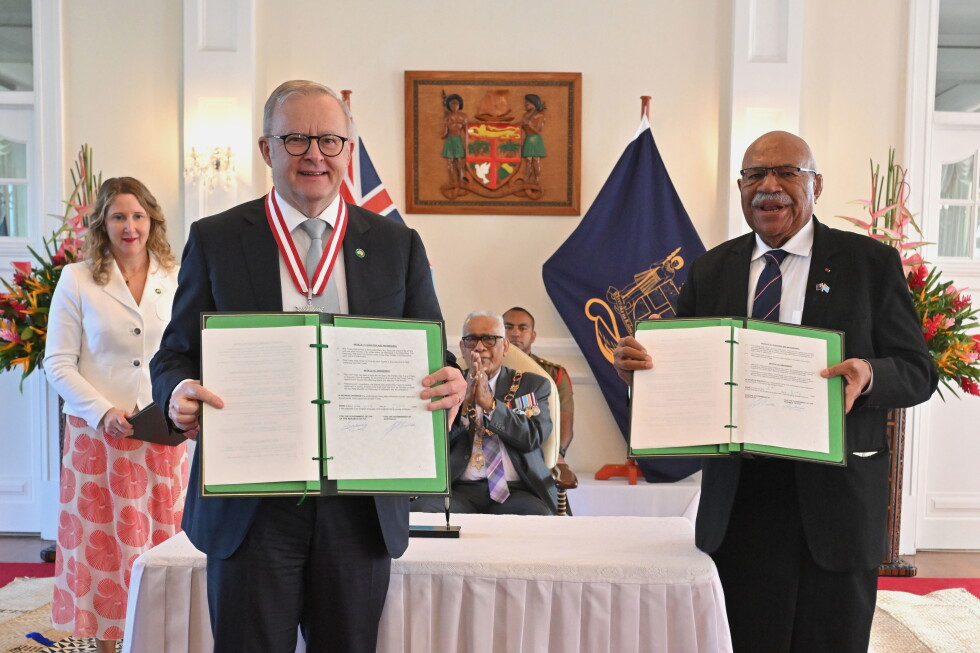
In a significant development reshaping geopolitical dynamics in the South Pacific, Australia and Fiji have formalized two landmark bilateral agreements, marking the second major diplomatic breakthrough for Australian Prime Minister Anthony Albanese’s administration in its efforts to counter growing Chinese influence across the region within a 12-month period.
The signing ceremony took place in Fiji’s capital city of Suva, where Albanese and Fijian Prime Minister Sitiveni Rabuka put pen to paper on the historic Ocean of Peace Alliance — Fiji’s first ever binding mutual defense treaty, and Australia’s fourth such defense agreement globally. The two leaders also signed the Vuvale Partnership, an economic cooperation treaty that commits Australia to injecting more than 1 billion Australian dollars, equivalent to roughly $693 million, into Fiji’s economy over the next decade.
Addressing reporters following the signing, Albanese emphasized the core commitment enshrined in the defense pact: “The Ocean of Peace Alliance introduces a mutual defense obligation, and there is no higher obligation than to come to each other’s aid at a time of need.”
Rabuka, for his part, downplayed expectations of harsh pushback from Beijing over the new agreements. He stressed that the pacts do not undermine either nation’s existing diplomatic and economic ties with China. “I do not expect China to have any severe pushback on either government. And I believe that they will welcome the understanding that is between Australia and Fiji,” Rabuka told journalists. “It does not threaten Fiji’s relationship with China nor Australia’s relationship with China.”
The new agreements are built on three foundational pillars: deepened security collaboration, closer economic integration, and stronger people-to-people connections between the two nations. Rabuka framed the pacts as a clear statement of shared purpose amid growing global instability: “This is a clear affirmation of Australia’s sustained commitment to the stability, resilience and prosperity of the Blue Pacific region at a time of global uncertainty. These treaties reflect our shared understanding of the evolving and interconnected challenges that are facing our region.”
The flurry of new security agreements across the South Pacific comes in response to a 2022 secretive security deal between China and the Solomon Islands, a pact that sparked widespread international concern over the potential for China to establish a permanent naval presence in the region. Since that deal was reached, Australia has moved aggressively to solidify its position as the preferred security partner for Pacific island nations.
Following his visit to Fiji, Albanese is scheduled to travel to the Solomon Islands on Tuesday to hold talks with new Prime Minister Matthew Wale, whose administration announced last month that it would conduct a full review of the 2022 security agreement with China. The two governments have already agreed to open new negotiations on a bilateral security pact between Canberra and Honiara.
Later this week, Albanese will host the leaders of Papua New Guinea and Tonga in the Australian city of Brisbane. Wednesday will mark the official entry into force of Australia’s bilateral defense treaty with Papua New Guinea, signed last year as Canberra’s third major defense pact.
The flurry of diplomatic activity follows just one week after Australia and Vanuatu signed a long-delayed bilateral security and economic agreement, the Nakamal Agreement, which includes provisions intended to block China from establishing a military outpost on Vanuatu’s territory. The deal was finalized nine months after the Vanuatuan government rejected an earlier draft, over concerns that the original text would limit the island nation’s ability to attract critical infrastructure investment from global sources. Following the signing of the Nakamal Agreement, China publicly expressed concern that the pact was specifically designed to counter Beijing’s growing influence in the region.