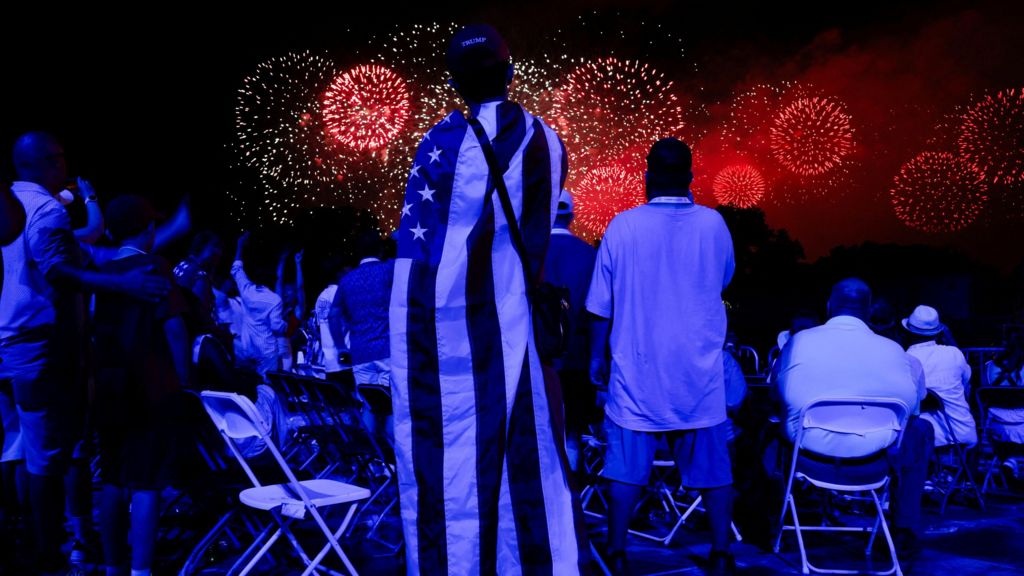
On July 4, 2026, the United States marked its semiquincentennial — 250 years since the 13 original colonies signed the Declaration of Independence to break free from British rule — with a day of overlapping celebrations, disruptive extreme weather, and fresh political friction that laid bare the nation’s deep ideological divides. The day unfolded against a punishing regional heat wave that has gripped the Eastern U.S. for days, with temperatures hitting 100°F (37°C) in Washington D.C. and forecast peaks as high as 108°F (42°C) across Maryland, Delaware and New Jersey. The dangerous conditions forced the cancellation of dozens of community events from the Mid-Atlantic to Colorado, left nearly 900,000 homes and businesses across multiple states without power after severe thunderstorms swept through the region, and required volunteer organizers to distribute free ice water to attendees on the National Mall.
At the nation’s capital, the day’s highest-profile event was a delayed rally headlined by President Donald Trump on the National Mall, part of his administration’s separately organized Freedom 250 celebration, which runs parallel to the congressionally mandated bipartisan America 250 initiative. Trump’s rally, which was pushed back hours after an early evening thunderstorm forced a full evacuation of the National Mall, opened ahead of what event organizers billed as the largest fireworks display in U.S. history. In remarks that wrapped up just before midnight, Trump leaned into familiar conservative political themes, rejecting communism, endorsing his preferred Save America Act legislation, and affirming the right to bear arms. He told the cheering crowd that “the American dream is back,” framing the milestone as the start of a new national era: “this is only the dawn of the golden age of America” with its destiny “written by God.” Closing his address, he declared, “May it rain forever and ever and ever, we will always be on top, we will never let our country fall, we will always be the best.” The massive fireworks display concluded around 1 a.m. in light rain, with attendees exiting the grounds after the finale. The event also featured a ceremonial flyover headlined by the newly updated Air Force One jet escorted by F22 Raptor fighter jets, alongside a pre-speech concert.
Critics have widely accused Trump of politicizing the 250th anniversary by centering himself in the national milestone and splitting the official celebration into two competing efforts, with the independent America 250 framework noting that Freedom 250 is “separate in name and power” from the congressionally established initiative. Competing community-focused events organized under the America 250 banner unfolded across the country, including the nationwide “America’s Block Party” initiative that brought local gatherings to every U.S. state. Top musical acts performed at iconic landmarks across major cities: Ne-Yo and Mary J. Blige took the stage in New York City’s Times Square, The Smashing Pumpkins and Chaka Khan headlined in Los Angeles, and Christina Aguilera and Will Smith performed in Philadelphia, widely known as the birthplace of American independence where the Declaration was signed. In Philadelphia, bipartisan members of Congress gathered at Independence Hall earlier in the week to commemorate the 1776 independence vote, with a special flyover held the same day the city hosted a FIFA World Cup match between France and Paraguay. America 250 organizers also placed a time capsule on-site to be opened in 2226, holding artifacts ranging from a signed copy of the U.S. Constitution and a Coca-Cola bottle to representative items from all 50 states and U.S. territories. At George Washington’s Mount Vernon estate in Virginia, a naturalization ceremony welcomed 150 new citizens from 50 different countries, who took the formal oath of allegiance to the United States.
Longstanding national traditions also went forward despite the heat: at New York’s Coney Island, the annual Nathan’s Famous International Hot Dog Eating Contest, held every Independence Day since 1972, saw competitive eating legend Joey Chestnut secure his 18th title after consuming 66 hot dogs in 10 minutes, while Miki Sudo claimed her 12th women’s championship with 38 and three-quarters hot dogs.
The day was not without displays of division beyond political events: approximately 400 members of the white nationalist group Patriot Front, founded in 2017 after splitting from a white supremacist organization following the deadly Unite the Right rally in Virginia, marched in uniform and masked through central Washington D.C. near the U.S. Capitol and Union Station, carrying U.S. flags. Footage of the march was shared by the group on its own Telegram channel and spread rapidly across social media.
All four living former U.S. presidents released public statements marking the milestone, offering reflections that touched on the nation’s ongoing work to live up to its founding ideals. Joe Biden, Trump’s immediate predecessor, recalled the Declaration’s core promise that all people are created equal, noting “We chose that path 250 years ago but that’s where the work began, not where it ended,” and warning that the promise of equal rights for all remains unfinished. Barack Obama, the nation’s first Black president, reshared excerpts of a recent speech emphasizing that “There’s more to do to fulfil the nation’s founding ideals. Every generation must take up the unfinished work of the last and carry it further – protecting what’s right, fixing what’s wrong, and making our union a little more perfect.” Former President George W. Bush called on Americans to engage actively with civic life, arguing “the next 250 years require Americans to be citizens, not spectators” who “take an active interest in the health and welfare of our country and the communities in which they live.” Former President Bill Clinton addressed the nation’s current political friction directly, writing “Today, we celebrate this milestone amid another period of deep division, renewed questions about America’s future and role in the world, and serious threats to our own institutions and to our democracy itself.”