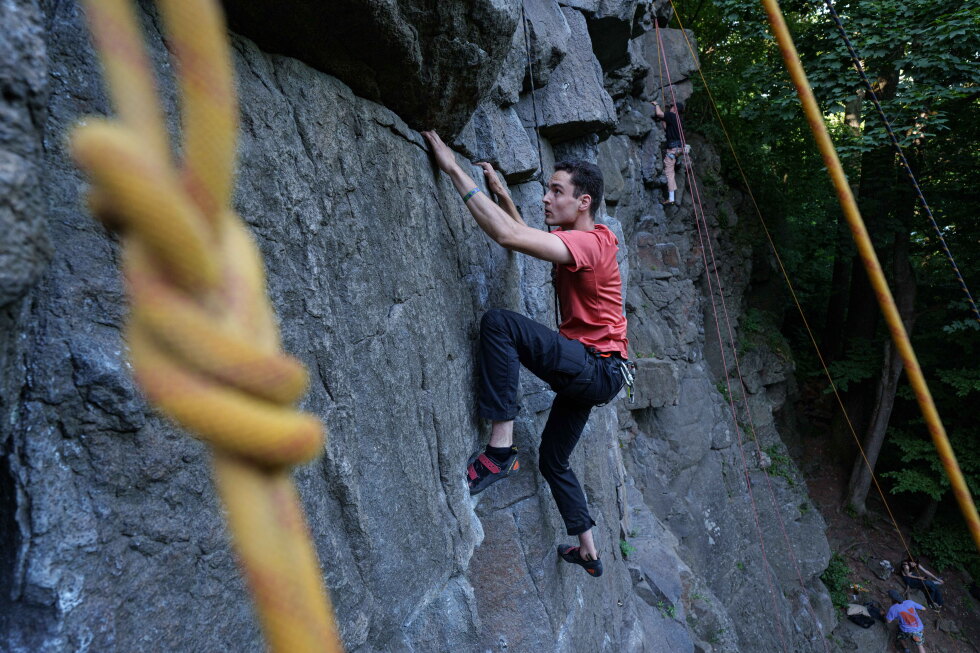
Nestled atop a jagged granite bluff overlooking a winding river, just a two-hour drive west of Ukraine’s capital Kyiv, hundreds of people gathered last week for a unique celebration of outdoor adventure, music, and human connection. This was the 2024 Stoned Climbers festival, Ukraine’s largest outdoor gathering that merges rock climbing with live performances, held in the scenic Zhytomyr region. In a country weathering more than two years of full-scale war, this volunteer-led event balances the joy of ordinary leisure with constant, quiet reminders that conflict remains just over the horizon.
By day, attendees spread across the landscape: experienced climbers scaled the steep cliff face, casual visitors cooled off in the nearby reservoir, and many tried their hand at stand-up paddleboarding on calm waters. When twilight fell, the forest came alive with sound, as live rock bands and electronic DJs took to the main stage, music drifting through the pine trees to the campground below. Unlike the 2023 iteration of the festival, when attendees watched Russian drones and missiles pass overhead en route to targets in Kyiv, this year’s event passed without enemy aircraft breaching the sky above the campsite. Still, air raid alert notifications pinged on attendees’ phones throughout the weekend, and off-duty soldiers blended quietly into the crowd of climbers and music fans. All profits from this year’s festival are donated to a fundraising campaign supporting Ukraine’s Azov Brigade, tying the event directly to the national war effort.
The festival traces its roots back to 2023, when a group of 15 climbing-obsessed friends launched the gathering after bonding over their shared love of Yosemite Valley’s iconic climbing culture. The U.S. national park is widely viewed as the birthplace of modern rock climbing, where a distinct counterculture grew around backcountry camping, van life, and multi-month expeditions up the valley’s famous granite walls.
“We realized climbing could be much more than just a competitive sport,” explained Dmytro Isaienko, 39, one of the festival’s co-founders. “It’s about a specific way of life — rooted in nature, camping, and time spent on the rocks.” The group set out to challenge the widespread belief that rock climbing is an exclusive hobby reserved for elite, professional athletes. Their first gathering in 2023 drew roughly 150 guests; this year, attendance surged to more than 500, the vast majority of whom are beginners or casual amateur climbers.
Organizing any large public event during wartime brings unique challenges, but Isaienko says the conflict has also given the festival a deeper, more critical purpose. Creating shared, safe spaces where Ukrainians can gather, learn new skills, and connect with one another has become a vital tool to sustain mental and emotional well-being through the strain of prolonged war. “You need to get away from the war for a while,” he said. “Leave Kyiv and come spend some time here together, a little longer than usual.”
On the rock face below the cliff top, patient instructors work one-on-one with complete beginners, walking them through fastening harnesses, chalking their hands, and spotting the next handhold on the granite. Every time a first-time climber pulls themselves to the top of the 25-meter cliff, spectators, fellow climbers, and instructors erupt in cheers and applause to celebrate the small victory.
Among this year’s first-time attendees was 21-year-old Liliia Karpach, who traveled from the western Lviv region to attend her first Stoned Climbers festival. “I decided to come because it had been a very long time since I’d climbed on real rocks,” she said. “I also wanted to meet the community in person and get to know new people.” Karpach noted that climbing is as much a mental practice as it is physical exercise, and encouraged others to give it a try: “If you’re really nervous about coming on your own, invite some friends. Even if neither of you knows how to climb, you’ll have a good time together.”
For 24-year-old instructor Andrii Lamei, helping new climbers build that confidence is the most rewarding part of the festival. While belaying a young first-time climber through the most challenging section of her ascent, he talked her through each movement step by step, helping her steady her nerves. As she climbed higher, her movements grew steadily more sure, and when she finally reached the top, Lamei encouraged her to pause before descending to take in the view. “Look around,” he shouted up to her. “Enjoy the moment. You made it.”
Lamei says climbing is more than a hobby for Ukrainians navigating the stress of wartime: “Climbing helps you work with stress. It helps you manage stressful situations in everyday life.” Like most Ukrainian men of military age, Lamei is barred from leaving the country under wartime travel restrictions, so he cannot yet fulfill his dream of climbing iconic destinations abroad. “I want to go across the border to visit Yosemite, to visit Norway’s mountains, but I can’t,” he said. “But maybe this is how I’m forced to enjoy what I have here.”
For Isaienko, that attitude is exactly what makes gatherings like Stoned Climbers so vital for Ukraine right now. While many Ukrainians have put large parts of their lives on hold during the war, he says the growing climbing community taking shape around the Zhytomyr cliffs proves that new traditions can still emerge even amid conflict. “This is a festival for everyone,” he said. “Including people who have never tried climbing before.” And every time another first-time climber reaches the top, the roar of applause rising from the base of the cliff makes clear that little by little, this community of resilience is growing.