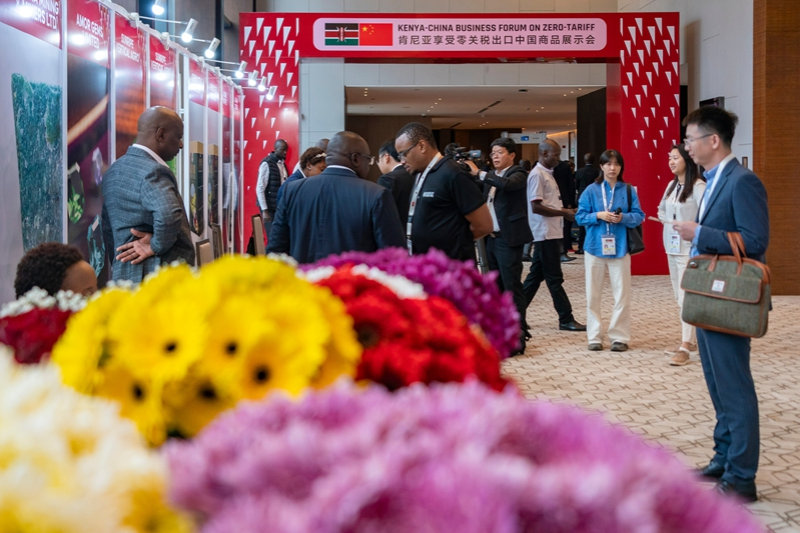
When China rolled out a sweeping zero-tariff policy for all eligible goods from diplomatically recognized African nations starting May 1 this year, East African economic hub Kenya moved quickly to position itself as a leading beneficiary, aiming to turbocharge its agricultural exports and unlock new investment opportunities in the world’s second-largest consumer market.
The zero-tariff policy, which eliminates import duties on a wide range of Kenyan goods, has opened unprecedented access to China’s 1.4 billion consumers. Kenya is now gearing up to leverage the 9th China International Import Expo (CIIE), scheduled to run from November 5 to 10 in Shanghai, as a launchpad to expand its market footprint, attract foreign direct investment, and deepen bilateral trade ties with China.
In a press briefing held in Nairobi ahead of the expo, Lucy Muchoki, director of programs and partnerships at the Kenya National Chamber of Commerce and Industry (KNCCI), emphasized Kenya’s unwavering commitment to maximizing the economic benefits of the new tariff framework. Speaking on behalf of KNCCI President Erick Rutto, Muchoki noted that the business community is actively mobilizing to help local producers and exporters seize this once-in-a-generation market opening.
“China has already granted Kenya and the broader African continent tariff-free access, and we are working around the clock to ensure our domestic businesses don’t leave this opportunity on the table,” Muchoki said. As a long-standing leading exporter of horticultural products to European markets, Kenya is now shifting focus to tap into the growing demand for high-quality agricultural goods in China, she added.
Early data already shows promising momentum: Kenya shipped 6.7 metric tons of avocados to China in the first month after the policy took effect, and industry stakeholders are targeting to triple this volume as consumer awareness and demand for Kenyan produce continues to rise. Beyond boosting raw commodity exports, Muchoki also highlighted the country’s eagerness to attract Chinese investment in local processing infrastructure, which would allow Kenya to export finished value-added products instead of raw goods, creating much-needed jobs for the country’s large youth population.
Financial sector stakeholders are also stepping up to support Kenyan exporters looking to enter the Chinese market. Vera Ontumbi, a trade banking specialist at Stanbic Bank Kenya, noted that the annual CIIE has emerged as one of the most critical platforms for the bank’s clients to connect with Chinese buyers, forge long-term commercial partnerships, and access China’s fast-growing consumer economy.
Ontumbi also promoted wider adoption of the renminbi for bilateral cross-border transactions, arguing that shifting away from third-party currencies would streamline payment processes, cut down on currency conversion and transaction costs, and boost operational efficiency for both Kenyan exporters and Chinese importers. “The future of China-Africa trade and investment is exceptionally bright, and we are working to ensure our clients are fully positioned to capture these emerging opportunities,” she added.
Hua Wei, president of the National Exhibition and Convention Center in Shanghai who led a recent Chinese delegation to Nairobi, explained that the CIIE holds a unique position in the global trade landscape as the world’s only national-level import-focused exhibition. This framework gives Kenyan producers a one-of-a-kind chance to showcase their goods directly to Chinese consumers and industry buyers.
Hua confirmed that Kenya will participate in the 2026 CIIE through two dedicated sections: a national pavilion and a trade-in-services exhibition zone. This dual presence will allow Kenya to highlight not only its agricultural and manufactured goods, but also its top-tier tourism attractions and untapped investment opportunities to global business leaders attending the event.
Zhou Zhencheng, minister counselor at the Chinese Embassy in Kenya, noted that the CIIE has evolved into a cornerstone global platform for expanding market access, strengthening multilateral economic cooperation, and advancing China’s policy goals of increasing imports and fostering more balanced global trade.
“China’s continued commitment to high-level opening-up will generate new shared opportunities for all countries around the world, and contribute to building a more inclusive, open global economy,” Zhou said.