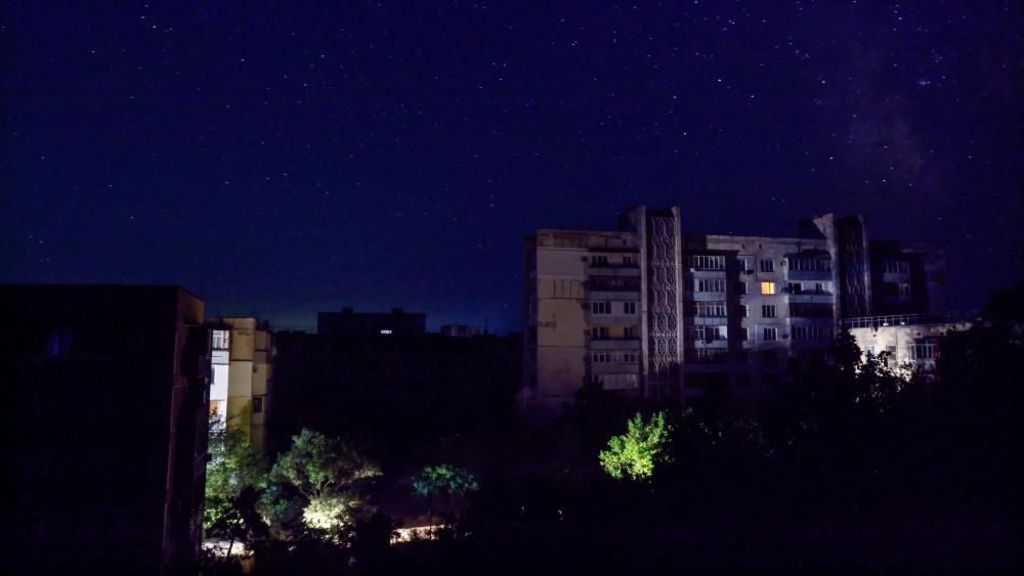
Escalating cross-border attacks between Russia and Ukraine have plunged the largest city in Russian-occupied Crimea into widespread power outages and fueled acute supply shortages, as Kyiv ramps up pressure on Russian-controlled infrastructure to advance its war aims.
Mikhail Razvozhayev, the Moscow-appointed governor of Sevastopol, announced Tuesday that a Ukrainian aerial assault had disabled the city’s primary power distribution network. He cautioned that some residential and commercial districts would remain without electricity through Wednesday evening, as repair crews worked to assess and fix the damage. In a public Telegram address, Razvozhayev sought to calm residents, stating, “We will not be intimidated by the lack of light. We have gone through more than that, and we will survive now.” He condemned the strike as a “vile” attempt to erode daily life and stoke public panic, adding that energy facilities have been placed under a special emergency response regime with all first responder teams on highest alert.
Local authorities have ordered residents to implement strict energy conservation measures: adjusting phone screen brightness to lower levels and closing unused background applications to preserve mobile battery life, amid expectations that daytime temperatures will climb to 30 degrees Celsius. Officials also urged residents to check in on elderly neighbors who may be vulnerable to the heat and power disruption.
Ukrainian military commanders confirmed the strike, with Robert Brovdi, head of Ukraine’s Unmanned Systems Forces, stating Wednesday that the operation targeted 48 active and planned Russian military sites across Crimea, including Sevastopol’s main power substation. In addition to the Sevastopol attack, explosions were reported in multiple other Crimean locations: Bakhchisarai, Kerch, and the vicinity of Mount Ai-Petri, which hosts a Russian Aerospace Forces radio engineering battalion.
The power outage comes on the heels of worsening fuel shortages across Sevastopol, triggered by Ukraine’s ongoing campaign to cut logistical links to the Crimean Peninsula. Internationally recognized as part of Ukraine, Crimea was illegally annexed by Russia in 2014, and has been connected to Russian territory via the Kerch Strait road-rail bridge and a land corridor through occupied southern Ukraine. On Sunday, Sergei Aksyonov, the Moscow-installed leader of Crimea, announced a full suspension of civilian petrol sales, restricting all fuel supplies exclusively to government and military services — a move that has sparked public frustration, as many local residents report that retail gas stations still hold stock in their storage tanks. The supply disruptions have also sparked panic buying at grocery stores, with sugar already reported to be depleted across many outlets.
The latest Crimean strikes are part of a broader pattern of intensified Ukrainian attacks on Russian-controlled energy infrastructure, a strategy designed to cut into Moscow’s oil revenues and pressure Russian President Vladimir Putin to enter peace negotiations. Sevastopol holds particular strategic importance for Russia, serving as a key naval and logistical hub for its military operations in southern Ukraine.
The exchange of attacks on Tuesday underscores the escalating drone war between the two nations: Russia’s defense ministry claims it destroyed more than 300 Ukrainian drones launched overnight, while Ukraine’s air force says it intercepted and destroyed 95 of 101 Russian drones launched against Ukrainian territory overnight.
The escalation follows a major Ukrainian strike earlier this week on an oil refinery in southeast Moscow. The Thursday attack left thick plumes of smoke billowing into the sky, and multiple residents reported black oil particles raining down on city streets, leaving stains on clothing and property. Moscow officials have publicly denied the occurrence of “oil rain,” but residents have confirmed the accounts to the BBC.
Now entering its fourth and a half year following Russia’s full-scale invasion, the conflict has seen little diplomatic movement in recent weeks. On June 4, Ukrainian President Volodymyr Zelensky released an open letter to Putin calling for direct, face-to-face negotiations to agree a ceasefire and end the full-scale war. Putin rejected the proposal as “rude” and refused the meeting, stating that peace talks must precede any ceasefire agreement. Earlier this week, a separate power outage was also reported in Yevpatoria, another Crimean city, during what local authorities described as a prior temporary disruption.